


Last Updated: October 2026
Section 197 goodwill amortization is the tax rule that lets a buyer deduct the cost of acquired goodwill over 15 years. The deduction is straight-line across a 180-month period, so a $1.5 million goodwill basis yields a $100,000 deduction each year. It applies to goodwill and certain other intangibles acquired as part of a trade or business. The rule gives buyers a predictable way to recover these costs. It replaced an older system where goodwill could not be written off at all.
The team at Sofer Advisors prepares the purchase price allocations that set this deduction, backed by Inc. 5000 recognition in both 2024 and 2025. The deduction applies only to acquired intangibles, never to self-created ones, and the amount comes directly from the allocation done after a deal closes. A defensible allocation is what keeps the yearly write-off safe if the return is ever examined.
If you have bought a business or are planning to, the way goodwill is allocated and amortized affects your cash taxes for 15 years. This guide explains what qualifies as a Section 197 intangible, how the amortizable basis is set, the anti-churning rules, and how the tax treatment differs from financial reporting. It also covers what happens if you sell before the 15 years are up.
Key Takeaways
- 15-year rule: acquired goodwill is amortized straight-line over 15 years (180 months) under IRC Section 197.
- Acquired only: the deduction applies to purchased intangibles, not to goodwill a business builds itself.
- Basis from the PPA: goodwill is the residual in a purchase price allocation, reported on IRS Form 8594.
- Anti-churning: rules block converting old, non-amortizable goodwill into a deduction through related-party deals.
- Reporting differs: for GAAP, public companies do not amortize goodwill, which creates a deferred tax difference.
Each of these points connects to the allocation that sets the deduction, and the sections below work through them in order.
Why Is Section 197 Goodwill Amortization Important to Understand?
The rule turns a large one-time purchase price into a steady annual deduction, so getting it right has real cash value. IRC Section 197 fixes the 180-month life and the straight-line method for acquired intangibles. The allocation that feeds it is disclosed to the IRS on Form 8594, the Asset Acquisition Statement, which both buyer and seller must file consistently. The anti-churning rules in Section 197(f)(9), rooted in the Omnibus Budget Reconciliation Act of 1993 that created the section, limit the benefit in related-party deals. A weak or inconsistent allocation invites an IRS challenge and can reverse the deduction years later.
What Qualifies as a Section 197 Intangible?
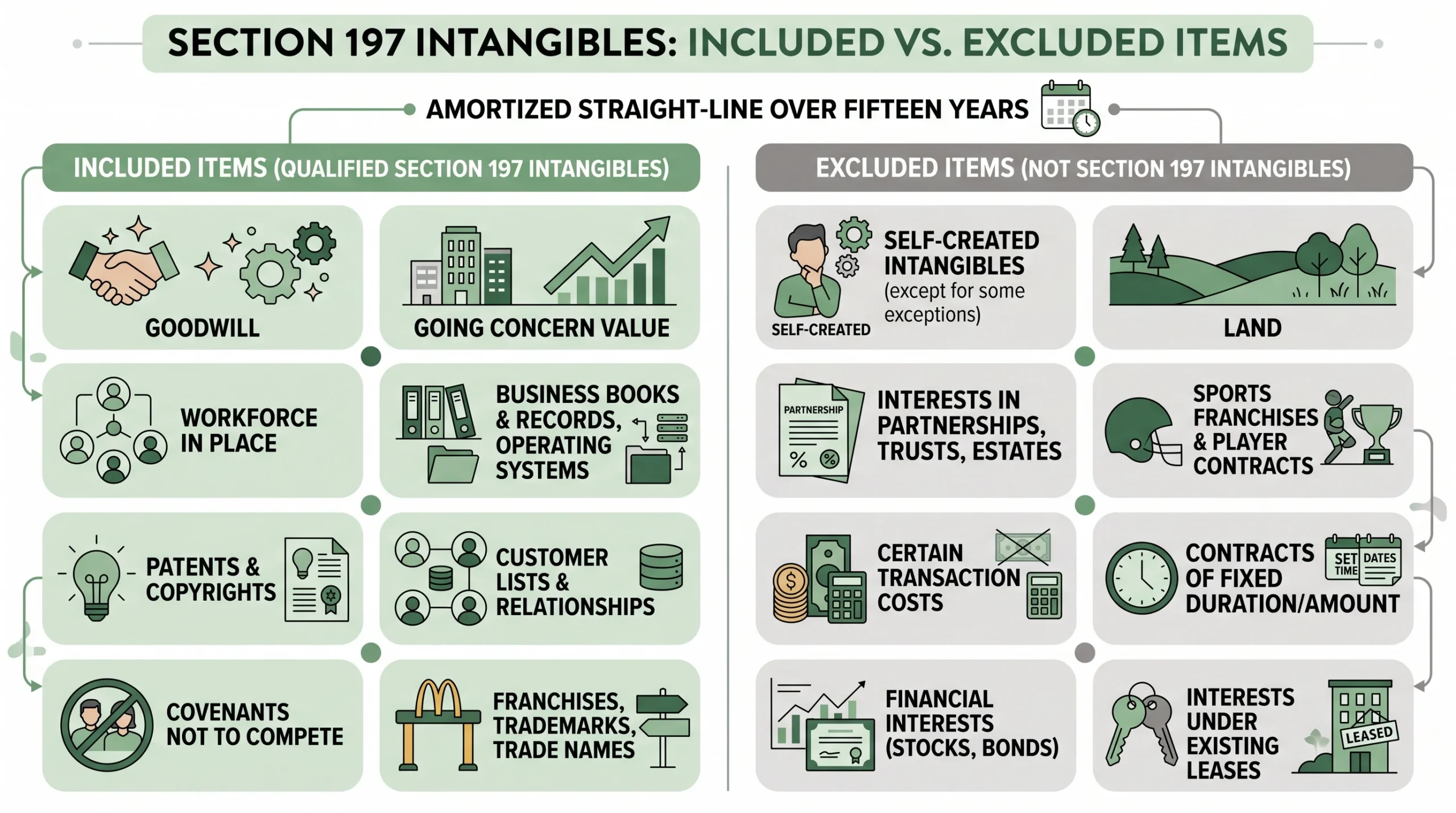
A Section 197 intangible is an acquired asset amortized over 15 years for tax. Goodwill is the main one, but the category is broad. It includes going-concern value and workforce in place. It covers customer-based intangibles, such as customer lists and subscriber bases. It also covers covenants not to compete tied to the purchase of a business.
The list goes further. Government licenses and permits qualify, as do franchises, trademarks, and trade names. Patents, copyrights, and formulas qualify when bought as part of a trade or business. But self-created intangibles usually do not qualify. Neither do certain financial interests, land, or off-the-shelf software bought separately. The table below sorts the common cases and why each side lands where it does.
| Asset category | Usually a Section 197 intangible | Usually excluded |
|---|---|---|
| Goodwill and going-concern value | Yes, when acquired with a business | Self-created goodwill |
| Customer-based intangibles | Customer lists and subscriber bases | Interests in land |
| Restrictive covenants | Covenants not to compete with a sale | Financial interests, such as stock or debt |
| Brand and legal rights | Trademarks, trade names, and franchises | Software bought separately, not with a business |
| Registered rights | Licenses, permits, patents, and copyrights | Interests under an existing lease or debt |
How Is the Amortizable Basis Calculated?
The basis comes from a purchase price allocation, or PPA. After an acquisition, the total price is spread across every acquired asset and liability. Tangible assets and identifiable intangibles are valued first. Goodwill is the residual, the part of the price that cannot be assigned to anything else.
That residual becomes the amortizable basis. It is reported to the IRS on Form 8594, which discloses how the price was split across asset classes, including Section 197 intangibles. From there, the basis is recovered straight-line over 180 months. The quality of the PPA drives the size of the deduction, so a defensible allocation matters a great deal. If the IRS later reallocates value away from goodwill, the deduction shrinks and prior returns may need to change.
What Are the Section 197 Anti-Churning Rules?
The anti-churning rules are a safeguard against manufactured deductions. They stop taxpayers from turning old, non-amortizable goodwill into a deduction through related-party deals. The rules came from the 1993 tax act that created Section 197. Goodwill held before that law took effect generally cannot be made amortizable by shuffling it between related parties.
The rules bite when the buyer and seller are related. If an owner sells a business to a related person, the buyer may be barred from amortizing goodwill the seller held before 1993. The point is to prevent a tax benefit where no real change in ownership occurred. These rules are intricate and come up most in restructurings. In a normal arm’s-length sale between unrelated parties, they rarely apply.
How Does the Tax Treatment Differ From GAAP Reporting?
Tax and financial reporting handle goodwill differently. For tax, Section 197 requires straight-line amortization over 15 years. For GAAP, public companies do not amortize goodwill at all. They test it for impairment each year instead. So the same asset follows two separate rules.
That split creates a timing difference. The tax return deducts amortization each year, while the GAAP statements hold the asset until an impairment. The result is usually a deferred tax liability on the balance sheet. A company must track both figures separately. They rarely match, and reconciling them is a normal part of financial reporting after a deal. The gap tends to widen over the 15-year period as the tax basis declines while the carrying value holds.
Why Is an Accurate Goodwill Valuation Crucial?
The valuation drives the size of the tax deduction, so accuracy protects real money. Because the PPA sets the goodwill basis, a sound allocation protects the write-off. If intangibles are overvalued or undervalued against tangible assets, the deduction can be wrong. That invites an IRS challenge during an audit.
A weak allocation carries real risk: misstated deductions, penalties, and extra scrutiny. If the figures are not supported by independent analysis, the IRS can reallocate the price. A rigorous valuation grounds every number in market data, which is the best defense if the transaction is ever reviewed. Clear, documented reasoning behind each figure reflects the Heart of a Teacher approach, which explains the data behind a conclusion rather than simply asserting a number. A deduction reversed in an audit can turn an expected benefit into a liability, so upfront rigor pays off.
If you want that allocation reviewed before you file, talk to a Sofer Advisors valuation specialist about the structure of your deal.
How Do You Choose a Provider for a Section 197 Valuation?
Buyers pick a provider based on deal size, audit sensitivity, and the complexity of the intangibles. Larger national firms such as Alvarez & Marsal, Stout, and Kroll serve big public companies with broad advisory teams. Sofer Advisors focuses on defensible, partner-led allocations for closely held and middle-market businesses, backed by expert witness testimony in 11+ cases and 180+ five-star Google reviews. The table earlier in this guide shows which assets fall inside Section 197, and the provider you choose should be able to defend every line of that split.
Sofer Advisors works through a four-phase process it calls The Sofer Difference, moving from Discovery to Diligence to Analysis to Delivery. That structure keeps each allocation grounded in market evidence and backed by a clear documentation trail. For a Form 8594 position that holds up under review, an independent valuation firm supplies both the analysis and the record behind it.
Frequently Asked Questions
Is amortization applicable to goodwill?
Yes, for tax purposes. Goodwill acquired in a qualifying business purchase must be amortized straight-line over 15 years under Section 197. For financial reporting, public companies under GAAP do not amortize goodwill; they test it for impairment instead. So the answer depends on whether you mean the tax return or the GAAP statements, and the two figures rarely match. Sofer Advisors prepares the tax basis valuation that sets the amortizable amount and keeps it defensible if the IRS asks.
What is a Section 197 deduction?
It is the yearly tax deduction from amortizing acquired intangibles over 15 years. It covers goodwill plus items like customer lists, licenses, franchises, and trade names. The deduction applies only to intangibles acquired as part of a trade or business, not self-created ones, and the amount is fixed by the purchase price allocation filed on Form 8594. Sofer Advisors sets that allocation so the deduction is supported by market data from the first year through the fifteenth.
How many years is goodwill amortized for tax?
Exactly 15 years, or 180 months, under the Internal Revenue Code. You cannot choose a different period for federal tax, even when the asset’s real economic life is shorter or longer. The law fixes the length to keep cost recovery uniform across all acquisitions. A customer list expected to fade in five years still amortizes over the full 15. Sofer Advisors builds the basis figure that drives this fixed 15-year timetable and documents how it was derived.
How do I calculate goodwill amortization?
Divide the acquired goodwill basis by 15 to get the annual deduction, then apply that same amount each year for the full period. The count begins in the month the acquisition closes, so the first and last years may be partial. The harder part is setting the basis itself, which is the residual after every identifiable asset is valued. Sofer Advisors prepares that residual through a purchase price allocation, so the yearly figure rests on evidence rather than estimate.
What if I sell the business before the 15 years end?
Amortization stops at the sale. The unamortized basis then factors into the gain or loss on the final sale of the assets, which closes out the tax recovery for those intangibles. Prior amortization reduces the remaining basis, so the taxable gain can be larger than owners expect. A sell-side valuation should account for how earlier deductions affect the figure. Sofer Advisors models that remaining basis so sellers see the real after-tax result before they sign.
Does Section 197 apply to goodwill I created myself?
No. Self-created goodwill is excluded. Section 197 applies only to goodwill and intangibles acquired by buying a trade or business. Value you build internally cannot be amortized under this section, even though it is real economic value that a future buyer will pay for. The deduction attaches to the buyer, not the founder. Sofer Advisors separates acquired goodwill from self-created value in an allocation so only the qualifying portion is amortized and the rest is documented.
Are anti-churning rules a common issue?
They mainly arise in related-party deals or restructurings where the seller is not independent of the buyer. In a normal arm’s-length purchase between unrelated parties, they rarely apply. Still, any deal with ownership overlap should be tested against them before claiming the deduction, since a missed check can void years of write-offs. Sofer Advisors reviews prior ownership history as part of the allocation so an anti-churning problem is caught before the return is filed, not after.
How much does a purchase price allocation cost?
A purchase price allocation engagement usually ranges from $15,000 to $50,000, with most middle-market deals near the middle of that band. The fee depends on the mix of assets, the number of identifiable intangibles, and the deal timeline. A flat scope is quoted up front, so the cost is clear before the work begins. Sofer Advisors sets the scope first, then quotes a fixed price. Request a free estimate for a range specific to your deal.
Related Case Studies
- Is Goodwill Tax Deductible: Section 197 Guide
- Personal Goodwill vs Enterprise Goodwill: Tax & Divorce Guide
- Goodwill Amortization vs Impairment: Key Differences
Executive Summary
Section 197 lets a buyer recover acquired goodwill and intangibles straight-line over 15 years, or 180 months, so a $1.5 million goodwill basis produces a $100,000 annual deduction. The amortizable basis is the residual in a purchase price allocation, reported to the IRS on Form 8594 and filed consistently by buyer and seller. Self-created goodwill is excluded, and the anti-churning rules bar manufactured deductions in related-party deals. For GAAP, public companies do not amortize goodwill, which creates a deferred tax difference. Most allocation engagements run $15,000 to $50,000. The first action is to gather the purchase agreement, the final price, and a list of every identifiable intangible.
What Should You Do Next?
Pull your purchase agreement and confirm how the price was split across tangible assets, identifiable intangibles, and the goodwill residual. Check any related-party element against the anti-churning rules before you file Form 8594, and make sure the buyer and seller allocations match. This guide was prepared by David Hern CPA ABV ASA, founder of Sofer Advisors, an Inc. 5000 firm specializing in purchase price allocations and tax basis valuations. Schedule a free consultation to discuss your specific situation.
People Also Read
About the Author
This guide was prepared by David Hern CPA ABV ASA, founder of Sofer Advisors, a business valuation firm headquartered in Atlanta, GA serving clients across the United States. David holds dual accreditations as an Accredited Senior Appraiser (ASA) and is Accredited in Business Valuation (ABV), credentials recognized by the IRS, SEC, and FINRA. He also holds the Certified Exit Planning Advisor (CEPA) designation. With 15+ years of valuation experience, David has served as an expert witness in 11+ cases across multiple jurisdictions and built Sofer Advisors into an Inc. 5,000-recognized firm with 180+ five-star Google reviews. Its full W2 employee team maintains subscriptions to all major valuation databases and operates under a next business day response policy.
For professional business valuation services, visit soferadvisors.com/about-us/ or contact Sofer Advisors at soferadvisors.com/contact-us/.
This content is for informational purposes only and does not constitute professional valuation advice. Business valuation conclusions depend on specific facts and circumstances. Contact Sofer Advisors for guidance regarding your specific situation.









