


Last Updated: June 2026
Section 1244 of the Internal Revenue Code gives investors in qualifying small business corporations a significant tax advantage when the business fails. Losses on the stock are treated as ordinary losses rather than capital losses. That distinction is not marginal, ordinary losses are deductible against all income. Capital losses are capped at $3,000 per year against ordinary income. For an investor who put $500,000 into a company that failed, the difference can be worth tens of thousands of dollars in actual tax savings.
The benefit is available by design, not by default. The stock must be issued in compliance with Section 1244 requirements from the beginning. A business that fails to document qualifying issuances at the time of formation cannot retroactively claim the benefit. Most closely held company founders never know the election exists until it’s too late. Sofer Advisors helps owners and their advisors work through exactly these questions and turn the analysis into a defensible business valuation they can act on.
The following takeaways summarize the key valuation and transaction factors covered in this guide.
Key Takeaways
- Section 1244 Allows Ordinary – Section 1244 allows ordinary loss treatment on losses from qualifying small business stock – up to $50,000 per year for single filers, $100,000 for married filing jointly.
- Without Section 1244 Stock – Without Section 1244, stock losses are capital losses, deductible only against capital gains plus $3,000/year of ordinary income.
- Qualifying Requires Corporation Domestic – Qualifying requires that: the corporation is domestic, total equity contributions did not exceed $1 million at the time of issuance, the stock was issued to the original shareholder, and the corporation derived more than 50% of gross receipts from active business operations.
- Section 1244 Losses Reported – Section 1244 losses are reported on Form 4797, Part II – not on Schedule D.
- Cannot Claim Section 1244 – You cannot claim both Section 1244 ordinary loss treatment and Section 1202 QSBS gain exclusion on the same shares.
- Business Valuation Experts Help – Business valuation experts help document the fair value and loss magnitude in contested or complex failed-business situations.
Each of these factors is examined in depth in the sections that follow.
What Is Section 1244 Stock and Why Does It Matter?
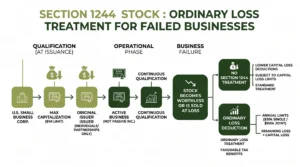
Section 1244 was enacted to encourage investment in small businesses by reducing the after-tax cost of failure. Congress recognized that investors who fund small companies take on higher risk than buyers of publicly traded securities. The standard capital loss limitation, deductible only up to $3,000/year against ordinary income, was an inadequate risk-offset for active business investors.
Under Section 1244, a shareholder who incurs a loss on qualifying stock can deduct that loss as an ordinary loss. Ordinary losses reduce adjusted gross income dollar-for-dollar. They are not subject to the $3,000 annual limitation that applies to capital losses. For a taxpayer in the 37% bracket, a $100,000 ordinary loss is worth $37,000 in federal tax savings in the year of the loss. The same loss as a capital loss might generate only $1,110 in tax savings in year one ($3,000 × 37%).
The annual limit is $50,000 for single filers and $100,000 for married filing jointly. Losses exceeding the limit in any given year revert to capital loss treatment. An investor with $400,000 in Section 1244 stock losses who is married filing jointly can recognize $100,000 of ordinary loss in the year of disposition. The remaining $300,000 is a capital loss subject to the standard limitations.
The ordinary-loss treatment for qualifying shares is set out by the IRS in Publication 550, which covers Section 1244 small business stock.
What Are the Qualifying Requirements for Section 1244 Stock?
The IRS imposes specific requirements that must be met at the time the stock is issued, not retroactively at the time of loss. Resources including the IRS website (irs.gov), Cornell Law School’s Legal Information Institute (law.cornell.edu), and the AICPA’s Tax Adviser publication detail these requirements:
- Domestic corporation. The issuing corporation must be a domestic C corporation. S corporations also qualify under the statute. Congress extended Section 1244 eligibility to S corporations through the Small Business Tax Revision Act of 1958 and subsequent guidance. Partnerships, LLCs taxed as partnerships, and sole proprietorships do not qualify.
- Total paid-in capital at issuance does not exceed $1 million. The $1 million threshold applies to the aggregate amount received by the corporation for all of its stock, both common and preferred, including contributions to capital. If cumulative equity contributions at the time the shares are issued exceed $1 million, the shares issued at that point are not Section 1244 stock. Shares issued before the $1 million threshold is crossed qualify. Those issued after do not.
- Original issue to a shareholder. The stock must be issued by the corporation directly to the shareholder. It cannot be acquired in the secondary market. Stock purchased from another shareholder, received as a gift, or inherited does not qualify.
- Active business operation. For the five tax years before the loss year (or for the entire period of the corporation’s existence if shorter), the corporation must have derived more than 50% of its gross receipts from active business operations. This means not from passive sources such as royalties, rents, dividends, interest, annuities, or gains on stock sales. This requirement prevents passive holding companies from qualifying.
- Consideration must be money or property. Stock issued for services does not qualify as Section 1244 stock.
| Requirement | Qualifying | Disqualifying |
|---|---|---|
| Entity type | Domestic C or S corporation | LLC, partnership, foreign corp |
| Capital threshold | Total equity ≤ $1M at issuance | Subsequent issuances after $1M crossed |
| Acquisition method | Original issue from corporation | Secondary market purchase, gift, inheritance |
| Business activity | >50% gross receipts from active operations | Primarily passive income sources |
| Consideration | Cash or property | Services rendered |
How Do You Report a Section 1244 Loss?
A Section 1244 loss is not reported on Schedule D. It is reported on Form 4797, Part II (Ordinary Gains and Losses). This is the key technical distinction many preparers miss. Reporting it on Schedule D treats it as a capital loss and forfeits the ordinary loss benefit.
The steps for reporting:
- Determine the amount of the loss: proceeds received (often $0 in a complete failure) minus adjusted basis in the shares.
- Identify what portion qualifies as Section 1244 stock (original issue shares within the $1 million cap).
- Apply the annual limit: $50,000 single / $100,000 MFJ.
- Report the qualifying ordinary loss portion on Form 4797, Part II.
- Report any excess loss (above the annual limit) on Schedule D as a capital loss.
The corporation does not file any special form. But it should keep contemporaneous records showing equity contributions at each issuance date, original issuees, and gross receipts composition. These records are the taxpayer’s defense in an audit.
What Records Should You Maintain to Protect Section 1244 Treatment?
The IRS does not require a formal election or designation to issue Section 1244 stock. But the taxpayer bears the burden of proving all qualifying requirements are met at the time of loss. Records that should be maintained from the date of issuance include:
- Corporate minutes documenting the board’s authorization of the stock issuance and the total consideration received
- A shareholder register showing the names, issuance dates, and consideration paid for each block of shares
- Annual income statements showing the breakdown of gross receipts between active and passive sources (to document the 50% active business test)
- Documentation that the aggregate paid-in capital at each issuance date did not exceed $1 million
Business owners who invest in multiple rounds of financing should track Section 1244 eligibility separately for each round. Early-round shares issued when the company had less than $1 million in equity contributions qualify. Later-round shares issued after the threshold was crossed do not.
David Hern CPA ABV ASA, founder of Sofer Advisors, brings a Heart of a Teacher to every engagement – translating complex valuation methodology into clear, actionable guidance that clients can act on before and after the report is delivered. With 15+ years of valuation experience, 11+ expert witness cases across multiple jurisdictions, and 180+ five-star Google reviews, David built Sofer Advisors into an Inc. 5000-recognized firm. The Sofer Difference is a four-phase process of Discovery, Diligence, Analysis, and Delivery that ensures every conclusion is defensible, documented, and tied to the specific facts of the business.
While national firms like Stout and Kroll serve large enterprise clients, Sofer Advisors specializes in middle-market businesses that require personalized attention, direct access to credentialed professionals, and a next business day response policy.
How Does Section 1244 Interact with Section 1202 QSBS?
Section 1202 provides a capital gains exclusion of up to 100% on gain from Qualified Small Business Stock (QSBS) held for more than five years. The requirements overlap significantly with Section 1244. Both apply to original-issue stock in domestic C corporations with active business operations and capitalization below certain thresholds.
The critical point: you cannot claim both Section 1244 ordinary loss treatment and Section 1202 gain exclusion on the same shares. If the stock qualifies as QSBS under Section 1202 and you have a gain, you exclude the gain. If the same stock produces a loss and meets Section 1244 requirements, you take the ordinary loss. The two provisions serve opposite scenarios, one for successful exits, one for failures, and a single block of shares will experience only one of those outcomes.
Planning implication: if a company is structured to qualify for Section 1202 QSBS at exit, confirm that the issuance also meets Section 1244 requirements as downside protection. Most qualifying conditions overlap. The primary difference is that Section 1244 applies to both C and S corporations, while Section 1202 QSBS is limited to C corporations.
How Does a Business Valuation Expert Help in a Section 1244 Context?
In straightforward cases, an investor buys stock, the company fails, the stock goes to zero, no valuation is needed. The loss is the investor’s basis.
But in contested situations, a valuation expert adds significant value:
- Partial failures and worthlessness determinations. A stock loss can only be claimed when stock becomes “worthless”, a fact-specific determination. If the corporation still has residual assets or ongoing operations, the stock is not yet worthless. A valuation analysis documenting that the equity value is zero (i.e., enterprise value is below total debt) supports the worthlessness claim.
- Conversion or liquidation disputes. When a business is partially wound down, converted, or sold at a distressed price, the valuation expert documents fair value at the relevant dates. This is relevant for determining basis at conversion, loss magnitude at sale, and allocation of proceeds among multiple shareholders.
- Fraud or misrepresentation claims. If an investor was induced to invest based on fraudulent representations, the damages include both the lost investment and the lost ordinary loss deduction. A valuation expert quantifies the investment’s fair value at the time of purchase and at the time of loss, supporting the damages analysis.
Sofer Advisors has supported clients in failed-business situations where both the magnitude of the loss and the timing of worthlessness were material to the tax and litigation outcome. Certified valuation analysis in these contexts provides a defensible, documented record of value at the relevant dates.
What Is the Limit on Section 1244 Stock Losses?
The statutory limits under IRC § 1244 are $50,000 per taxable year for a single taxpayer and $100,000 per taxable year for a husband and wife filing a joint return. These limits apply to the aggregate ordinary loss from all Section 1244 stock across all companies in that tax year, not per company.
A married investor who loses $250,000 on qualifying Section 1244 stock can recognize $100,000 as an ordinary loss in the year of the disposition. The remaining $150,000 becomes a capital loss. It is deductible only against capital gains plus $3,000/year of ordinary income. If the investor has no capital gains, that $150,000 capital loss will take 50 years to fully absorb at $3,000/year. The ordinary loss benefit for the first $100,000 is so highly valuable. Maximizing its use is a real planning priority.
One planning note: if an investor has a large Section 1244 loss that exceeds the annual limit, consider whether the disposition can be structured across two tax years. The IRS may challenge installment recognition of a worthlessness-driven loss. Consult a tax advisor before attempting to spread Section 1244 losses over multiple years.
The questions below address the most common issues business owners raise before engaging a qualified appraiser for a section 1244 stock loss engagement.
Frequently Asked Questions
What is a Section 1244 stock loss?
A Section 1244 stock loss is a loss on qualifying small business stock that is treated as an ordinary loss rather than a capital loss. Ordinary losses can be deducted against all income, not limited to $3,000/year.
How do you report a Section 1244 stock loss?
Section 1244 losses are reported on Form 4797, Part II (Ordinary Gains and Losses). The ordinary loss portion (up to $50,000 single / $100,000 MFJ) goes on Form 4797. Any excess above the limit is a capital loss reported on Schedule D.
What is the limit on Section 1244 stock losses?
The annual ordinary loss limit is $50,000 for single filers and $100,000 for married filing jointly. Losses above these limits become capital losses subject to the standard deduction limitations.
Can an S corporation issue Section 1244 stock?
Yes. Section 1244 applies to both C corporations and S corporations. All other qualifying requirements still apply.
Does Section 1244 apply to LLC membership interests?
No. Section 1244 applies only to stock in domestic corporations. LLC membership interests and limited partnership interests do not qualify regardless of how the entity is taxed.
Can I claim Section 1244 losses on inherited stock?
No. Section 1244 requires that the stock was issued by the corporation directly to the taxpayer claiming the loss. Stock acquired through inheritance, gift, or secondary market purchase does not qualify.
What happens if the company exceeds $1 million in equity contributions after issuance?
Stock issued before the $1 million threshold was crossed qualifies. Stock issued after that point does not. Track qualifying status separately for each round.
Does Section 1244 require a formal election or designation?
No formal election is required. But the corporation should keep records showing equity contributions at each issuance date, original issuees, and annual gross receipts composition. These records are the defense in an audit.
What is the difference between Section 1244 and Section 1202?
Section 1202 provides a capital gains exclusion on QSBS held more than five years, it applies to successful investments. Section 1244 provides ordinary loss treatment on losses from qualifying stock, it applies to failed investments.
Can a business valuation help with a Section 1244 claim?
Yes. A valuation expert can document the fair market value of equity at the relevant date. This proves worthlessness or supports damages claims in fraud or breach cases.
Related Case Studies
- Estate Planning Business Valuation Georgia Gift Tax Compliance Guide
- 409A Valuation Atlanta Startup Equity Compensation Guide 2026
- Selling A Business In Georgia Complete Exit Planning Guide 2026
Executive Summary
- Section 1244 provides ordinary loss treatment on qualifying small business stock losses – worth far more than capital loss treatment for investors in higher tax brackets.
- The $1 million equity cap, active business requirement, and original-issue requirement must all be met at the time of issuance, not retroactively.
- Losses are reported on Form 4797, Part II – not Schedule D – up to the annual limit of $50,000/$100,000.
What Should You Do Next?
If you are facing a failed business investment or advising a client on the tax consequences of a business failure, engage experts before the final disposition, not after. David Hern CPA ABV ASA, founder of Sofer Advisors, holds dual ASA and ABV credentials recognized by the IRS, SEC, and FINRA, with 15+ years of valuation experience and 180+ five-star Google reviews. Schedule a consultation to discuss your business valuation needs.
People Also Read
- Why You Must Start Planning Your Business Exit Now With The Right Valuation Expert
- When To Start Succession Planning Your Strategic Timeline Guide
About the Author
This guide was prepared by David Hern CPA ABV ASA, founder of Sofer Advisors – a business valuation firm headquartered in Atlanta, GA serving clients across the United States. David holds dual accreditations as an Accredited Senior Appraiser (ASA) and is Accredited in Business Valuation (ABV), credentials recognized by the IRS, SEC, and FINRA. He also holds the Certified Exit Planning Advisor (CEPA) designation. With 15+ years of valuation experience, David has served as an expert witness in 11+ cases across multiple jurisdictions and built Sofer Advisors into an Inc. 5000-recognized firm with 180+ five-star Google reviews. The firm’s full W2 employee team maintains subscriptions to all major valuation databases and operates under a next business day response policy.
For professional business valuation services, visit soferadvisors.com/about-us/ or schedule a consultation at soferadvisors.com/contact-us/.
This content is for informational purposes only and does not constitute professional valuation advice. Business valuation conclusions depend on specific facts and circumstances. Contact Sofer Advisors for guidance regarding your specific situation.