


Last Updated: October 2026
A restaurant EBITDA multiple estimates enterprise value by multiplying earnings before interest, taxes, depreciation, and amortization by a market factor. Based on market transaction data such as BVR’s DealStats, private restaurant deals often land in a 3.0x to 5.0x EBITDA range. The exact figure depends heavily on the concept and its profitability. The range is a starting point for analysis, not a final answer for any single restaurant.
The team at Sofer Advisors values restaurants and hospitality businesses for owners, buyers, and lenders, backed by Inc. 5000 recognition in both 2024 and 2025. Accurate valuation means understanding what drives cash flow in food service, because two restaurants with the same revenue can trade at very different multiples. The gap often comes down to margin, lease, and risk.
If you own a restaurant and are thinking about a sale, a refinancing, or a partner buyout, the multiple you can actually command rests on how your numbers are prepared. This guide explains what moves the multiple up or down, how concept affects value, what a healthy EBITDA margin looks like, and how to calculate adjusted EBITDA. It also covers the mistakes owners make before a sale.
Key Takeaways
- Typical range: most independent restaurants sell near a 3.0x to 5.0x EBITDA multiple, but concept and performance shift it.
- Profit drives price: higher, steadier EBITDA margins, ideally above 10 percent, support higher multiples.
- Concept matters: quick-service and fast-casual often earn higher multiples than full-service dining.
- Normalize first: a real valuation adjusts EBITDA for owner pay and one-time costs to show true earnings.
- Skip the rules of thumb: a generic multiple, with no look at your lease, location, and brand, leads to mispricing.
Each of these points traces back to how durable the cash flow looks to a buyer, and the sections below work through them in order.
Why Is Understanding Restaurant EBITDA Multiples Important?
The multiple is the single number that turns earnings into a price, so getting it right protects real money in a sale or a loan. A credible restaurant valuation follows the fair market value standard of IRS Revenue Ruling 59-60, which directs the appraiser to weigh earnings, the concept, and comparable sales rather than a single rule of thumb. Professional reports are prepared under USPAP, the Uniform Standards of Professional Appraisal Practice, so the method and data can be reviewed. The market evidence itself comes from transaction databases such as BVR’s DealStats, which record what private restaurants actually sold for. A conclusion grounded in these standards is far easier to defend to a lender, a buyer, or the IRS.
What Drives Restaurant Multiples Up or Down?
Four factors drive the multiple most. The first is the operating concept. The second is location strength. The third is brand recognition. The fourth is the lease. A favorable, long-term lease adds stability that buyers pay for. A weak or short lease does the opposite.
Buyers look past the headline numbers too. They check the condition of equipment, since deferred maintenance is a hidden cost. They value consistent profit backed by real customer loyalty. They weigh how much the business depends on the owner. A restaurant that runs smoothly without the founder present is worth more to a buyer. Each of these signals tells the buyer whether the cash flow is durable or fragile. A restaurant with a strong team, a solid lease, and well-maintained equipment reads as low risk. One that depends on a single owner and defers repairs reads as high risk. That risk read is what ultimately sets where the multiple lands in the range.
How Do Restaurant Types Affect Multiples?
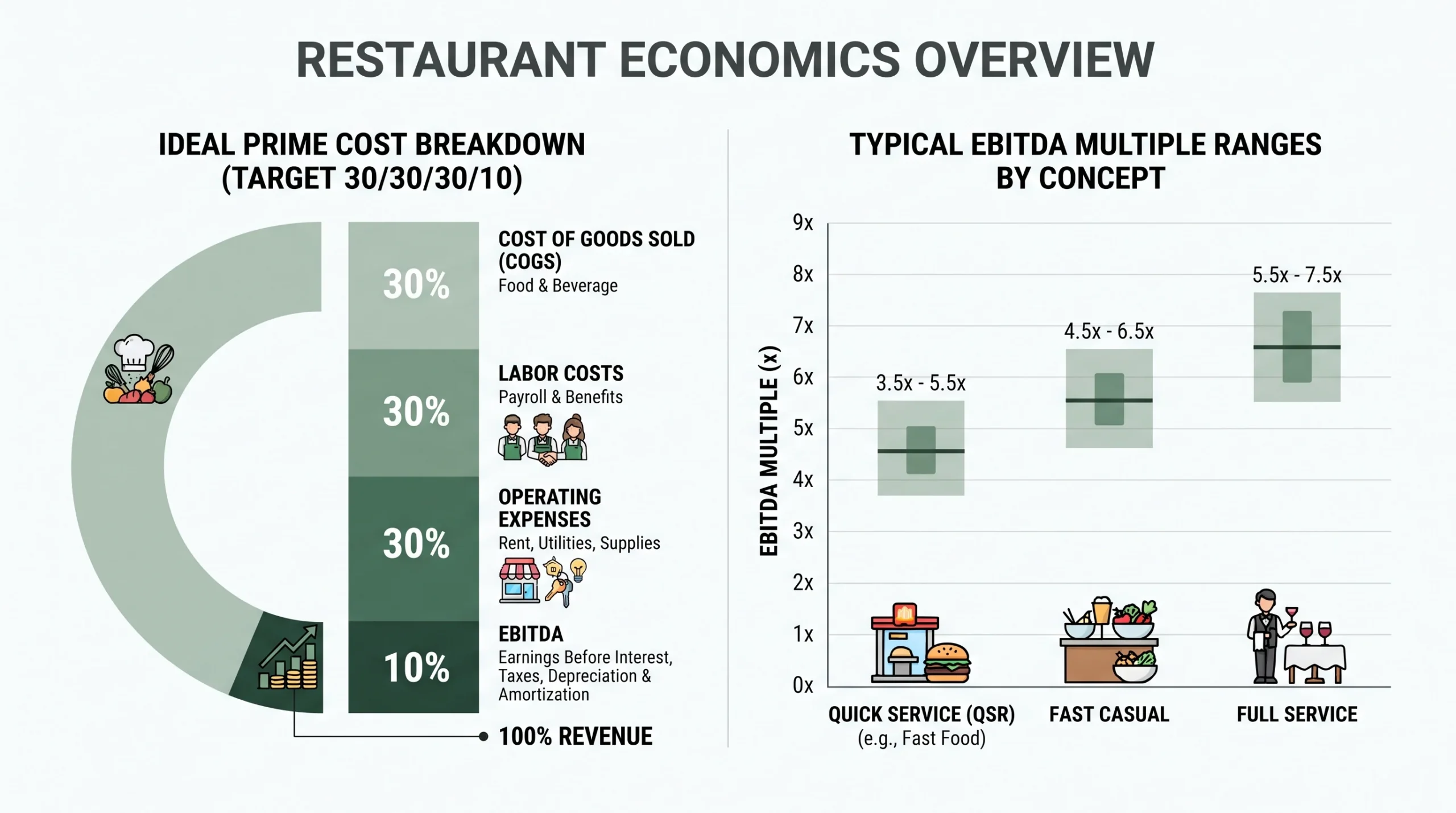
Restaurant type maps to risk and scalability. Fast-casual and quick-service brands often earn higher multiples than full-service or fine dining. The reason is repeatability. Limited-service models use standardized operations and leaner labor, which support growth. Fine dining often carries higher fixed costs and leans on a specific chef or owner.
The gaps are real. Based on market transaction data, a fast-casual concept may trade around 3x to 5x earnings, while an independent full-service spot often sits closer to 2x to 4x. Franchise locations can price differently again, reflecting the lower risk of a proven system. These are ranges, not guarantees. The final multiple depends on the specific unit’s performance and its risk profile.
What Is a Good EBITDA Margin for a Restaurant?
A good EBITDA margin usually falls in the 10 to 15 percent range. That shows the business covers its costs and still generates cash for growth. Top-quartile operators can exceed 20 percent. They get there by controlling core expenses tightly. Efficiency in the kitchen and the dining room is the main driver of profit.
Many operators use the 30/30/30/10 framework to track spending. It targets roughly 30 percent of revenue for cost of goods sold, 30 percent for labor, and 30 percent for overhead like rent and utilities. The final 10 percent is the target profit. Prime cost, which combines food and labor, is the number operators watch most. When food or wage costs rise, adjusting prime cost protects the margin. Menu pricing, portion control, and staff scheduling are the main levers. Operators who watch prime cost weekly tend to hold steadier margins, and steadier margins earn a better multiple at sale.
How Is EBITDA Calculated for a Restaurant?
Start with net income and add back interest, taxes, depreciation, and amortization. That gives raw EBITDA. But raw EBITDA rarely reflects the true earnings a buyer would inherit, so the valuator normalizes it. Normalization is where the real work happens.
The adjustments remove items that are not part of normal operations. Add back one-time costs, such as a legal settlement or a kitchen renovation. Add back the owner’s pay above a market salary for the role. Remove personal expenses, like a personal vehicle run through the business. The result is adjusted EBITDA, or for smaller owner-run spots, seller’s discretionary earnings. That figure is the true base that the valuation multiple is actually applied to. If you want that normalization reviewed before you take a price to market, talk to a Sofer Advisors valuation specialist about your numbers.
How Do You Choose a Valuation Provider?
Providers differ by the size and purpose of the job. Automated online tools give a quick estimate from public data, but miss local context. Large national firms such as Alvarez & Marsal, Stout, and Kroll handle complex, multi-state and institutional deals with broad teams. Sofer Advisors gives the hands-on, partner-led analysis an independent operator needs, backed by expert witness testimony in 11+ cases and 180+ five-star Google reviews. The right fit depends on why you need the report.
| Provider type | Best for | Focus |
|---|---|---|
| Automated tools | Preliminary estimates | Public market data, no local context |
| Large national firms | Complex multi-state M&A | Large-scale deals and audits |
| Specialized practices | Independent and small-group restaurants | Tailored, defensible analysis |
| Sofer Advisors | Owners needing an audit-ready report | Lease, equipment, and owner-benefit review |
The key question is the end use. A quick internal benchmark can come from a tool, but a report for a lender, the IRS, or a shareholder dispute needs a certified, defensible analysis. Sofer Advisors works through a four-phase process it calls The Sofer Difference, moving from Discovery to Diligence to Analysis to Delivery. That structure reflects the Heart of a Teacher approach, explaining the data behind each adjustment so an owner understands the number rather than just receiving it.
What Mistakes Do Owners Make?
The most common mistake is using the wrong market data. Owners often grab generic public company multiples, which rarely fit a small private restaurant’s risk. Another is failing to normalize earnings properly. Skipping deferred capital expenditures, using incomplete records, and ignoring a below-market lease all distort the result.
A subtler mistake is confusing enterprise value with personal goodwill. If the owner is the main driver of revenue, a buyer may see that value as transferable only if the owner stays. That changes the risk and the price. Owners also tend to value the business on revenue rather than earnings, which overstates the price. Buyers pay for profit and durable cash flow, not top-line sales. Setting expectations on the right metric early prevents a painful gap later in a negotiation.
Frequently Asked Questions
What is a typical restaurant EBITDA multiple?
Most independent restaurants trade near 3.0x to 5.0x EBITDA, based on market transaction data such as DealStats. The exact figure depends on concept, profitability, and lease terms. A strong fast-casual brand can reach the top of the range, while a single full-service location often sits lower. The final number always turns on the specific unit’s risk profile, not an industry average. Sofer Advisors sets the multiple from your actual results and comparable sales rather than a generic figure.
What drives a restaurant multiple higher?
Steady, high EBITDA margins, a strong location, a favorable long-term lease, and low owner dependence all push the multiple up. Buyers pay more for durable, transferable cash flow that does not depend on the founder being present every day. Deferred maintenance, a short lease, and heavy reliance on the owner push the multiple down. Each factor signals how risky the earnings are. Sofer Advisors documents these drivers so the report supports the highest defensible multiple for your restaurant.
Do quick-service restaurants get higher multiples than fine dining?
Often yes. Quick-service and fast-casual concepts use standardized operations and leaner labor, which scale well and reduce risk. Fine dining carries higher fixed costs and depends on a specific chef or owner, which raises risk and usually lowers the multiple. The gap is about repeatability, not the quality of the food. A proven, transferable system commands more. Sofer Advisors weighs your concept against comparable sales so the multiple reflects how your model really operates.
What is a good EBITDA margin for a restaurant?
Generally 10 to 15 percent, with top operators above 20 percent. The margin reflects how well the business controls prime cost, which combines food and labor and is the number operators watch most closely. A higher, steadier margin supports a higher valuation multiple because it signals durable profit. Weak or erratic margins drag both the margin and the multiple down. Sofer Advisors benchmarks your margin against industry data and shows where it lands for buyers.
How is EBITDA calculated for a restaurant?
Start with net income and add back interest, taxes, depreciation, and amortization to get raw EBITDA. Then normalize by adding back one-time costs and above-market owner pay, and removing personal expenses run through the business. The adjusted figure, or seller’s discretionary earnings for owner-run spots, is what the multiple is applied to. That normalization is where much of the value is won or lost. Sofer Advisors prepares the adjusted EBITDA so the earnings reflect true operations a buyer would inherit.
Are industry rule-of-thumb multiples reliable?
Only as a rough starting point. A generic multiple ignores your location, lease, concept, and margins, which are exactly the factors that move value most. Relying on it alone often leads to mispricing, in either direction. A real valuation adjusts the multiple to the specific restaurant’s facts and comparable sales. Sofer Advisors uses market data to replace the rule of thumb with a figure you can defend to a buyer or lender.
What is the biggest valuation mistake restaurant owners make?
Using public company multiples that do not fit a small private restaurant, and failing to normalize earnings. Ignoring deferred capital needs and confusing personal goodwill with enterprise value are close behind. Each one can distort the saleable value and set an expectation the market will not meet. Sofer Advisors corrects these errors up front so the price you take to market holds up under a buyer’s diligence.
How much does a restaurant valuation cost?
A standard restaurant valuation ranges from $7,500 to $25,000. The fee depends on the number of locations, the complexity of the operation, and the purpose of the report, whether for a sale, a loan, or a dispute. A flat scope is quoted up front, so the cost is clear before work begins. Sofer Advisors sets the scope first, then quotes a fixed price. Request a free estimate for a range specific to your restaurant.
Related Case Studies
- Medical Practice Valuation Multiples 2025-2026: Complete Guide
- How to Calculate the Value of a Restaurant: Expert Guide
- How Much Is a Restaurant Worth? Complete Valuation Guide
Executive Summary
Private restaurants typically sell near a 3.0x to 5.0x EBITDA multiple, based on market data such as BVR’s DealStats, but concept, location, lease, and owner dependence move the figure within and beyond that band. Quick-service and fast-casual concepts usually earn more than full-service or fine dining because they scale. A healthy EBITDA margin runs 10 to 15 percent, with top operators above 20 percent, driven by tight prime-cost control. The multiple applies to adjusted EBITDA, normalized for one-time costs and above-market owner pay. Most valuations run $7,500 to $25,000. The first action is to gather three to five years of profit and loss statements, the lease, and an equipment list.
What Should You Do Next?
Pull three to five years of profit and loss statements and tax returns, then normalize your EBITDA for owner pay and one-time costs so the earnings reflect true operations. Gather your lease, your equipment list with ages, and point-of-sale reports before a buyer or lender asks. This guide was prepared by David Hern CPA ABV ASA, founder of Sofer Advisors, an Inc. 5000 firm specializing in restaurant and hospitality valuations. Schedule a free consultation to discuss your specific situation.
People Also Read
About the Author
This guide was prepared by David Hern CPA ABV ASA, founder of Sofer Advisors, a business valuation firm headquartered in Atlanta, GA serving clients across the United States. David holds dual accreditations as an Accredited Senior Appraiser (ASA) and is Accredited in Business Valuation (ABV), credentials recognized by the IRS, SEC, and FINRA. He also holds the Certified Exit Planning Advisor (CEPA) designation. With 15+ years of valuation experience, David has served as an expert witness in 11+ cases across multiple jurisdictions and built Sofer Advisors into an Inc. 5,000-recognized firm with 180+ five-star Google reviews. Its full W2 employee team maintains subscriptions to all major valuation databases and operates under a next business day response policy.
For professional business valuation services, visit soferadvisors.com/about-us/ or contact Sofer Advisors at soferadvisors.com/contact-us/.
This content is for informational purposes only and does not constitute professional valuation advice. Business valuation conclusions depend on specific facts and circumstances. Contact Sofer Advisors for guidance regarding your specific situation.









