


Last Updated: September 2026
The cost savings and revenue gains in an acquisition are the extra value a buyer expects to create by combining two businesses into one. Cost savings come from removing duplicate expenses and stronger buying power. Revenue gains come from cross-selling, wider distribution, and better pricing. In many deals these combined benefits add 10% to 30% to the standalone value of the target.
This value matters because it shapes the price. A seller wants credit for the upside. A buyer wants to keep the reward for the risk it takes on. The line between the two runs through the standard of value, and knowing which benefit is which protects your position at the table.
Sofer Advisors provides neutral, third-party valuations for owners weighing a sale or merger. With 180+ five-star Google reviews and Inc. 5000 recognition, it applies IRS and FASB standards to complex deal structures. Its senior team has testified as an expert witness in 11+ cases across Georgia, Florida, California, and New Mexico.
Key Takeaways
- Two sources of value: cost savings come from removing duplicate overhead; revenue gains come from selling more.
- Two standards of value: market-participant benefits fit fair market value; buyer-specific benefits fit investment value.
- Quantify from the bottom up: size each item, apply a realization haircut, phase it in, then discount to present value.
- Subtract the cost to achieve: integration spending and one-time charges lower the net benefit a buyer keeps.
- Sellers capture only part: buyers hold back much of the buyer-specific upside as their return for the risk.
These factors shape both the price and who keeps the reward. The sections below examine each in detail.
What are acquisition cost savings and revenue gains?
Acquisition cost savings and revenue gains are the added value a buyer expects when two businesses run as one. A merger, as the SEC describes it, joins two firms into a single entity. Cost savings reduce the combined expense base, and revenue gains lift the combined top line. Together they explain why a buyer may pay more than the target’s standalone worth.
These benefits are not the same as the base business value. The income approach and the market approach measure what the target earns today, and the added value sits on top of that figure. Both the buyer and the seller study it closely, and they rarely agree on its size.
How do you separate cost savings from revenue gains?
You separate them by asking whether the benefit lowers a cost or raises a sale. Cost savings are easier to predict because the buyer controls its own spending. Revenue gains are harder, since they depend on customers. The common cost savings are these:
- Removing duplicate roles in finance, human resources, and back-office work
- Consolidating offices, plants, or warehouses into fewer sites
- Stronger buying power on supplies, freight, and insurance
- Shared software, systems, and support contracts
Each cost item can be tied to a line on the budget, so a buyer can check the math. Revenue gains take more care, since they rest on selling that has not happened yet. The common revenue gains are these:
- Cross-selling each firm’s products to the other’s customers
- Reaching new regions or channels through the partner’s network
- Better pricing from a wider or stronger product line
- Faster growth from combined research and sales teams
Because revenue gains carry more doubt, buyers apply a heavier discount to them. A dollar of cost savings is worth more than a dollar of hoped-for revenue. A careful appraiser weighs each source on its own, so an owner sees which parts of the story a buyer will trust.
What are market-participant vs buyer-specific benefits?
Market-participant benefits are gains any typical buyer could achieve, while buyer-specific benefits belong to one acquirer alone. This split decides which standard of value applies. Under ASC 805, fair value is measured from a market-participant view, so it includes only the benefits a normal buyer could reach, and fair market value works much the same way. Buyer-specific benefits instead go into investment value, the worth to one named party.
Our guide on fair market value vs investment value shows how the same business can carry two figures. A market-participant benefit, such as basic overhead cuts, shows up in most offers. A buyer-specific benefit, such as a rare distribution network, shows up in only one. The table below sorts the four types.
| Benefit type | Market-participant (fair value) | Buyer-specific (investment value) |
| Cost savings | General overhead and site cuts any buyer could make | Deep savings from an acquirer’s own plants nearby |
| Revenue gains | Basic cross-selling most buyers could run | Access to one buyer’s unique channel or brand |
This sorting drives the price capture question later. When a buyer records the deal, it splits the price across assets in a purchase price allocation that follows the market-participant rule. Buyer-specific value that no other bidder shares is harder for a seller to prove. A sound analysis maps each benefit to the right standard so the conclusion matches how the IRS and buyers read it.
How do you quantify and discount these deal benefits?
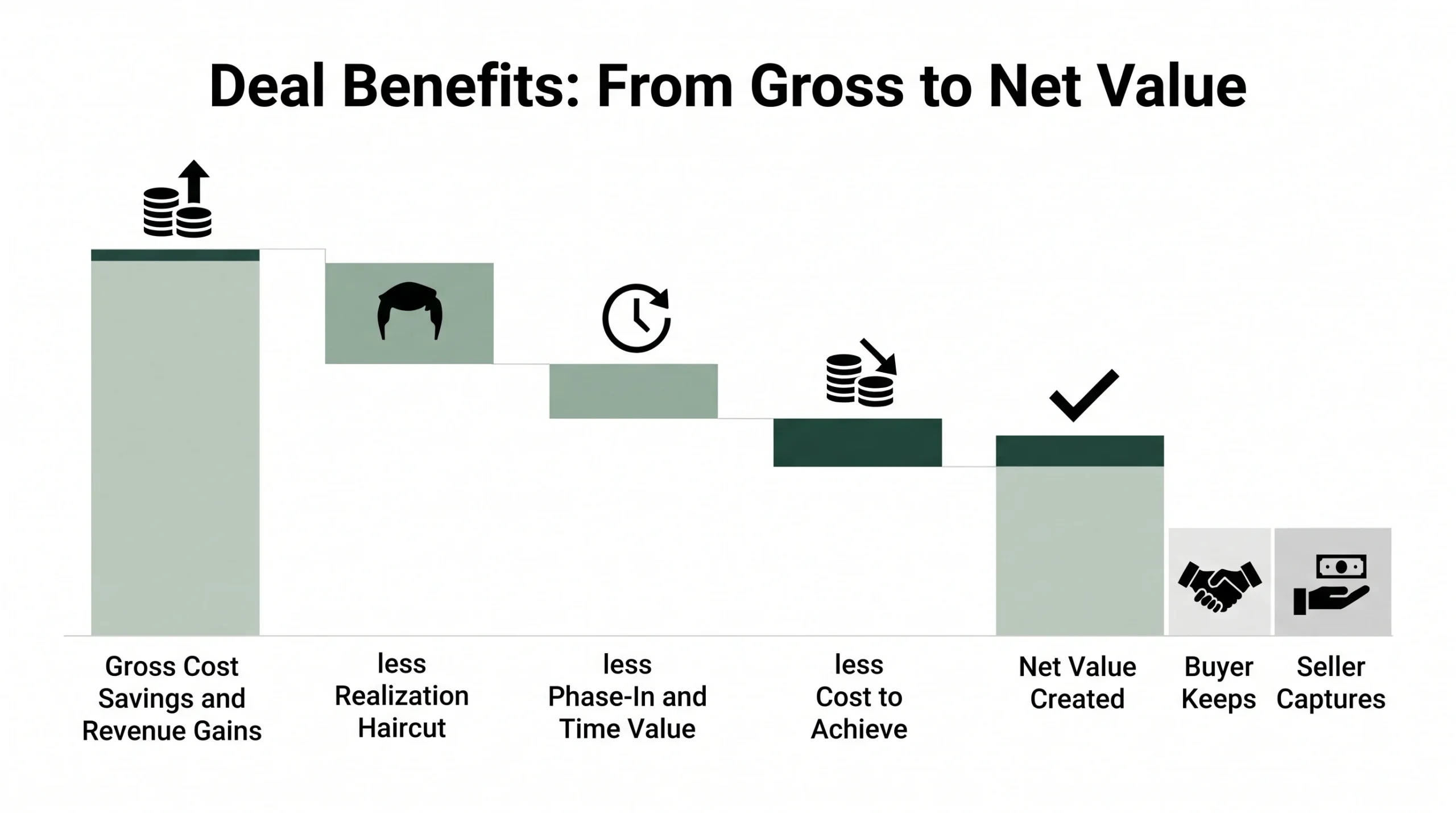
You quantify deal benefits with a bottom-up estimate, a realization haircut, a phase-in timeline, and a present-value discount. Start by sizing each item in plain dollars. A duplicate role removed saves a known salary, and a consolidated site saves a known rent. Add the pieces to reach a gross yearly benefit before any adjustments. A bottom-up figure is easier to defend than a broad percentage guess.
Few benefits arrive in full or on day one. A realization haircut cuts the gross figure for the share that will not stick. A phase-in timeline spreads the rest over two or three years. Then you discount the stream to present value at a rate that reflects the risk. Finally, subtract the one-time cost to achieve them, such as severance and system work. What remains is the net value the buyer can count on.
This path reflects The Sofer Difference, the firm’s four-step process of Discovery, Diligence, Analysis, and Delivery. Discovery gathers the facts, Diligence tests each claim, Analysis builds the model, and Delivery explains the result in plain terms.
How much of the value can the seller actually capture?
A seller captures only part of the added value, and often a small part of the buyer-specific piece. The buyer takes the risk and pays the cost to achieve, so it expects a return. In a negotiation it shares some upside to win the deal but keeps the rest. Where the split lands depends on how many bidders compete and how visible each benefit is.
Market-participant benefits are the easier ones to capture. Because any typical buyer could reach them, several bidders price them in, and a control premium often reflects this shared value. Buyer-specific benefits are harder to capture, since only one bidder sees them and has no pressure to hand them over. A seller who shows real, provable upside and runs a competitive process keeps more of it. This is the heart of transactional advisory work: knowing what your added value is worth and what the market will pay.
Which valuation firm should value acquisition benefits?
Owners choose among independent valuation firms, deal brokers, and large advisory groups. All three can size the benefits, but their incentives differ. An independent firm follows standards like USPAP and stays neutral on the price. A broker earns a fee when the deal closes, so its estimate can lean high. Large firms like Alvarez & Marsal, Stout, and Kroll serve the biggest deals. The table below compares the options.
| Provider type | Service focus | Conflict of interest |
| Sofer Advisors | Neutral, defensible value of the deal benefits | None; fee is flat, not tied to a sale |
| Deal broker | Marketing and closing the transaction | High; commission based on sale price |
| Large advisory firm | Enterprise-scale deal support | Moderate; success fees |
A conflict arises when the party sizing the benefits also earns from the deal closing, which is why an owner benefits from a separate, neutral read. Sofer Advisors works with a Heart of a Teacher approach, explaining each assumption so an owner understands the number rather than just receiving it. As a full W2 team with next business day response and access to all major valuation databases, the firm brings senior review to every engagement.
The added value in a deal is real, but it must be sorted, sized, and split with care. The questions below cover what owners ask most.
Frequently Asked Questions
What are the cost savings and revenue gains in an acquisition?
They are the added value a buyer expects from running two businesses as one. Cost savings come from removing duplicate overhead, consolidating sites, and stronger buying power. Revenue gains come from cross-selling, wider distribution, and better pricing. Together they can add 10% to 30% to the target’s standalone value, though the size depends on the fit between the two firms.
What is acquisition benefit valuation?
It is the process of putting a defensible dollar figure on the cost savings and revenue gains a deal is expected to create. The analyst sizes each item from the bottom up, applies a haircut for the part that will not stick, phases it in, and discounts it to present value. The cost to achieve is then subtracted, showing what the added value is worth today.
How do you calculate combined benefits in M&A?
Start with a bottom-up estimate of each cost saving and each revenue gain in dollars. Apply a realization haircut for the share that will not materialize. Phase the rest in over two or three years, then discount to present value with a risk-adjusted rate. Subtract the one-time cost to achieve them. The net figure is the added value, kept separate from the base business value.
How much of the combined value does a seller capture?
A seller usually captures only part of it, and often a small part of the buyer-specific value. The buyer takes the risk and pays the cost to achieve, so it keeps a share as its return. Market-participant benefits are easier to capture because several bidders price them in. Buyer-specific benefits are harder, since only one bidder sees them. A competitive process pushes more value into the price.
What is the difference between cost savings and revenue gains?
Cost savings lower the combined expense base, while revenue gains lift the combined top line. Cost savings are more predictable because a buyer controls its own spending, so they earn more credit in a model. Revenue gains depend on customers the buyer does not control, so they carry a heavier discount. A dollar of proven cost savings is generally worth more than a dollar of hoped-for new revenue.
Are market-participant benefits included in fair market value?
Yes. Market-participant benefits are gains any typical buyer could achieve, so they belong in fair market value and in fair value under ASC 805. These include general overhead cuts and basic cross-selling most buyers could run. Buyer-specific benefits, which only one acquirer can reach, are excluded from fair market value and sit in investment value instead. This line decides which standard the appraiser applies.
What are buyer-specific benefits worth to one acquirer?
They can be worth a great deal, but only to the single buyer who can reach them. A buyer-specific benefit might be feeding the target’s product through a rare distribution network or a nearby plant. Because no other bidder shares that advantage, it does not show up across competing offers. That is why it is harder for a seller to capture, and why the acquirer has little pressure to pay full value.
Why do buyers subtract the cost to achieve the benefits?
Because the gains are rarely free. Cutting duplicate roles brings severance. Merging systems brings software and consulting fees. Consolidating sites brings moving and lease costs. These one-time charges reduce the net value a buyer keeps, so a sound model subtracts them from the gross benefit. Ignoring the cost to achieve overstates the upside and leads to a price that is too high.
How much does an acquisition valuation from Sofer Advisors cost?
A standard business valuation for a transaction from Sofer Advisors runs $7,500 to $25,000, with a timeline of four to eight weeks. Cost depends on deal size, the number of benefit items to model, and the depth of diligence needed. Larger or more complex combinations reach the higher end. For a quote tied to your deal, reach out for a valuation estimate with your financials and a summary of the target.
Related Case Studies
- Business Valuation for Mergers: Buy-Side vs Sell-Side
- Earn-Out Valuation in M&A: Structuring and Fair Value
- Top Value Drivers Buyers Pay a Premium For in 2026
Executive Summary
The cost savings and revenue gains in an acquisition are the added value a buyer expects from combining two firms. Cost savings come from removing duplicate overhead and buying power; revenue gains come from cross-selling and wider reach. You size each from the bottom up, apply a realization haircut and a phase-in, discount to present value, then subtract the cost to achieve them. Market-participant benefits fit fair market value and ASC 805 fair value; buyer-specific benefits fit investment value. Sellers capture only part of the upside, and a competitive process captures more.
What Should You Do Next?
List every cost saving and revenue gain your deal could create, and tag each one as market-participant or buyer-specific. Size each item in dollars, apply a haircut for what will not stick, and subtract the cost to achieve it. Then get an independent valuation before you negotiate, since a neutral figure gives you a firm base and shows a buyer your numbers hold.
David Hern CPA ABV ASA, founder of Sofer Advisors, provides neutral, defensible valuations for owners weighing a sale or merger. Schedule a consultation to discuss your situation.
People Also Read
- Calculating Goodwill in an Acquisition: Formula Explained
- Quality of Earnings Reports: What Buy-Side QofE Actually Tests
About the Author
This guide was prepared by David Hern CPA ABV ASA, founder of Sofer Advisors, a business valuation firm headquartered in Atlanta, GA serving clients across the United States. David holds dual accreditations as an Accredited Senior Appraiser (ASA) and is Accredited in Business Valuation (ABV), credentials recognized by the IRS, SEC, and FINRA. He also holds the Certified Exit Planning Advisor (CEPA) designation. With 15+ years of valuation experience, David has served as an expert witness in 11+ cases across multiple jurisdictions and built Sofer Advisors into an Inc. 5000-recognized firm with 180+ five-star Google reviews. Its full W2 employee team maintains subscriptions to all major valuation databases and operates under a next business day response policy.
For professional business valuation services, visit soferadvisors.com/about-us/ or contact Sofer Advisors at soferadvisors.com/contact-us/.
Disclaimer: This content is for informational purposes only and does not constitute professional valuation advice. Business valuation conclusions depend on specific facts and circumstances. Contact Sofer Advisors for guidance regarding your specific situation.









