


Last Updated: October 2026.
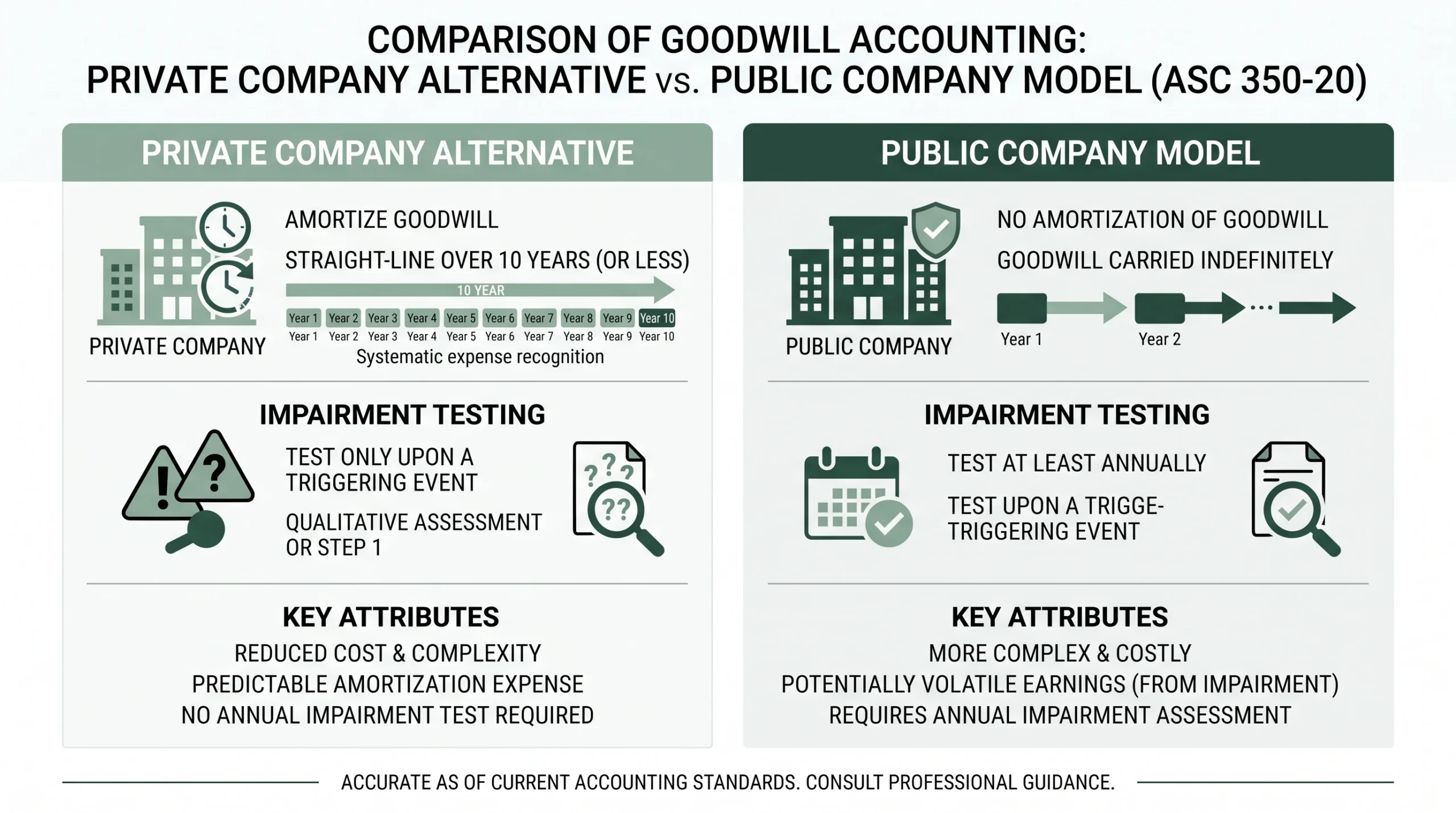
A private company goodwill alternative is an accounting election under U.S. GAAP that lets a private company amortize goodwill on a straight-line basis over 10 years, or less, instead of testing it for impairment every year. The Financial Accounting Standards Board created it through ASU 2014-02, which lives in ASC 350-20. A company that elects it tests goodwill only when a triggering event signals a possible decline in value.
Business owners and their CPAs weigh this election against the yearly impairment model that public companies follow. The team at Sofer Advisors helps leadership teams decide whether the election fits their financial statements and their long-term plans, backed by Inc. 5000 recognition in both 2024 and 2025.
This guide explains what the election covers, how the amortization works, when you still have to test for impairment, and how the private model differs from the public rules. It also covers what the choice means when you sell the business or raise money.
Key Takeaways
- Amortize instead of test: an eligible private company can write goodwill down on a straight-line basis over 10 years, or a shorter life, rather than run a yearly impairment test.
- Private entities only: the election is open to nonpublic business entities under the FASB definition, so public companies and conduit bond obligors cannot use it.
- Triggers still apply: you must still test goodwill when an event signals its fair value has fallen below its carrying amount.
- Comparability is the cost: the steady charge is predictable, but your statements read differently from a public company and from your own tax return.
- Plan before you elect: the choice is prospective and hard to reverse, so match it to your reporting goals first.
Each of these pieces ties into the wider reporting plan. The sections below take them one at a time.
Why Does the Private Company Goodwill Election Matter?
The election matters because it changes how much work your year-end close takes and how your balance sheet reads. A private company that amortizes goodwill records a steady expense each year and skips the annual impairment test. That saves time and outside valuation fees. It also makes the reported value of goodwill fall on a fixed schedule rather than move with the market.
That trade-off is the whole decision. Public companies cannot amortize goodwill at all. They test it every year and write it down when its value drops. A private company that elects the alternative swaps that yearly test for a simple, steady charge. The cost is comparability. A lender or a buyer who lines your statements up against a public company will see a different pattern. So the choice is not just an accounting detail. It shapes how lenders and investors read your numbers.
What Is the Private Company Goodwill Alternative?
The private company goodwill alternative is an accounting policy choice under ASC 350-20. It lets a nonpublic entity amortize goodwill on a straight-line basis over 10 years, or a shorter life if that fits the business better. The entity then tests goodwill for impairment only when a triggering event happens, not on a fixed yearly schedule. The FASB added this choice through ASU 2014-02.
Before this rule, every company carried goodwill at its full amount and tested it each year. For a small business, that test was costly and hard to defend. The 2014 update gave private companies a simpler path. A related rule, ASU 2014-18, lets a private company fold certain customer-related intangibles and noncompete agreements into goodwill, so there is less to value on its own. A company that elects the intangibles rule must also elect the goodwill amortization rule. The two work together.
How Does Amortization Work Under This Alternative?
Goodwill is amortized in equal amounts over the chosen period, up to 10 years. You take the total goodwill, divide it by the number of years, and record that charge each year. The policy applies to all goodwill you already carry and to any new goodwill from a future acquisition under ASC 805. Once you pick a life for a pool of goodwill, you keep using it.
The default life is 10 years. A shorter life is allowed when the facts support it, such as a customer contract that ends sooner. The charge is predictable, which makes planning easier. It also differs from the tax rules, so your book and tax numbers will not match. We walk through that split in our guide to goodwill amortization versus impairment. Many private companies choose this path to cut the cost of yearly fair value work.
What Triggers an Impairment Test if You Amortize?
Even with amortization, you must test goodwill when a triggering event suggests its fair value has dropped below its carrying amount. A triggering event is a real change in the business or its market. Examples include the loss of a major customer, a sharp drop in cash flow, a new law that cuts into profit, or the departure of key people. When one occurs, you measure fair value and compare.
A private company that elects the alternative can test at the entity level or at the reporting-unit level, whichever it picks. Under ASU 2021-03, it can also check for triggering events only at the end of each reporting period, not all year long. That relief cuts monitoring work. But the test itself still needs a real fair value estimate when a trigger fires. That is the moment an independent appraisal earns its keep, because a weak number invites a restatement later.
How Does the Private Model Differ From the Public Rules?
Public companies may not amortize goodwill. U.S. GAAP makes them test it for impairment at least once a year and write it down when a reporting unit is worth less than its carrying amount. IFRS works much the same way, with an annual test. The private company alternative is the exception. It swaps the yearly test for straight-line amortization and a trigger-based test.
There is also a tax angle that often confuses owners. For book purposes under GAAP, the private election amortizes goodwill over 10 years or less. For tax purposes, Internal Revenue Code Section 197 amortizes purchased goodwill over 15 years. These are two separate schedules for the same asset, so your financial statements and your tax return will not line up. A buyer, a lender, or the IRS reads each one on its own terms. Knowing which rule drives which report keeps the numbers clean.
How Do You Choose a Valuation Partner?
Owners pick a valuation partner based on the size of the business, the reason for the work, and the budget. A triggering-event test still needs a defensible fair value, so the appraiser matters. Large national firms serve big public companies with broad teams. A specialized firm gives closely held businesses senior-level attention on every file. The table below lays out the common options.
| Provider | Typical role | Best for |
|---|---|---|
| Specialized valuation firm (e.g. Sofer Advisors) | Builds amortization schedules and triggering-event fair value, documented for auditors | Private companies that elect the goodwill alternative |
| Large national firm | Broad advisory plus valuation at enterprise scale | Large public companies with complex, multi-unit reporting |
| In-house accounting team | Records the amortization entries each period | Routine bookkeeping between valuation events |
Large national firms such as Alvarez & Marsal, Stout, and Kroll serve big public companies with deep advisory benches. Sofer Advisors focuses on defensible, partner-led valuations for closely held and middle-market businesses, with 180+ five-star Google reviews and expert testimony in 11+ cases behind its reports. Sofer Advisors runs each engagement through a four-phase process it calls The Sofer Difference, moving from Discovery to Diligence to Analysis to Delivery. That order ties every number to the facts behind it. It reflects the Heart of a Teacher approach, which means explaining the reasoning rather than just handing over a figure. You can see how Sofer Advisors approaches business valuation services for financial reporting.
Frequently Asked Questions
Do you amortize goodwill for private companies?
Yes. A private company may elect to amortize goodwill on a straight-line basis over 10 years, or a shorter period if that fits the business. This election, under ASU 2014-02, replaces the yearly impairment test with a steady charge. The company still tests goodwill when a triggering event signals a drop in value. Sofer Advisors helps owners weigh this election against the standard model and documents the fair value when a test is required.
What is the difference between personal goodwill and business goodwill?
Personal goodwill attaches to one individual’s reputation, skill, or relationships. Business goodwill belongs to the company itself, through its brand, systems, and market position. Personal goodwill usually does not transfer in a sale unless that person stays on. The distinction matters in tax and divorce cases, where only transferable value counts. Sofer Advisors separates the two so a valuation reflects the value tied to the business, not to a single owner’s presence.
Why do companies write off goodwill?
Companies write off goodwill when its carrying amount is higher than its fair value. That gap shows up during an impairment test, often after a lost customer, a downturn, or a weak acquisition. The write-off records the drop as a loss and lowers the asset on the balance sheet. It does not involve cash. Sofer Advisors performs impairment testing under ASC 350 to help leaders judge whether recorded goodwill still reflects the fair value of a reporting unit.
What are the three main types of goodwill?
Valuation discussions often name three forms: acquired goodwill, inherent goodwill, and personal goodwill. Acquired goodwill is the premium paid above fair value in a purchase. Inherent goodwill is the reputation and customer loyalty a company builds on its own over time. Personal goodwill is tied to a specific person. Sofer Advisors sorts these components so a report shows what actually transfers to a buyer and what stays with the founder in a sale or transfer.
Can a private company reverse the goodwill amortization election?
Reversing is hard. The election is a long-term accounting policy that applies to all current and future goodwill. To switch back, a company must meet the test for a change in accounting principle and show the new method is preferable, which auditors scrutinize. Most companies treat the choice as permanent. Sofer Advisors advises owners to review their reporting goals before they elect, so the choice fits a planned sale, audit, or financing down the road.
Does amortizing goodwill remove the need for an impairment test?
No. Amortization lowers goodwill on a fixed schedule, but it does not end the duty to test. A private company that elects the alternative still tests when a triggering event points to a drop in fair value below the carrying amount. The relief is in frequency, not in the test itself. Sofer Advisors measures fair value when a trigger fires, so the entry holds up for auditors and for anyone reading the financial statements.
How does amortizing goodwill affect EBITDA?
Goodwill amortization is an operating expense, so it lowers reported net income. It is a non-cash charge, which means many analysts add it back when they calculate adjusted EBITDA. The result is a steady, predictable expense instead of the large, uneven hits that impairment write-downs create. Sofer Advisors helps controllers and CFOs show how this election moves net income and EBITDA, so lenders and buyers read the numbers the way the company intends.
How much does goodwill impairment testing cost?
Goodwill impairment testing usually runs from $7,500 to $25,000 and takes about two to six weeks, depending on how many reporting units are involved and how clean the data is. The fee covers the fair value work that supports the accounting entry. Sofer Advisors scopes each engagement first, then quotes a flat fee up front. Request a free estimate for your situation.
Related Case Studies
- Goodwill Impairment Testing Step by Step: An ASC 350 Guide
- Is Goodwill Amortized or Impaired? Book vs Tax
- Reporting Unit Determination Under ASC 350
Executive Summary
The private company goodwill alternative lets a nonpublic entity amortize goodwill over 10 years, or less, instead of running an annual impairment test. The FASB created it in ASU 2014-02, and ASU 2021-03 later let electing companies check for triggering events only at period end. The payoff is a steady, predictable charge and lower yearly valuation cost. The price is weaker comparability with public companies and a book figure that will not match the 15-year tax schedule under Section 197. A triggering-event test still needs a real fair value, so the election trims the routine without removing the need for a defensible appraisal when value drops.
What Should You Do Next?
Start by pulling your latest financial statements, your goodwill balances by acquisition, and any board or lender agreements that set reporting terms. Decide why you need the number, whether for a routine close, a triggering event, or a planned sale, so the method matches the purpose. This guide was prepared by David Hern CPA ABV ASA, founder of Sofer Advisors, an Inc. 5000 firm that builds defensible valuations for financial reporting. Schedule a free consultation at the Sofer Advisors contact page to discuss your specific situation.
People Also Read
- Goodwill Impairment Testing ASC 350: Complete Guide for 2025-2026
- Purchase Price Allocation ASC 805 and IFRS 3: Complete Guide for Business Leaders
About the Author
This guide was prepared by David Hern CPA ABV ASA, founder of Sofer Advisors, a business valuation firm headquartered in Atlanta, GA serving clients across the United States. David holds dual accreditations as an Accredited Senior Appraiser (ASA) and is Accredited in Business Valuation (ABV), credentials recognized by the IRS, SEC, and FINRA. He also holds the Certified Exit Planning Advisor (CEPA) designation. With 15+ years of valuation experience, David has served as an expert witness in 11+ cases across multiple jurisdictions and built Sofer Advisors into an Inc. 5,000-recognized firm with 180+ five-star Google reviews. Its full W2 employee team maintains subscriptions to all major valuation databases and operates under a next business day response policy.
For professional business valuation services, visit soferadvisors.com/about-us/ or contact Sofer Advisors at soferadvisors.com/contact-us/.
This content is for informational purposes only and does not constitute professional valuation advice. Business valuation conclusions depend on specific facts and circumstances. Contact Sofer Advisors for guidance regarding your specific situation.









