


Last Updated: September 2026
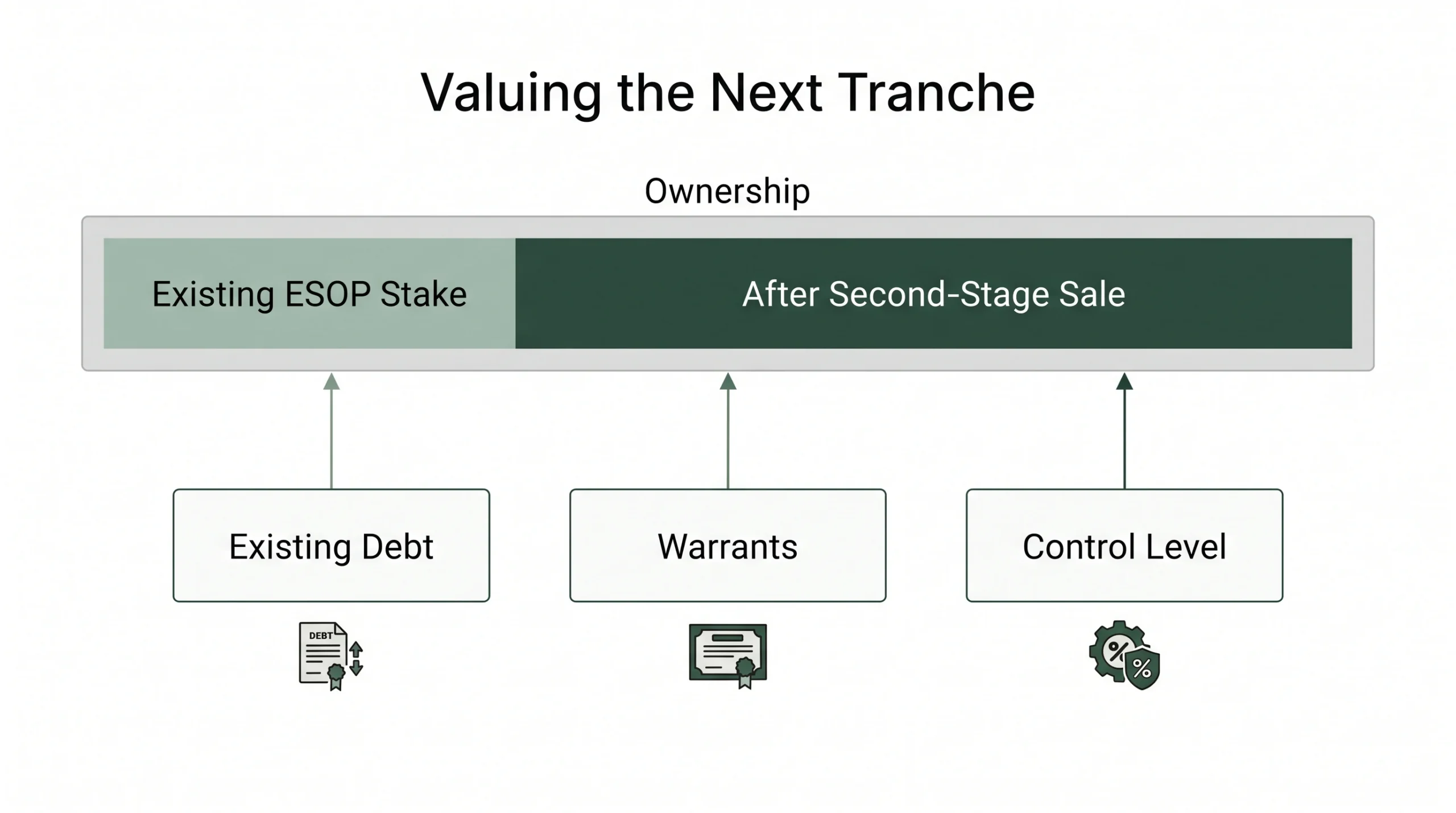
A partial second-stage ESOP sale is a follow-on transaction in which a company sells an additional block of stock to an employee stock ownership plan that already owns part of the business. The price of that next tranche is not a copy of the first sale. Debt from the first stage still sits on the balance sheet, first-stage warrants dilute the share base, and the control level being conveyed can move the value from a minority basis to a control basis. The National Center for Employee Ownership counts 6,358 ESOP companies in the United States, and many buy their shares in stages, not all at once.
Second-stage pricing matters because the company valued in stage two is more indebted and more diluted than the one sold in stage one. An independent appraisal sets the fair market value of the new shares so the plan pays adequate consideration and does not overpay, which protects the trustee, the seller, and the employee participants at once.
Sofer Advisors provides independent, third-party opinions of value for ESOP transactions across the United States. The firm applies established appraisal standards to layered deal structures and explains each driver plainly, a Heart of a Teacher approach that shows owners and trustees how a second sale differs from the first. Its senior appraisers hold dual ABV and ASA accreditation and have testified as expert witnesses in 11+ cases.
Key Takeaways
- Existing debt lowers equity value: the loan from the first sale still sits on the balance sheet, so the next tranche is valued on a more indebted company.
- First-stage warrants dilute the price: warrants and synthetic equity expand the fully diluted share base, spreading value across more claims.
- Control level sets the standard of value: a sale that lifts the plan to control can support a control-level value; a further minority purchase stays on a minority basis.
- Adequate consideration still governs: the plan may pay no more than fair market value, a rule the Department of Labor enforces.
- Independent appraisal protects everyone: a neutral opinion of value defends the trustee, the seller, and the participants.
The second tranche rarely prices at the same figure per share as the first, and the sections below show why.
What is a second-stage ESOP sale?
A second-stage ESOP sale is a follow-on purchase in which an ESOP that already holds a partial stake buys an additional block of shares from the owner. In a common path, the plan buys 30% to 49% at stage one, then returns later for another tranche, sometimes reaching 51%, sometimes 100%. Owners often reach this point as part of a longer ownership transfer plan that spreads liquidity over several years.
The second sale is a fresh appraisal, not a rerun of the first. Between the two events, the company has serviced first-stage debt, paid distributions, and perhaps issued warrants, so its financial picture has moved. The National Center for Employee Ownership tracks how staged purchases have grown as owners exit gradually rather than in one step.
How does existing ESOP debt change the value of the next tranche?
Existing ESOP debt reduces the equity value available to the next tranche because the loan from the first sale still sits on the balance sheet. When the first stage was debt-financed, the company borrowed or accepted a seller note to fund the purchase and repays that loan from operating cash flow. Equity value equals enterprise value minus net debt, so a larger debt balance leaves less value for the shares the plan is about to buy.
This is the core reason a second tranche can price below the first per share even when the business performs well. A careful appraisal models the remaining first-stage debt and repayment schedule so the conclusion reflects the true equity cushion, not the debt-free picture from stage one.
How do first-stage warrants and synthetic equity affect the price?
First-stage warrants and synthetic equity dilute the fully diluted value, so the next tranche is priced across a larger set of claims. Sellers and lenders often receive warrants in the first deal, the right to buy stock later at a set price. When those warrants are in the money, the appraiser counts them in the fully diluted share base, which lowers the value assigned to each ESOP share.
Synthetic equity such as stock appreciation rights or phantom stock works the same way. These instruments are not ESOP shares, but they carry an economic claim that a careful appraisal reflects before it sets the tranche price. Ignoring them would overstate what the plan should pay and put the trustee at risk on adequate consideration.
Does the second-stage sale convey control or a minority interest?
Whether the second-stage sale conveys control depends on how much the plan owns once it closes. If the tranche lifts the ESOP from a minority position to majority or full ownership, the incremental shares may support a control level of value. If the plan is only adding to a minority stake and stays below control, the appraiser values the new shares on a minority basis and applies a discount for lack of marketability and, where appropriate, a minority discount.
The appraiser selects the correct level of value for the shares being sold, then tests it against fair market value. This is where a second-stage engagement most often differs from the first, and it drives the range in the transaction advisory analysis. The table below compares how the two paths are priced.
| Pricing factor | Minority second-stage tranche | Control second-stage tranche |
| Level of value | Minority basis | Control basis |
| Minority discount | May apply | Generally none |
| Marketability discount | Often applies | Reduced or limited |
| Typical trigger | Small add-on below 50% | Plan crosses to 51% or reaches 100% |
The distinction is not cosmetic. A tranche that takes the plan to full ownership can carry a control-level price for the incremental shares, while a further minority purchase carries the discounts of a passive stake. Getting the level of value wrong overpays the seller or shortchanges the participants, which is what adequate consideration is meant to prevent.
How does adequate consideration govern the follow-on price?
Adequate consideration means the plan may pay no more than fair market value for the new shares, a standard the U.S. Department of Labor enforces under ERISA. The trustee relies on an independent appraisal to meet that duty, and the appraiser follows fair market value principles set out in IRS Revenue Ruling 59-60 and professional appraisal standards.
Tax structure can shape the cash available to support that price. A company that becomes 100% ESOP-owned and elects S-corporation status pays no federal income tax on the plan’s share of earnings, which can free up cash to service the first-stage debt. That cash flow feeds the valuation, but it does not change the ceiling: the plan still pays fair market value and no more. The ESOP Association publishes guidance reinforcing this discipline for trustees.
Which valuation firm should value a second-stage ESOP sale?
The right firm for a second-stage ESOP sale is an independent appraiser with no stake in whether the deal closes. Owners can choose among independent valuation firms, transaction advisors, and large national consulting practices. National firms like Alvarez & Marsal, Stout, and Kroll serve the biggest engagements, while an independent appraiser focuses on a defensible opinion of value for the tranche. The table compares the options.
| Provider type | Service focus | Conflict of interest |
| Sofer Advisors | Neutral, defensible opinion of value for the tranche | None; flat fee, not tied to closing |
| Transaction advisor | Structuring and placing the deal | Higher; success fee tied to a close |
| National consulting firm | Large, complex engagements | Moderate; broad scope, less senior focus |
A conflict arises when the party setting the value also earns a fee for closing the deal. Because the appraisal supports the trustee’s adequate consideration duty, it needs to stay separate from any success fee. Sofer Advisors keeps the appraisal function distinct and follows a four-step process it calls The Sofer Difference: Discovery, Diligence, Analysis, and Delivery. That structure gives owners and trustees a clear path to a defensible report.
Frequently Asked Questions
How is a second-stage sale to an existing ESOP valued?
A second-stage sale is valued with a fresh appraisal of the company as it stands on the valuation date, not a repeat of the first price. The appraiser measures current earnings, subtracts remaining first-stage debt to reach equity value, counts any warrants in the fully diluted share base, and applies the correct level of value for the shares being sold. That conclusion is the fair market value the plan may pay.
How does existing ESOP debt affect the price of the next tranche?
Existing ESOP debt lowers the equity value the next tranche is priced on. The loan from the first sale remains on the balance sheet and is repaid from cash flow, so equity value, which is enterprise value minus net debt, is smaller than before. A second tranche can therefore price below the first per share even when the business is growing.
Does a follow-on partial sale to an ESOP convey control?
It depends on how much the plan owns after the sale closes. If the tranche takes the ESOP from a minority stake to majority or full ownership, the incremental shares can be valued on a control basis. If the plan is only adding to a minority position and stays below control, the shares are valued on a minority basis, usually with marketability and minority discounts applied.
What does it mean for an ESOP to already carry debt when a second tranche is sold?
It means the first purchase was debt-financed and the balance has not been fully repaid. The company borrowed or accepted a seller note to fund the first stage and services that obligation from operating cash flow. When the second tranche is valued, the appraiser treats the remaining balance as net debt, which reduces the equity value available to the new shares and shapes the price the plan can pay.
How is the price of an additional block of shares sold to an ESOP determined?
The price is set by an independent appraisal that concludes fair market value on the valuation date. The appraiser applies the income, market, and asset approaches, adjusts for remaining debt and any dilutive warrants, and selects a control or minority level of value based on what the plan will own. The trustee uses that conclusion to confirm the plan pays adequate consideration.
What is a partial ESOP sale?
A partial ESOP sale is a transaction in which an owner sells only a portion of the company stock to the plan rather than the whole business. Many owners begin with a partial sale to gain liquidity while keeping a stake, then complete the transition in later tranches. Each partial sale is appraised on its own facts, so a later block reflects the company as it stands then.
How do warrants from the first ESOP sale affect the second sale?
Warrants issued in the first sale dilute the fully diluted share base, which lowers the value assigned to each share in the second sale. When warrants are in the money, the appraiser includes them in the share count so the price reflects every claim on future value. Synthetic equity such as stock appreciation rights is treated the same way, since it carries an economic claim though it is not stock.
Does the ESOP have to pay fair market value for the additional shares?
Yes. Under ERISA, the plan may pay no more than adequate consideration, which is fair market value on the transaction date. The Department of Labor enforces this rule, and the trustee relies on an independent appraisal to meet the duty. Overpaying exposes the trustee and sponsor to liability, so the appraisal must be defensible and follow recognized fair market value standards.
How much does an ESOP valuation cost?
An ESOP valuation typically runs $15,000 to $35,000 and takes 6 to 10 weeks for work of this scope. Cost depends on the company’s size, the deal structure, and the number of instruments to analyze, such as warrants or synthetic equity. For a quote tied to your second-stage transaction, contact Sofer Advisors with your financials and cap table.
Related Case Studies
- ESOP Transaction Process Steps: Complete Guide for Business Owners
- ESOP Feasibility Study: Is Your Business a Good Candidate?
- ESOP Tax Benefits: What Owners and Employees Gain
Executive Summary
A second-stage ESOP sale is priced on a different company than the first. Debt from the first stage still sits on the balance sheet, so equity value is lower and the next tranche can price below the first per share. First-stage warrants and synthetic equity dilute the fully diluted base. The control level conveyed sets the standard of value: a tranche that lifts the plan to full ownership can carry a control price, while a further minority purchase stays on a minority basis with discounts. Adequate consideration caps every version at fair market value, so an independent appraisal safeguards the trustee, the seller, and the participants.
What Should You Do Next?
Pull your current balance sheet and confirm the remaining first-stage debt, then list every warrant and synthetic equity grant with its strike price and vesting terms. Decide how much the plan will own after the tranche, since that sets a control or minority basis. Commission an independent appraisal before you agree to a per-share price, so the trustee can document adequate consideration.
David Hern CPA ABV ASA, founder of Sofer Advisors, provides independent, defensible valuations for ESOP transactions. Schedule a consultation to discuss your second-stage sale.
People Also Read
- Control Premium in Business Valuation: When It Applies
- Minority Interest and Marketability Discounts Guide
About the Author
This guide was prepared by David Hern CPA ABV ASA, founder of Sofer Advisors, a business valuation firm headquartered in Atlanta, GA serving clients across the United States. David holds dual accreditations as an Accredited Senior Appraiser (ASA) and is Accredited in Business Valuation (ABV), credentials recognized by the IRS, SEC, and FINRA. He also holds the Certified Exit Planning Advisor (CEPA) designation. With 15+ years of valuation experience, David has served as an expert witness in 11+ cases across multiple jurisdictions and built Sofer Advisors into an Inc. 5000-recognized firm with 180+ five-star Google reviews. Its full W2 employee team maintains subscriptions to all major valuation databases and operates under a next business day response policy.
For professional business valuation services, visit soferadvisors.com/about-us/ or contact Sofer Advisors at soferadvisors.com/contact-us/.
Disclaimer: This content is for informational purposes only and does not constitute professional valuation advice. Business valuation conclusions depend on specific facts and circumstances. Contact Sofer Advisors for guidance regarding your specific situation.









