


Last Updated: June 2026
This article is for plumbing business owners, their accountants, and brokers who need to understand how valuations are calculated. By the end, you will know what multiples buyers use in 2026, what drives value up or down, and what steps to take before listing.
A plumbing business valuation is the process of finding the fair market value of a plumbing company based on its financial performance, customer base, workforce stability, and market position. Every major business event – a sale, a partner buyout, an SBA loan, or an ownership transfer – requires a defensible number, not a guess.
Most plumbing contractors underestimate what their business is worth. Revenue alone does not tell the full story. A company with $1.2 million in sales, a stable crew, and recurring service contracts can trade at a significant premium over a similar-revenue business where everything runs through the owner. Sofer Advisors, based in Atlanta, GA, helps plumbing business owners across the United States get accurate, defensible valuations for sales, transitions, and planning.
Key Takeaways
- EBITDA Multiples Drive Most Deals – Plumbing businesses typically sell at 3x to 5x EBITDA, with well-run companies exceeding 6x when recurring revenue and crew stability are strong.
- Revenue Multiples Provide a Quick Check – Small plumbing companies often trade at 0.4x to 0.8x annual revenue, while larger companies can reach 1.0x or higher.
- Owner Dependency Is the Top Value Killer – A business where the owner handles all estimates and client relationships is worth significantly less than one with a trained management layer.
- Service Contracts Add Measurable Value – Recurring maintenance agreements create predictable cash flow that buyers pay a premium for, sometimes adding half a turn or more to the multiple.
- Three Approaches Confirm the Number – Qualified appraisers use the income, market, and asset approaches together to reach a defensible fair market value conclusion.
- Timing and Preparation Matter – Businesses that prepare 12 to 24 months before a sale consistently achieve 15 to 25% higher sale prices than those marketed without advance planning.
The sections below examine each in detail.
What Is a Plumbing Business Valuation?
A plumbing business valuation is a formal analysis that converts financial data, market comparables, and risk factors into a single defensible value. It follows USPAP and IRS guidelines. The result holds up to scrutiny from a buyer’s attorney, a bank underwriter, or a tax authority.
Three approaches shape every valuation. The income approach measures earnings and capitalizes them to present value. The market approach compares the company to similar businesses that have sold. The asset approach values tangible and intangible assets net of liabilities.
For most plumbing companies, the income approach carries the most weight. A company with $300,000 in EBITDA and aging trucks outvalues one with the same fleet. Only $80,000 in EBITDA cannot compete on price. Buyers pay for earnings – not equipment.
EBITDA multiples for plumbing businesses held firm in the 3x to 5x range through 2025 and into 2026. Top-tier operators command clear premiums above that floor.
What EBITDA Multiples Apply to Plumbing in 2026?
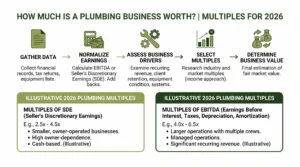
EBITDA (earnings before interest, taxes, depreciation, and amortization) is the most common measure buyers use to price a plumbing business. The multiple depends on business size, revenue mix, and how transferable the company is without the current owner. In 2026, plumbing companies generally trade in these ranges.
| Company Size (Annual Revenue) | Typical EBITDA Multiple | Notes |
|---|---|---|
| Under $500K | 2.0x – 3.0x | High owner dependency, limited recurring revenue |
| $500K – $1.5M | 3.0x – 4.5x | Moderate crew, some service contracts |
| $1.5M – $5M | 4.0x – 5.5x | Diversified services, management beginning to form |
| $5M+ | 5.0x – 7.0x | Strong brand, recurring contracts, PE buyer interest |
These ranges align with data from trade broker platforms and home services merger advisory firms.
The multiple applies to normalized EBITDA – not total revenue. Normalization means adding back the owner’s above-market salary, one-time expenses, and personal vehicle costs. A plumbing owner paying himself $350,000 when a replacement manager costs $120,000 has a $230,000 addback. At a 3x multiple, that adjustment alone adds nearly $700,000 to concluded value.
How Do You Value a Business with $500,000 in Sales?
A plumbing business with $500,000 in annual revenue sits in the small-company tier. Buyers focus on crew stability, customer relationships, and whether the business can run without the founder.
If EBITDA is 15% to 20% of revenue – typical for a one-to-two truck operation – the business earns $75,000 to $100,000 before addbacks. Adding back excess owner pay might push normalized EBITDA to $120,000 to $160,000. At a 3x multiple, value lands between $360,000 and $480,000.
Revenue multiples provide a cross-check. Small plumbing companies often trade at 0.4x to 0.6x annual sales. At this revenue level that yields $200,000 to $300,000. Buyers at this size are typically individual owner-operators who weigh customer longevity, technician retention, and online reputation.
How Do You Value a Business with $100,000 in Sales?
A plumbing operation with $100,000 in annual revenue is typically a sole proprietor or single-truck business. What a buyer purchases is usually a customer list, equipment, and a phone number. Goodwill at this size is almost entirely personal goodwill tied to the owner. It does not automatically transfer with the sale.
Normalized EBITDA at this level may be $20,000 to $40,000 after a market-rate owner salary. At a 2x multiple, that produces a going concern value of $40,000 to $80,000. Some buyers prefer to purchase the equipment and customer list outright rather than acquire the full entity.
A flat 0.4x revenue multiple on $100,000 yields $40,000. That figure aligns with the EBITDA floor and confirms the estimate is in the right range.
What Factors Drive Value Up or Down?
Several factors move a plumbing business above or below the median multiple. Understanding them before going to market helps you focus improvement efforts. Plan 12 to 24 months before a sale.
Factors that increase value include recurring maintenance contracts with predictable renewal rates and a trained management layer that handles scheduling and crew oversight without owner involvement. Documented systems such as ServiceTitan and employee manuals also increase value. They make the business trainable for any buyer.
Factors that reduce value include owner dependency, customer concentration above 20% with one client, aging equipment, inconsistent financial records, and deferred licensing renewals. Each is a risk signal that buyers address by reducing the multiple they offer.
Appraisers apply a discount rate that reflects specific risk. A small plumbing company with concentrated customer risk might carry a 30% to 35% capitalization rate. A diversified company with stable contracts might warrant 18% to 22%. That difference translates to hundreds of thousands of dollars for companies earning $300,000 or more. The Sofer Difference is a four-phase process – Discovery, Diligence, Analysis, and Delivery. It shows owners exactly what drives their number and how to move it higher before a sale.
Why Does Goodwill Matter in a Plumbing Valuation?
Goodwill is the value that exceeds a company’s net tangible assets. For a plumbing business, it includes customer relationships, brand reputation, trained staff, and established systems. It is often the largest component of value in any profitable operation.
Goodwill divides into two types. Enterprise goodwill belongs to the business and transfers with a sale. Personal goodwill belongs to the owner and does not automatically transfer. A plumbing owner who handles all key accounts and holds the license personally carries significant personal goodwill. Buyers discount it.
Sellers who shift goodwill from personal to enterprise consistently see higher offers. Hiring a licensed master plumber as operations manager and transitioning client relationships to the company builds enterprise value. A buyer can price that with confidence. Proper goodwill allocation also affects exit taxes. Personal goodwill sold by the shareholder in an asset deal may qualify for capital gains treatment rather than ordinary income rates.
David Hern CPA ABV ASA brings a Heart of a Teacher approach to every engagement. He translates goodwill mechanics and discount rate assumptions into plain language before the report is finalized.
Frequently Asked Questions
How do I value my plumbing business?
Start with your last three years of tax returns. Calculate normalized EBITDA by adding back excess owner pay, personal expenses, and one-time costs. Apply an EBITDA multiple of 3x to 5x based on company size and quality. Cross-check with a revenue multiple and an asset floor. A certified ASA or ABV appraiser confirms the number using recognized methodology and market transaction data.
How much is a business worth with $500,000 in sales?
A plumbing business with $500,000 in annual sales typically has a fair market value between $200,000 and $480,000. The range depends on profitability and owner dependency. If normalized EBITDA reaches $130,000 after addbacks, a 3x multiple produces $390,000. Revenue multiples of 0.4x to 0.6x suggest $200,000 to $300,000 as a secondary check. The income approach gives the more accurate result where cash flow drives buyer interest.
How much is a business worth with $100,000 in sales?
A plumbing business with $100,000 in annual revenue is typically valued at $40,000 to $80,000 as a going concern. Normalized EBITDA at this size is often $20,000 to $40,000 after a market-rate owner salary. If personal goodwill dominates, buyers may prefer to purchase the equipment and customer list separately. Acquiring the full entity is less common at this size.
What EBITDA multiple applies to plumbing businesses in 2026?
Most plumbing companies trade between 3x and 5x EBITDA in 2026. Smaller companies under $500,000 in revenue typically see 2x to 3x. Mid-size companies with $1.5 million to $5 million in revenue can reach 4x to 5.5x. Companies with recurring service contracts and strong management depth can exceed 6x.
Does owner salary affect the valuation number?
Yes, significantly. If the owner earns $300,000 but a replacement manager would cost $100,000, appraisers add back $200,000 to EBITDA. At a 4x multiple, that single adjustment adds $800,000 to the concluded value. A certified appraisal documents these addbacks before negotiations. That prevents buyers from recharacterizing them to justify a lower price.
What is seller’s discretionary earnings (SDE) and when is it used?
SDE is normalized EBITDA plus one full owner pay package – salary and benefits combined. It is the standard measure for small businesses where the owner works full-time in the operation. Buyers apply SDE multiples of 2x to 3.5x at this size. SDE is more common than EBITDA multiples for businesses under $2 million in annual revenue.
How much does a plumbing business valuation from Sofer Advisors cost?
A standard valuation engagement typically ranges from $7,500 to $25,000. The range depends on business size, complexity, and appraisal purpose. Most engagements complete within four to eight weeks. Rush engagements are available at a 25% to 50% premium. Schedule a free consultation to receive a scoped estimate based on your company’s size, financials, and specific valuation need.
What is the difference between a formal appraisal and a broker opinion of value?
A formal appraisal follows USPAP standards and is prepared by a credentialed ASA or ABV appraiser. It produces a defensible conclusion for IRS submissions, SBA loans, litigation, or buy-sell transactions. A broker opinion of value is an informal estimate used to price a listing – faster but carrying no regulatory weight. For any legal, tax, or financing purpose, a formal appraisal is required.
What standards apply to a plumbing business appraisal?
Qualified appraisers follow USPAP for methodology and professional ethics. The IRS requires tax-filing appraisals from a qualified appraiser holding ASA or ABV credentials. Those credentials are recognized by the IRS, SEC, and FINRA. For SBA loans, lenders require valuations meeting SBA Standard Operating Procedure 50 10 guidelines. The right appraiser knows which standard applies to your transaction and structures the report accordingly.
Related Case Studies
- How Do You Determine What A Business Is Worth Complete Guide
- Business Valuation For Mergers Buy Side Vs Sell Side
- Selling A Business In Georgia Complete Exit Planning Guide 2026
Executive Summary
Plumbing business valuation in 2026 centers on normalized EBITDA multiples of 3x to 5x for most operators, with top-tier companies exceeding 6x when recurring revenue, management depth, and transferable systems are present. Revenue multiples of 0.4x to 1.0x provide a secondary check. The income, market, and asset approaches work together to produce a defensible fair market value. Key value drivers are service contract revenue, owner independence, crew stability, and documented systems. Owner dependency and customer concentration are the primary value reducers.
What Should You Do Next?
Gather your last three years of tax returns and financials, list your active service contracts, and note how many hours per week the business needs you personally. Those three data points shape the starting point of any professional valuation. Then contact a certified appraiser before you talk to a broker, a buyer, or a bank – the order matters.
David Hern CPA ABV ASA, founder of Sofer Advisors holds dual ASA and ABV accreditations recognized by the IRS, SEC, and FINRA, with 15+ years of valuation experience. The firm has earned 180+ five-star Google reviews and Inc. 5000 recognition for accurate, defensible valuations. Schedule a consultation to find out what your plumbing business is worth in the current market.
People Also Read
- Why You Must Start Planning Your Business Exit Now With The Right Valuation Expert
- What To Expect During A Business Valuation Step By Step Process
About the Author
This guide was prepared by David Hern CPA ABV ASA, founder of Sofer Advisors – a business valuation firm headquartered in Atlanta, GA serving clients across the United States. David holds dual accreditations as an Accredited Senior Appraiser (ASA) and is Accredited in Business Valuation (ABV), credentials recognized by the IRS, SEC, and FINRA. He also holds the Certified Exit Planning Advisor (CEPA) designation. With 15+ years of valuation experience, David has served as an expert witness in 11+ cases across multiple jurisdictions and built Sofer Advisors into an Inc. 5000-recognized firm with 180+ five-star Google reviews. The firm’s full W2 employee team maintains subscriptions to all major valuation databases and operates under a next business day response policy.
For professional business valuation services, visit soferadvisors.com or schedule a consultation.
This content is for informational purposes only and does not constitute professional valuation advice. Business valuation conclusions depend on specific facts and circumstances. Contact Sofer Advisors for guidance regarding your specific situation.