


Last Updated: June 2026
A cybersecurity company valuation is based on either ARR or EBITDA multiples, and which metric applies depends on the revenue model and growth rate. High-NRR cybersecurity SaaS businesses with government or enterprise customers command 8x to 18x ARR. Profitable managed security service providers (MSSPs) trade at 8x to 14x EBITDA. Professional services security firms generally clear 5x to 9x EBITDA. The right multiple depends on how recurring and defensible the underlying revenue is.
The cybersecurity M&A market in 2026 remains very active. Strategic buyers have kept up bolt-on purchases. These include Palo Alto Networks, CrowdStrike, Microsoft, and Cisco. They want to expand platform coverage. Mid-market PE funds are building MSSP platforms through rollups. Private cybersecurity valuations sit well above the broader tech market. The reasons are mission-critical retention, regulatory tailwinds, and persistent threat growth. Sofer Advisors helps owners and their advisors work through exactly these questions and turn the analysis into a defensible business valuation they can act on.
The following takeaways summarize the key valuation and transaction factors covered in this guide.
Key Takeaways
- Cybersecurity SaaS Companies ARR – Cybersecurity SaaS companies with ARR above $5M and NRR above 115% typically trade at 10x–18x ARR. ARR multiples compress significantly below those thresholds.
- Business Model Pure Software – The business model – pure software, MSSP, or professional services – is the most important driver of valuation method. Don’t apply software multiples to a services business.
- Net Revenue Retention 120 – Net Revenue Retention above 120% is a premium signal. It shows that customers expand, not just renew.
- FedRAMP Authorization Cleared Personnel – FedRAMP authorization and cleared personnel can add 2x–4x turns to an EBITDA multiple. This applies to companies with significant federal exposure.
- Customer Focus 20 Single – Customer focus above 20% in any single account is a deal risk. Buyers will use escrow or earnouts.
- Private Cybersecurity Multiples Trade – Private cybersecurity multiples trade at a 30%–50% discount to public comps. This reflects illiquidity and lack of scale.
- Buyers Look Strong Recurring – Buyers look for strong recurring revenue. Predictable cash flow drives higher multiples.
Each of these factors is examined in depth in the sections that follow.
How Are Cybersecurity Companies Valued?
The answer depends almost entirely on the revenue model. Three distinct business types operate under the “cybersecurity company” label. They are valued on fundamentally different bases.
Pure software / SaaS products cover endpoint protection, SIEM, identity, and cloud security. They are valued on ARR multiples when growing. The Rule of 40 is a standard screen. It adds revenue growth rate plus EBITDA margin. Companies above 40 command premium multiples. Companies below 40 are discounted. In 2026, high-growth cyber SaaS with NRR above 115% is achieving 12x–18x forward ARR. These companies must show ARR growth above 30%. Growth below that compresses the multiple.
MSSPs generate recurring managed services revenue. These include managed security, SOC-as-a-service, MDR, and XDR managed services. They typically run under multi-year contracts. MSSPs are valued on EBITDA multiples of 8x–14x. EBITDA margin for MSSPs often runs 15%–25%. Below 15% compresses multiples significantly.
Professional services firms cover pen testing, incident response, compliance consulting, and vCISO work. They are valued on EBITDA multiples of 5x–9x. Revenue is project-based and non-recurring. This limits multiple expansion regardless of growth rate.
The table below shows 2026 valuation benchmarks by cybersecurity company type:
| Business Type | Primary Metric | Multiple Range | Key Driver |
|---|---|---|---|
| SaaS security product (high growth, NRR >115%) | ARR | 12x–18x | Growth rate + NRR |
| SaaS security product (moderate growth) | ARR | 7x–12x | Rule of 40 |
| MSSP / MDR (recurring managed services) | EBITDA | 8x–14x | Contract length + margin |
| MSSP with federal/government contract base | EBITDA | 10x–16x | FedRAMP + cleared staff |
| Professional services (pen test, IR, consulting) | EBITDA | 5x–9x | Use rate + retention |
| Hybrid (product + services) | Blended ARR + EBITDA | 8x–14x | Revenue mix |
The critical error in private cybersecurity valuations is applying SaaS multiples to a services business. A company with $10M in “ARR” that is 40% professional services is not the same as a pure SaaS product. Buyers will not price it that way.
A market multiple is a starting point, not a conclusion of value. A defensible fair market value still rests on the factors the IRS sets out for valuing closely held businesses under Revenue Ruling 59-60.
How Does Net Revenue Retention (NRR) Drive Cybersecurity Valuations?
NRR measures how much revenue a company retains and grows from existing customers over 12 months. It accounts for churn, downsells, and expansions. It is the single most powerful metric in cybersecurity SaaS valuations. It reveals growth without new customer acquisition.
NRR above 130% means existing customers are growing their spend by 30% annually. A business can grow total ARR with zero new customers. NRR between 110% and 130% is strong. It is typical for best-in-class cybersecurity platforms. NRR below 100% means the company is losing revenue from existing customers. That signals product weakness. It will compress multiples severely.
For context: CrowdStrike has reported NRR above 120%. Zscaler and SentinelOne have shown similar retention. These public benchmarks inform what PE and strategic buyers expect from private companies at scale.
Private cybersecurity companies with NRR below 100% should not pursue a growth-multiple thesis. They should focus on EBITDA. They should also present a path to NRR recovery before going to market.
Gross Revenue Retention (GRR) is also scrutinized. GRR excludes expansions. GRR above 90% is strong given the competitive intensity in cybersecurity. GRR below 85% signals product-market fit issues or a very competitive segment.
What Is the 80/20 Rule in Cybersecurity and Why Do Buyers Care?
The 80/20 principle in cybersecurity states that about 80% of breaches exploit a small set of known vulnerability types. These include unpatched systems, weak credentials, and misconfigured cloud environments. Phishing is also on the list. Companies that address the highest-frequency attack vectors have larger markets and more durable demand.
From a valuation standpoint, buyers apply this framework when reviewing a cyber firm’s positioning. A company selling endpoint detection, identity security, or cloud security is addressing what enterprises must buy. Its market is large. Regulated mandates drive adoption. A company selling a narrow specialty may face a smaller market and higher substitution risk.
Buyers also apply this logic to customer spend. In most cyber programs, most enterprise security budgets flow to a small number of platform vendors. These include Microsoft Defender, CrowdStrike Falcon, and Palo Alto Cortex. Independent security companies that work with these dominant platforms are viewed as more likely to be acquired. They are easier to buy than standalone products that require customers to replace existing tools.
For MSSP and services businesses, the 80/20 dynamic shows up in customer profitability. Typically 20% of customers generate 80% of margin. Buyers will map customer-level profitability. They flag cross-subsidization quickly. Low-margin accounts hurt the story.
David Hern CPA ABV ASA, founder of Sofer Advisors, brings a Heart of a Teacher to every engagement – translating complex valuation methodology into clear, actionable guidance that clients can act on before and after the report is delivered. With 15+ years of valuation experience, 11+ expert witness cases across multiple jurisdictions, and 180+ five-star Google reviews, David built Sofer Advisors into an Inc. 5000-recognized firm. The Sofer Difference is a four-phase process of Discovery, Diligence, Analysis, and Delivery that ensures every conclusion is defensible, documented, and tied to the specific facts of the business.
While national firms like Stout and Kroll serve large enterprise clients, Sofer Advisors specializes in middle-market businesses that require personalized attention, direct access to credentialed professionals, and a next business day response policy.
What Makes a Cybersecurity Company Command a Premium Multiple?
Several factors reliably separate premium-multiple cybersecurity companies from average ones in 2026:
Government contracts and FedRAMP authorization. Federal agencies and DoD contractors require FedRAMP-authorized solutions. The process takes 12–24 months. It costs $500K–$2M+. A company with FedRAMP authorization has a durable competitive moat. Strategic buyers and PE funds with federal platforms pay a 2x–4x EBITDA multiple premium. This applies to companies with established government contract vehicles. The moat is hard to replicate. Competitors cannot shortcut the process.
SOC 2 Type II certification is table stakes for enterprise sales in 2026. A company without it will face buyer price adjustments and post-close conditions.
Platform integration depth. Companies deeply integrated into Microsoft, CrowdStrike, or Palo Alto ecosystems benefit from customer stickiness. Being a certified Marketplace partner on AWS, Azure, or GCP signals go-to-market advantage. Buyers value this. It lowers customer acquisition cost sharply.
Cleared personnel and facilities. Companies with personnel holding DoD clearances are highly valued by defense-focused buyers. Certified SCIFs are also valued. This asset cannot be built quickly.
Recurring revenue focus. Companies with 70%+ of total revenue from contractually committed recurring sources command higher multiples. ARR and MRR are valued over professional services at the same revenue level.
How Do Public Comps Translate to Private Cybersecurity Valuations?
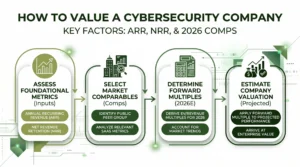
Public cybersecurity companies trade at ARR and revenue multiples. These reflect the liquidity premium of public markets. They also reflect the scale of large platforms. Diversification matters too. Key public comps include CrowdStrike, Palo Alto Networks, SentinelOne, Fortinet, and Zscaler.
In mid-2026, high-growth public cyber firms are trading at about 12x–20x forward revenue. Profitable, moderately-growing platforms are trading at 7x–12x forward revenue. These multiples are inputs to private company valuations. They are not direct benchmarks.
Private company discount: analysts often apply a 30%–50% discount to public comps. This reflects illiquidity, smaller scale, and focus risk. A public company at 15x ARR suggests a comparable private company might transact at 8x–12x ARR. This assumes a competitive process. A single buyer narrows that range.
The discount narrows when the company has a clean audit and institutional-quality financials. Multiple strategic bidders also narrow the discount. Proprietary technology with no close substitute helps too. The discount widens when the company is smaller. Heavy services dependence adds to the gap. A bilateral negotiation without competitive tension also widens it.
The questions below address the most common issues business owners raise before engaging a qualified appraiser for a cybersecurity company valuation engagement.
Frequently Asked Questions
How are cybersecurity companies valued differently from other software companies?
The mission-critical nature of cybersecurity creates structurally higher NRR than horizontal SaaS. Customers cannot easily churn. Leaving their organization exposed is not acceptable. This higher customer retention justifies a premium multiple.
What is a reasonable ARR multiple for a private cybersecurity SaaS company in 2026?
For a private company with $5M–$20M ARR and 25%+ growth, expect 8x–14x ARR. NRR above 110% is also needed. Companies with FedRAMP or unique technology can exceed this range. Below $5M ARR, multiples compress due to scale risk.
Does EBITDA matter for cybersecurity company valuations?
It depends on the stage. For early-growth companies, buyers focus on ARR and growth. For companies above $20M ARR or established MSSPs, EBITDA margin becomes very important. Buyers want a path to profit at scale.
What revenue mix maximizes a cybersecurity company’s valuation?
70%+ recurring subscription or managed services revenue is the best mix. Professional services should be under 30% of total revenue. Professional services revenue is valued at 1x–2x revenue at best. SaaS ARR is valued at 8x–18x.
How does customer focus affect a cybersecurity company’s sale price?
A single customer above 20% of revenue is a deal risk. Buyers will either adjust the multiple down or structure part of the price as an earnout. Government customer focus is treated more favorably. Government contracts offer more predictability than commercial ones.
What cybersecurity certifications add the most value in a deal?
FedRAMP (High > Moderate > Low), SOC 2 Type II, ISO 27001, and DoD CMMC Level 2/3. FedRAMP High is the most valuable. It enables sales to the most sensitive federal use cases. It also creates the highest switching cost for customers.
How long does a cybersecurity M&A process typically take?
A typical process from initial buyer talks to signed purchase agreement runs 6–12 months for a well-prepared seller. FedRAMP-authorized companies with government contracts often take longer. CFIUS screening and contract novation add time.
What are the most common deal structures for cybersecurity company purchases?
Smaller companies under $20M ARR are often acquired through asset or stock purchases. Earnouts are tied to ARR retention and growth. Larger deals typically use stock purchases with rep and warranty insurance. Strategic buyers often require employment agreements with key engineering and sales personnel.
Related Case Studies
- Technology Company Valuation Atlanta Guide For Startups And Growth Companies
- SaaS Valuation Complete Guide To Software Company Value
- Technology Company Valuation Methods A Complete Guide
Executive Summary
- Cybersecurity companies are valued on ARR multiples (product/SaaS) or EBITDA multiples (MSSP, services). Applying the wrong metric dramatically misrepresents value.
- NRR above 115% is the most powerful premium driver for SaaS cybersecurity businesses. It signals organic expansion within the existing customer base.
- FedRAMP authorization, cleared personnel, and government contract vehicles add material multiple premiums in the current acquisition market.
What Should You Do Next?
If you own a cybersecurity business and are considering a sale, recap, or need a valuation for litigation or partnership purposes, getting the method right from the start determines the outcome. David Hern CPA ABV ASA, founder of Sofer Advisors, holds dual ASA and ABV credentials recognized by the IRS, SEC, and FINRA, with 15+ years of valuation experience and 180+ five-star Google reviews. Schedule a consultation to discuss your business valuation needs.
People Also Read
- Technology Company Valuation Methods A Complete Guide
- Technology Company Valuation Atlanta Guide For Startups And Growth Companies
About the Author
This guide was prepared by David Hern CPA ABV ASA, founder of Sofer Advisors – a business valuation firm headquartered in Atlanta, GA serving clients across the United States. David holds dual accreditations as an Accredited Senior Appraiser (ASA) and is Accredited in Business Valuation (ABV), credentials recognized by the IRS, SEC, and FINRA. He also holds the Certified Exit Planning Advisor (CEPA) designation. With 15+ years of valuation experience, David has served as an expert witness in 11+ cases across multiple jurisdictions and built Sofer Advisors into an Inc. 5000-recognized firm with 180+ five-star Google reviews. The firm’s full W2 employee team maintains subscriptions to all major valuation databases and operates under a next business day response policy.
For professional business valuation services, visit soferadvisors.com/about-us/ or schedule a consultation at soferadvisors.com/contact-us/.
This content is for informational purposes only and does not constitute professional valuation advice. Business valuation conclusions depend on specific facts and circumstances. Contact Sofer Advisors for guidance regarding your specific situation.









