


Last Updated: September 2026
An indefinite-lived intangible impairment test is the review ASC 350-30 requires to check whether a trade name, brand, or license has lost value. The test asks one question. Does the asset’s carrying amount sit above its fair value? If it does, the company writes the asset down by that gap. You must run this test at least once a year. You also run it any time events suggest the asset is more likely than not impaired.
This standard covers intangible assets other than goodwill. Think of a heritage trade name, an FCC broadcast license, or a taxi medallion. These assets have no set end date, so companies do not amortize them. Instead, they test the recorded value against current market reality. Getting the test right keeps financial statements accurate and keeps auditors comfortable.
Sofer Advisors prepares independent fair value opinions that support these ASC 350-30 tests. With 180+ five-star Google reviews and a full W2 team of 14, we help controllers and CFOs document each conclusion. David Hern CPA ABV ASA holds dual ABV and ASA credentials recognized by the IRS, SEC, and FINRA.
Key Takeaways
- Scope: ASC 350-30 covers indefinite-lived intangibles other than goodwill, such as trade names, brands, and certain licenses.
- Timing: Test at least annually, and sooner when events make impairment more likely than not.
- Step 0 option: An optional qualitative check can skip the full quantitative test when a loss looks unlikely.
- One-step math: The quantitative test compares carrying amount to fair value, and the shortfall is the impairment loss.
- Life review: Each year, confirm the life is still indefinite; if not, reclassify the asset to finite-lived and amortize it.
These rules shape how you plan, test, and document each intangible on your balance sheet. The sections below walk through the triggers, the Step 0 option, the fair value math, and how the process differs from goodwill. Each answer starts with the short version. Then it adds the detail your auditor will expect to see in the file.
What triggers impairment testing under ASC 350-30?
ASC 350-30 sets two triggers. First, you test every indefinite-lived intangible at least once a year. Second, you test again whenever events make it more likely than not that the asset is impaired. A trigger does not prove a loss. It only forces a closer look. If the review shows the carrying amount may exceed fair value, you move to a quantitative test and measure the gap.
Common triggers are easy to spot once you know them. They include the loss of a major customer tied to the brand, new competition, or a regulator action against a license. A sharp drop in revenue can also count. So can rising discount rates or a weaker outlook for the product line. We help leadership teams flag these signals during their regular review. We also document why a test was or was not needed.
What is the qualitative assessment (Step 0)?
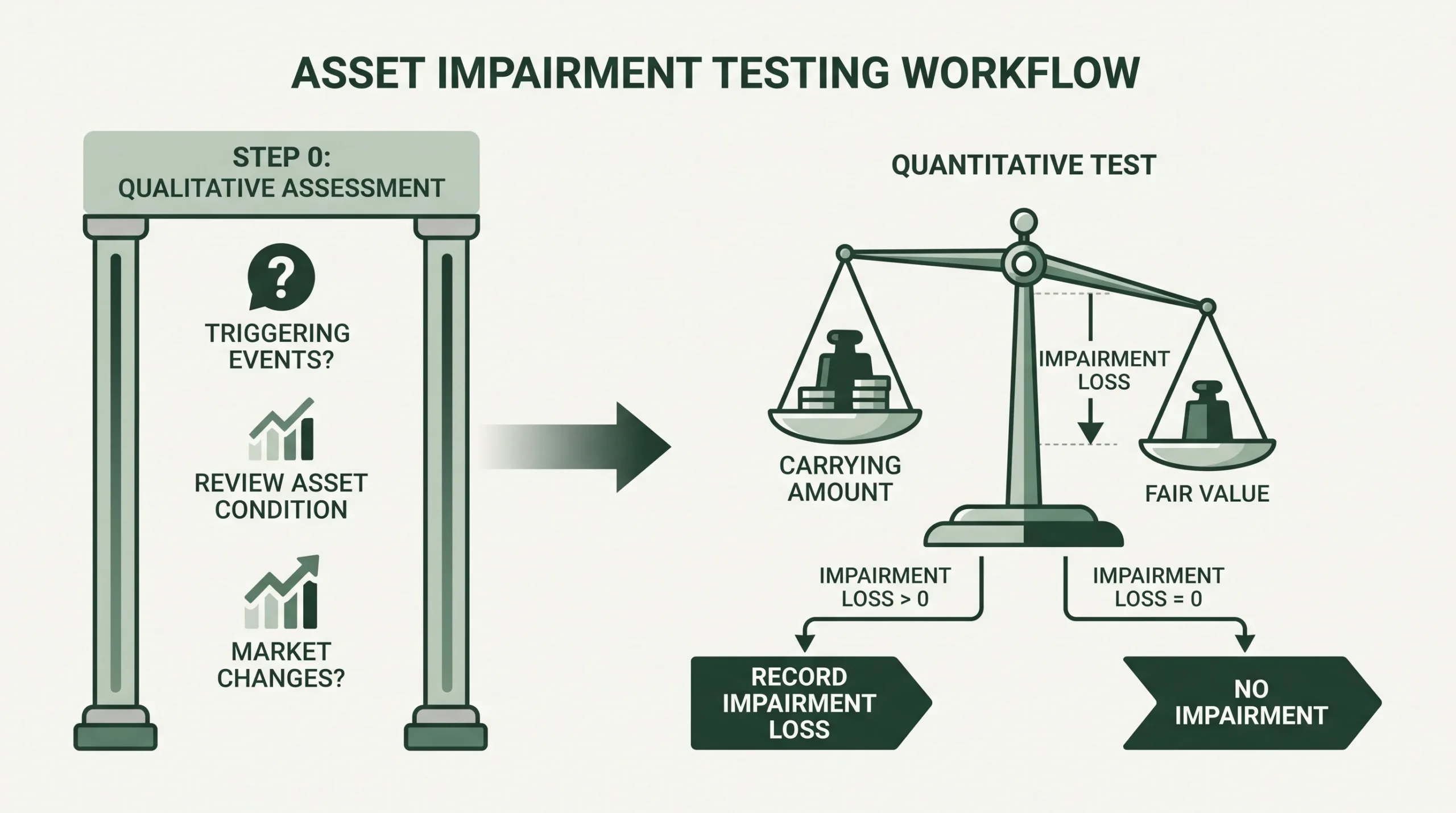
Step 0 is an optional qualitative check. Before you run the full math, you weigh whether it is more likely than not that fair value sits below carrying amount. If the answer is no, you can skip the quantitative test for that year. If the answer is yes, or if you are unsure, you move to the quantitative test. You may also skip Step 0 and go straight to the math.
The check looks at real factors. These include the wider economy, industry trends, cost changes, and the asset’s own results. A stable brand with steady royalties may clear Step 0 with ease. A license facing new rules may not. The goal is simple. Use objective evidence to decide whether a full valuation is worth the cost this period. A weak Step 0, though, invites hard audit questions later.
How is the quantitative impairment test performed?
The quantitative test is one step. You compare the asset’s fair value to its carrying amount on the balance sheet. If fair value is higher, there is no impairment. If the carrying amount is higher, you record an impairment loss equal to the difference. There is no undiscounted cash flow screen here. That screen belongs to long-lived assets under ASC 360, not to indefinite-lived intangibles.
Analysts often measure fair value with the income approach. For a trade name, a common method is relief from royalty. It estimates the royalty a company would pay to license the name from an outside owner. Those saved royalties, discounted to today, point to fair value. Sofer Advisors uses the income approach alongside market data so the conclusion holds up under audit review. The ASC 820 fair value hierarchy guides which inputs carry the most weight.
How does this differ from goodwill impairment?
The main difference is the unit you test. Under ASC 350-30, you test each indefinite-lived intangible on its own. Under ASC 350-20, you test goodwill at the reporting unit level, not asset by asset. Both may use a qualitative screen. Both compare carrying amount to fair value in the quantitative step. But the level of measurement, and the way a loss is allocated, set them apart.
A reporting unit is an operating segment or one level below it. Goodwill lives at that broader level because it has no separate legal life. Our goodwill impairment testing guide covers that process in depth. Long-lived assets follow a third path under ASC 360. That path uses a two-step model with an undiscounted cash flow screen first. Mixing these three tests is a common error, and auditors catch it fast.
When should you reassess the indefinite useful life?
You reassess the life every reporting period. ASC 350-30 asks whether events still support an indefinite life. If a limit now exists, legal, regulatory, contractual, or competitive, the asset is no longer indefinite-lived. You then reclassify it to finite-lived. From that point, you amortize the asset over its remaining useful life. You also test it for impairment as a finite-lived asset before you start to amortize.
Picture a brand once expected to last forever that now faces a hard product sunset. Or a license that renewed freely but now has a firm end date. Those changes cut the life short. The reclassification is not optional. It follows the facts on the ground. We flag these shifts during each annual review, so the balance sheet reflects the current legal and market picture rather than an old assumption.
What happens when an impairment loss is recognized?
When you recognize a loss, you record a non-cash charge on the income statement. You then cut the asset’s carrying amount to its fair value. Under US GAAP, this loss is permanent. You cannot reverse it later, even if the asset recovers. That one-way rule raises the stakes on the first measurement. A weak fair value study can lock in the wrong number for good.
Because the charge sticks, the fair value work has to be sound. Sofer Advisors performs Financial Reporting Valuation that ties each conclusion to observable data and clear assumptions. A well-documented file helps the number survive audit review and any later question from the SEC. Auditors lean on standards like PCAOB AS 2501 when they test fair value estimates. Precise inputs today protect the reported figure tomorrow.
How do you choose a valuation provider?
Choose a provider by fit, independence, and how well they explain the work. National firms like Alvarez & Marsal, Stout, and Kroll serve the largest public companies. Middle-market firms give senior-level attention on every file. The right choice depends on your size, your auditor, and your timeline. An independent, well-supported opinion is what carries weight in the audit room. The valuation should also meet recognized standards, such as USPAP.
| Feature | Sofer Advisors | National firms (Alvarez & Marsal, Stout, Kroll) |
| Primary client | Middle-market private and public companies | Large-cap and multinational enterprises |
| Engagement style | Partner-led, Heart of a Teacher approach | Layered teams and standard frameworks |
| Typical timeline | Two to six weeks | Six to twelve weeks or more |
The Sofer Difference runs on four steps: Discovery, Diligence, Analysis, and Delivery. In Discovery we learn your asset and your audit needs. In Diligence we gather the data and the market inputs. In Analysis we build the fair value model. In Delivery we hand you a clear report you can defend. A partner stays close the whole way, so you get senior judgment, not a quick handoff to junior staff. Sofer Advisors keeps that standard on every engagement.
Frequently Asked Questions
What are examples of indefinite-lived intangible assets?
Examples include trade names, brand names, certain broadcast or FCC licenses, taxi medallions, and some perpetual franchise rights. These assets share one trait. No legal, regulatory, contractual, or competitive factor limits their useful life. Patents and non-compete agreements do not qualify, since they carry a clear end date. The label depends on the expected life of the economic benefit, not on the type of asset alone.
Is goodwill impairment a good thing?
Goodwill impairment is rarely seen as good news. It marks a permanent drop in the recorded value of an acquired business. The charge often signals that the purchase price ran ahead of results, or that the unit hit trouble. It is a non-cash charge, so it does not drain cash. Still, it can dent reported earnings and raise questions from lenders, boards, and regulators about the original deal.
What is ASC 350-30?
ASC 350-30 is the US GAAP standard for the later measurement and impairment testing of intangible assets. It focuses on assets other than goodwill, including those with indefinite lives. The standard requires a test at least once a year, and sooner if events point to a loss. It also asks whether the indefinite life still holds. Goodwill follows a separate subtopic, ASC 350-20, at the reporting unit level.
Do you amortize intangible assets with indefinite life?
No. You do not amortize an intangible asset while its life stays indefinite. The standard assumes the benefit has no foreseeable end, so amortization would not reflect reality. Instead, you test the carrying amount for impairment at least once a year. You also recheck the life each period. If a limit appears, the asset becomes finite-lived, and amortization then begins over the remaining useful life.
How often must indefinite-lived intangibles be tested for impairment?
They must be tested at least once a year. A company may pick any consistent annual date for the test. On top of the annual test, a company must test again whenever events make impairment more likely than not. Triggers include lost customers, new competition, legal challenges, or a weak outlook. The annual test sets a floor, and event-driven testing fills the gaps between those dates.
What is the difference between fair value and carrying amount?
Carrying amount is the value at which an asset sits on the balance sheet, after any prior impairment. Fair value is the price a market participant would pay in an orderly sale at the measurement date. The impairment test compares the two. If the carrying amount is higher, the difference becomes the loss. Fair value reflects current conditions, while carrying amount reflects past cost and past adjustments.
Can an impairment loss on an indefinite-lived intangible be reversed?
No. Under US GAAP, an impairment loss on an indefinite-lived intangible cannot be reversed once recognized. Even if the asset regains value in a later year, the lower carrying amount stays fixed. This one-way rule keeps reporting conservative and consistent. It also raises the bar on the first measurement, since a rushed or weak fair value study can lock in a figure that will not be corrected.
How does ASC 350-30 differ from ASC 360?
ASC 350-30 governs indefinite-lived intangibles with a single-step test that compares carrying amount to fair value. ASC 360 governs long-lived assets, such as equipment and finite-lived intangibles. ASC 360 uses a two-step model. It first screens with undiscounted cash flows, then measures any loss against fair value. The screen is the key difference. Indefinite-lived intangibles skip that screen and go straight to the fair value comparison.
How much does indefinite-lived intangible impairment testing from Sofer Advisors cost?
An impairment testing engagement under ASC 350 and ASC 360 typically ranges from $7,500 to $25,000, over about two to six weeks. The final fee depends on the number of assets, the quality of available market data, and the timeline. A single trade name costs less than a portfolio of licenses. For a quote tied to your assets, contact Sofer Advisors with your asset list and audit dates.
Related Case Studies
- Purchase Price Allocation ASC 805 and IFRS 3: Complete Guide for Business Leaders
- Intangible Asset Valuation: Methods for Measuring Hidden Value
- How to Value Intellectual Property: Patents and Trademarks
Executive Summary
ASC 350-30 governs indefinite-lived intangibles other than goodwill, such as trade names, brands, and certain licenses. Companies test each asset at least once a year, and again when events make impairment more likely than not. An optional Step 0 qualitative check can skip the full test when a loss looks unlikely. The quantitative test is one step: compare carrying amount to fair value, and book any shortfall as a permanent loss. Firms also recheck the useful life each period and reclassify to finite-lived when a limit appears. A typical engagement runs $7,500 to $25,000 over two to six weeks.
What Should You Do Next?
First, list every indefinite-lived intangible on your balance sheet, and confirm each life is still indefinite. Second, if a triggering event hit this year, run a Step 0 review to decide whether a full quantitative test is needed. Third, keep a clear file of the factors you weighed, since auditors will ask to see it before they sign off.
David Hern CPA ABV ASA, founder of Sofer Advisors, leads independent fair value work for financial reporting. Schedule a consultation to discuss your situation.
People Also Read
- Goodwill Impairment Testing ASC 350: Complete Guide for 2025-2026
- What is Impairment Testing? Asset Value Assessment Guide
About the Author
This guide was prepared by David Hern CPA ABV ASA, founder of Sofer Advisors, a business valuation firm headquartered in Atlanta, GA serving clients across the United States. David holds dual accreditations as an Accredited Senior Appraiser (ASA) and is Accredited in Business Valuation (ABV), credentials recognized by the IRS, SEC, and FINRA. He also holds the Certified Exit Planning Advisor (CEPA) designation. With 15+ years of valuation experience, David has served as an expert witness in 11+ cases across multiple jurisdictions and built Sofer Advisors into an Inc. 5000-recognized firm with 180+ five-star Google reviews. Its full W2 employee team maintains subscriptions to all major valuation databases and operates under a next business day response policy.
For professional business valuation services, visit soferadvisors.com/about-us/ or contact Sofer Advisors at soferadvisors.com/contact-us/.
Disclaimer: This content is for informational purposes only and does not constitute professional valuation advice. Business valuation conclusions depend on specific facts and circumstances. Contact Sofer Advisors for guidance regarding your specific situation.









