


Last Updated: October 2026
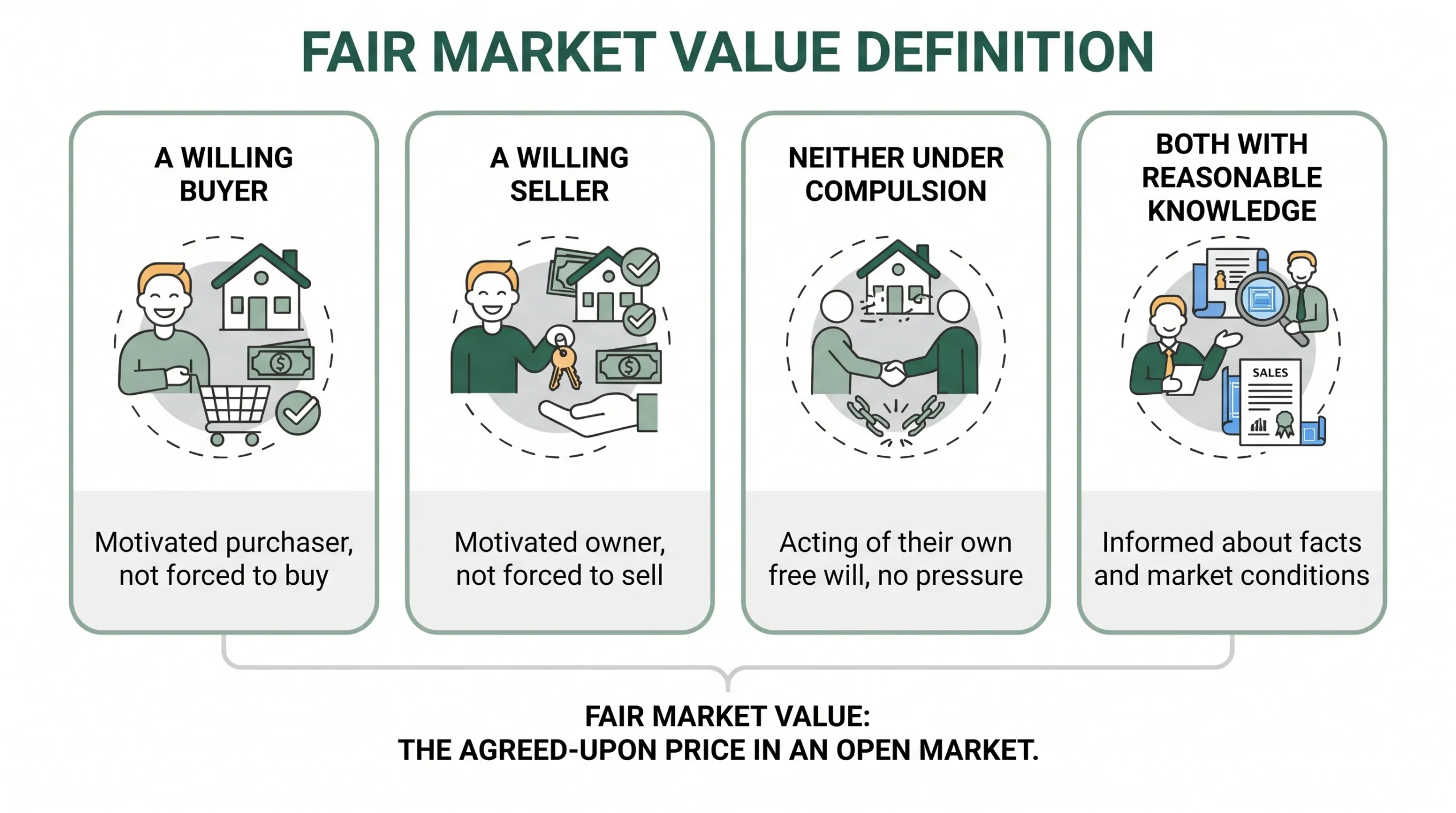
Fair market value, or FMV, is a legal definition, not a synonym for price. The Treasury sets the exact meaning. FMV is the price at which property would change hands between a willing buyer and a willing seller, with neither under any compulsion to act and both holding reasonable knowledge of the relevant facts. Those four conditions are the whole test. Miss one and the number is not fair market value.
The team at Sofer Advisors applies this standard every day for business owners, CPAs, and estate attorneys, backed by Inc. 5000 recognition in both 2024 and 2025 and 180+ five-star Google reviews. FMV is also not the same as fair value or investment value. People treat those terms as interchangeable. They are not, and the gap can change a tax bill.
This guide defines FMV, lists the four conditions, and shows how experts measure it. It also separates FMV from fair value and from investment value, and explains where the standard applies on a tax return and in financial reporting.
Key Takeaways
- FMV is a four-part test: willing buyer, willing seller, no compulsion on either side, and reasonable knowledge of the facts by both.
- The parties are hypothetical: FMV assumes a typical buyer and seller, not the actual people in a specific deal, so a motivated price is not FMV.
- It is the federal tax standard: FMV governs estate, gift, and income tax matters, and it is defined in Treasury regulations and Revenue Ruling 59-60.
- FMV is not fair value or price: statutory fair value in shareholder disputes and investment value to one buyer follow different rules.
- Experts weigh three approaches: the income, market, and asset approaches give the evidence behind a defensible FMV conclusion.
Each point ties into a wider tax or reporting need. The sections below take them one at a time.
Why Is FMV Important to Understand?
FMV decides how much tax is due and whether a filing survives review. The IRS uses one standard for estate, gift, and income tax. If a reported value does not meet that standard, an examiner can adjust it, add tax, and apply penalties. The four conditions are the test an examiner applies. A value built on a willing buyer and willing seller, with no compulsion and full knowledge, holds up. A value built on a rushed sale or a single eager buyer does not. Getting the definition right is the first line of defense.
What Is Fair Market Value?
Fair market value is the price a willing buyer would pay a willing seller for property, when neither is forced to act and both know the relevant facts. The federal definition appears in two places that read almost word for word. The estate tax rule sits in Treasury Regulation 20.2031-1(b). The gift tax rule sits in Treasury Regulation 25.2512-1. Both describe the same willing buyer and willing seller standard.
Each of the four conditions matters. The buyer and seller are willing, so neither is pushed into the deal. Neither acts under compulsion, so a forced sale or a fire sale price does not count. Both have reasonable knowledge of the relevant facts, so a value cannot rest on one side knowing something the other does not. And the buyer and seller are hypothetical. FMV asks what a typical buyer would pay a typical seller, not what one specific person paid in one specific deal. That is why a real transaction price is evidence of FMV, but not proof of it.
How Do You Calculate or Determine FMV?
You determine FMV by applying three valuation approaches and weighing the results. The income approach looks at the future cash flows the property can produce. The market approach compares prices paid for similar assets. The asset approach totals the worth of what the company owns, net of what it owes. Each approach is a separate line of evidence. An appraiser weights them based on the asset and the purpose of the work.
For a closely held business, the analysis also follows IRS guidance on determining value and the factors in Revenue Ruling 59-60. That ruling lists the items an appraiser must weigh, such as the nature of the business, its earning capacity, its book value, and the outlook for its industry. A profitable, steady company often leans on the income approach. A company in an active trading market may lean on the market approach. The goal is one defensible number, with the reasoning written down so it reads clearly to an examiner.
How Does FMV Differ From Fair Value and Investment Value?
FMV, fair value, and investment value answer three different questions, so they rarely produce the same number. FMV is the hypothetical, market-based tax standard. Statutory fair value is a legal construct used in shareholder disputes and some divorce cases. It is defined by state law, and many states bar the discounts for lack of control and lack of marketability that FMV allows. So a minority owner can receive a higher figure under fair value than under FMV for the same shares.
Investment value is different again. It is the worth of an asset to one particular buyer, given that buyer’s own plans, financing, and expected cost savings. A strategic acquirer may pay above FMV because the asset is worth more inside its business. That extra is investment value, not fair market value. Price, meanwhile, is simply what changed hands in one deal. It can sit above or below FMV depending on who was at the table. Naming the right standard for the task is half the work.
Where Does FMV Apply in Tax and Financial Reporting?
FMV is the measuring stick across federal tax filings. An estate reports assets at FMV on Form 706. A taxable gift is measured at FMV on Form 709. Charitable deductions, inherited basis, and sales between related parties all turn on the same standard. In each case the willing buyer and willing seller test decides the number, and a documented appraisal is what supports it if the return is examined. You can see how Sofer Advisors handles valuations for tax and estate reporting built to this standard.
Financial reporting uses a related but separate idea. Under ASC 820, the accounting standard measures fair value as an exit price in an orderly transaction between market participants at the measurement date. That sounds close to FMV, but the frameworks differ on discounts and on the assumed market. A number built for a tax return will not automatically satisfy an auditor, and the reverse is true as well. Matching the standard to the purpose keeps the work usable for the intended reader.
Who Determines FMV, and How Do the Options Compare?
Owners choose a valuation partner based on the size of the asset, the audit exposure, and the purpose of the report. Large national firms such as Alvarez & Marsal, Stout, and Kroll serve big public companies with broad advisory teams. Sofer Advisors focuses on defensible, partner-led valuations for closely held and middle-market businesses, with expert witness testimony in 11+ cases behind its reports. The table below sets out the common options.
| Provider | Typical role | Best for |
|---|---|---|
| Specialized valuation firm (e.g. Sofer Advisors) | Measures FMV and documents the reasoning for a tax or reporting filing | Closely held and family transfers needing audit-ready support |
| Large national firm | Broad advisory plus valuation at enterprise scale | Large public companies with complex, multi-entity needs |
| Software estimate tool | Produces a fast, low-cost figure with no signed opinion | Early internal planning where no filing or defense is needed |
Sofer Advisors runs each engagement through a four-phase process it calls The Sofer Difference, moving from Discovery to Diligence to Analysis to Delivery. That structure ties every FMV conclusion to the facts and the three approaches behind it. It reflects the Heart of a Teacher approach, which means explaining the reasoning behind a number rather than just handing over a figure. For a value that stands up to review, an independent appraisal supplies both the number and the record behind it.
Frequently Asked Questions
What is FMV on a tax return?
On a tax return, FMV is the price property would fetch between a willing buyer and a willing seller, with neither forced to act and both aware of the facts. The IRS requires this standard for estate, gift, and income tax, so the figure reflects real market worth rather than a motivated price. Sofer Advisors documents each FMV conclusion with the evidence an examiner expects, which keeps the reported value defensible if the return is later reviewed.
How do you calculate fair market value?
You calculate fair market value by applying three approaches and weighing them. The income approach values future cash flows. The market approach compares prices for similar assets. The asset approach nets what a company owns against what it owes. An appraiser weights the three based on the asset and the purpose. Sofer Advisors builds each conclusion from all three lines of evidence, then writes down the reasoning so the number reads clearly to an auditor or a tax examiner.
How does the IRS determine FMV?
The IRS determines FMV by testing the facts of each case against the willing buyer and willing seller standard, leaning on the factors in Revenue Ruling 59-60. Those factors include the nature of the business, its earnings, its book value, and the outlook for its industry. The agency weighs appraisal evidence rather than setting a fixed formula. Sofer Advisors builds reports around these same factors, giving the IRS the documented support it looks for when it reviews a stated value.
What are the four conditions of fair market value?
The four conditions are a willing buyer, a willing seller, no compulsion on either side, and reasonable knowledge of the relevant facts by both parties. All four must hold, and the parties are hypothetical rather than the actual people in one deal. If any condition fails, the number is not fair market value. Sofer Advisors tests every valuation against these four conditions, so the conclusion matches the exact standard the Treasury regulations and the IRS require.
What is the difference between fair market value and fair value?
Fair market value is the hypothetical, market-based standard used for federal tax. Statutory fair value is a legal construct set by state law for shareholder disputes and some divorces, and many states bar the control and marketability discounts that FMV permits. So the same shares can carry a higher figure under fair value. Sofer Advisors identifies the governing standard first, then values to it, so the report fits the court or the tax authority that will read it.
How does fair market value differ from investment value?
Fair market value asks what a typical buyer would pay a typical seller. Investment value asks what an asset is worth to one specific buyer, given that buyer’s own plans, financing, and expected savings. A strategic acquirer may pay above FMV because the asset fits its business, and that extra is investment value. Sofer Advisors keeps the two separate, measuring FMV for tax and reporting while noting investment value where a particular buyer changes the picture.
What is Revenue Ruling 59-60?
Revenue Ruling 59-60 is the IRS guidance that sets out how to value closely held stock for estate and gift tax. It lists the factors an appraiser must weigh, including the nature of the business, its earnings, its dividend capacity, its book value, and the economic outlook. It remains the backbone of tax valuation today. Sofer Advisors anchors its closely held work in this ruling, so each FMV conclusion rests on the factors the IRS expects to see addressed.
How much does a fair market value valuation cost?
Most fair market value valuations run from $7,500 to $25,000 and take about two to six weeks, depending on the business interest and the deadline. The range covers the analysis needed to support the number and document the standard of value. A flat fee is quoted up front, so the cost is clear before the work starts. Sofer Advisors scopes the engagement first, then quotes a fixed price. Request a free estimate for your situation.
Related Case Studies
- Fair Market Value Definition: IRS Standard Explained
- Revenue Ruling 59-60: The IRS Foundation of Business Valuation
- Statutory Fair Value vs Fair Market Value in Shareholder Disputes
Executive Summary
FMV is a legal definition with four conditions, not a synonym for price. It is the price a willing buyer would pay a willing seller, with neither under compulsion and both holding reasonable knowledge of the facts. The buyer and seller are hypothetical, so a motivated deal price is evidence of FMV but not proof of it. The standard is set in Treasury Regulations 20.2031-1 and 25.2512-1 and in Revenue Ruling 59-60, and it governs estate, gift, and income tax. FMV is not statutory fair value, which follows state law, and it is not investment value, which is worth to one buyer. Experts measure FMV with the income, market, and asset approaches. The first step is matching the right standard to the filing at hand.
What Should You Do Next?
Start by naming the event that triggers the valuation, such as an estate filing, a gift, or a 409A report, since the event sets the standard of value. Gather the financial statements, ownership records, and any prior appraisals, because a clean file supports a defensible number. This guide was prepared by David Hern CPA ABV ASA, founder of Sofer Advisors, an Inc. 5000 firm specializing in neutral third-party valuations for tax and estate reporting. Schedule a free consultation to discuss your specific situation.
People Also Read
- Fair Market Value vs Investment Value in Business Sales
- 409A Valuation vs Fair Market Value: Key Differences Explained
About the Author
This guide was prepared by David Hern CPA ABV ASA, founder of Sofer Advisors, a business valuation firm headquartered in Atlanta, GA serving clients across the United States. David holds dual accreditations as an Accredited Senior Appraiser (ASA) and is Accredited in Business Valuation (ABV), credentials recognized by the IRS, SEC, and FINRA. He also holds the Certified Exit Planning Advisor (CEPA) designation. With 15+ years of valuation experience, David has served as an expert witness in 11+ cases across multiple jurisdictions and built Sofer Advisors into an Inc. 5,000-recognized firm with 180+ five-star Google reviews. Its full W2 employee team maintains subscriptions to all major valuation databases and operates under a next business day response policy.
For professional business valuation services, visit soferadvisors.com/about-us/ or contact Sofer Advisors at soferadvisors.com/contact-us/.
This content is for informational purposes only and does not constitute professional valuation advice. Business valuation conclusions depend on specific facts and circumstances. Contact Sofer Advisors for guidance regarding your specific situation.









