


Last Updated: September 2026
An ESOP repurchase obligation study is a forward-looking forecast of the cash a company will need to buy back vested shares from employees who leave the plan. When a business is owned by an employee stock ownership plan, departing participants have a right to sell their shares back at fair market value. Because the stock has no public market, the company or the plan trust must provide that cash. A single study often projects this liability 10 to 20 years ahead.
This obligation matters because it grows quietly for years after the plan is formed. As the share price rises and employee accounts get larger, the yearly buyback bill climbs with them. Many owners are caught off guard when a wave of retirements arrives at once. A study turns that hidden risk into a number the board can plan around.
Sofer Advisors helps business owners and trustees measure this future liability before it strains cash flow. The firm brings a Heart of a Teacher approach to every engagement, explaining each assumption in plain terms. With 180+ five-star Google reviews, Inc. 5000 recognition, and 15+ years of valuation experience, its team builds forecasts owners and fiduciaries can act on.
Key Takeaways
- It is a real duty: an ESOP must buy back vested shares when a participant leaves, retires, dies, becomes disabled, or diversifies.
- It keeps growing: a rising share price and larger accounts push the yearly buyback cost higher over time.
- A study forecasts it: census data, turnover, retirement, and share-price assumptions project the timing and size of future payments.
- Pre-funding protects cash flow: a sinking fund, corporate-owned life insurance, or share recycling spreads the cost out.
- The 25% rule is separate: that limit caps deductible contributions and has nothing to do with the buyback duty.
These points shape how a company plans for the buyback of employee shares. The sections below explain how the obligation forms, how a study measures it, and how to fund it.
What is an ESOP repurchase obligation?
An ESOP repurchase obligation is a company’s legal duty to buy back vested shares from participants when they leave the plan. Under ERISA, participants in a private company ESOP have a right to receive the fair market value of their account. Because the shares do not trade on a public market, the company or the plan trust must supply the cash. The duty is triggered by several events: a participant retires, dies, becomes disabled, quits, or elects to diversify near retirement age.
Each of these events forces a distribution. The plan pays the participant the value of their shares, and those shares return to the trust or the company. Over time this creates a steady stream of payments the business must cover from its own cash flow. A trustee oversees the process to keep it fair for everyone. Owners who run an ESOP feasibility study early can flag this future duty before the plan even closes.
Why does the repurchase obligation keep growing?
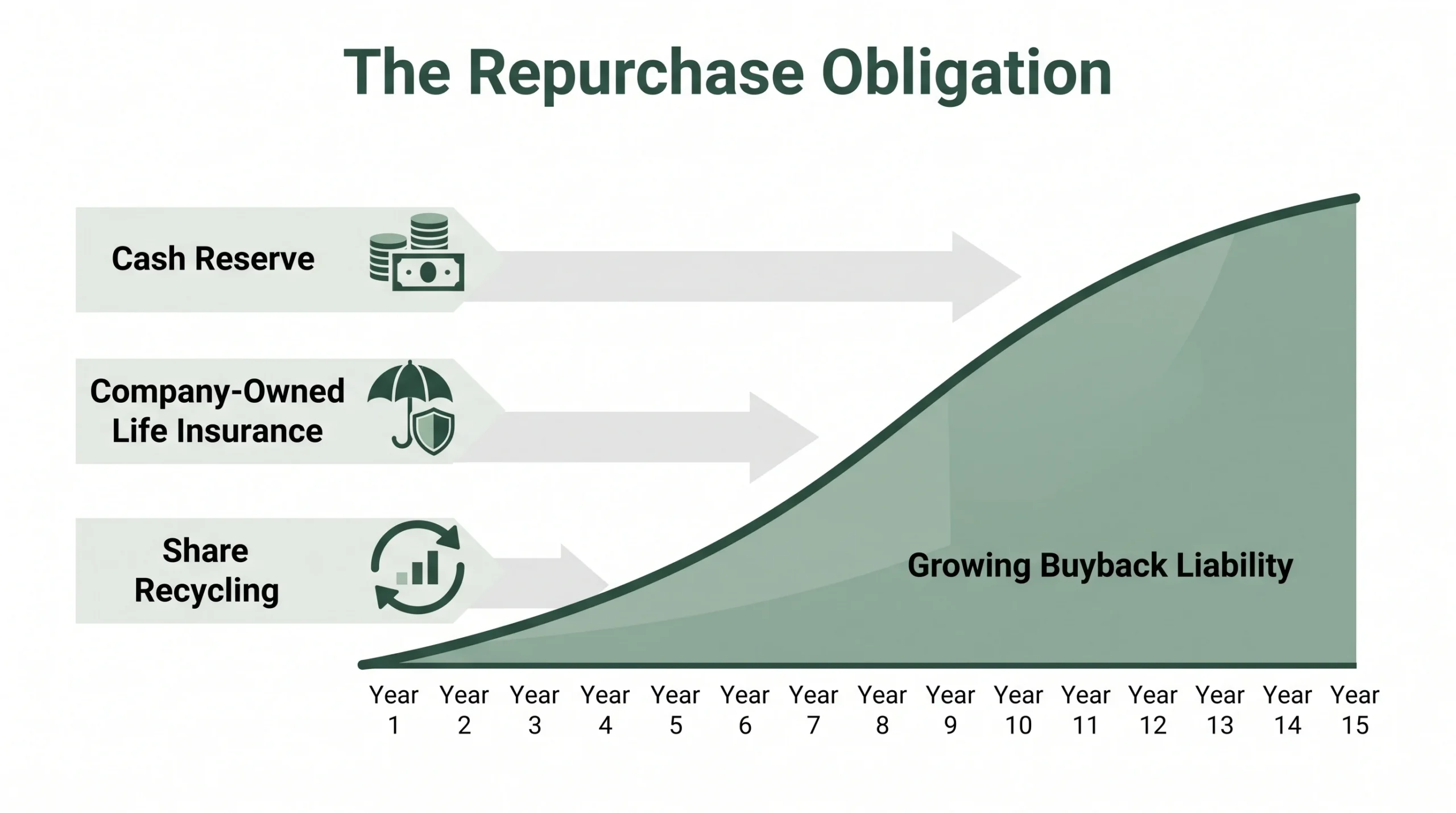
The repurchase obligation grows because two forces push it up at the same time. First, the share price usually rises as the company grows, so each account is worth more when it is cashed out. Second, employees build larger balances the longer they stay, and more of them reach retirement over the years. The result is a rising curve that can surprise owners a decade after the plan closes.
This pattern is often called the repurchase wave. In the early years, few participants leave and the cash cost feels small. Later, a cluster of long-tenured employees retires within a short window, and the annual bill can jump sharply. A company that treats the early low cost as normal can face a cash flow drag it never budgeted for.
What goes into a repurchase obligation study?
A repurchase obligation study forecasts the timing and size of future buybacks using the plan’s own data. The analyst starts with participant census data, then adds assumptions about how and when people will leave. The study projects share value and totals the yearly cash need. The main inputs are:
- Census data: age, tenure, salary, and vested balance for every participant
- Turnover and retirement rates: how many people leave each year and when
- Mortality and disability rates: the odds of death or disability by age
- Diversification elections: older participants who shift part of their account out of stock
- Projected share value: how fast the price per share is expected to grow
- Distribution policy: lump sum or installments, paid right away or after a delay
Each input changes the shape of the forecast. Faster share-price growth lifts every future payment. A generous distribution policy, such as immediate lump sums, front-loads the cash need, while installments spread it out. Because small changes compound over 10 to 20 years, a good study tests several scenarios rather than one fragile estimate. Sofer Advisors builds these scenarios so owners can see both a base case and a stressed case side by side.
How do companies fund the repurchase obligation?
Companies fund the repurchase obligation in three main ways: they set aside cash, they buy insurance, or they recycle shares. Most use a mix. The right blend depends on the company’s cash flow, its tax position, and how large the future wave looks. This work often sits inside the broader transactional advisory support around an ESOP.
| Funding method | How it works | Best fit |
| Sinking fund / cash reserve | The company saves cash each year in a dedicated account | Steady, predictable obligations |
| Corporate-owned life insurance | Policies on participants pay out to cover buybacks | An older workforce with death or retirement risk |
| Share recycling | Repurchased shares move to remaining participants | Firms that want to keep the ESOP funded |
| Redemption | The company buys shares and retires them | Firms managing account balance growth |
Each method has trade-offs. A sinking fund is simple but ties up cash that could fund growth. Corporate-owned life insurance can match large payouts tied to death or retirement, though the premiums add a yearly cost. Recycling keeps shares in the plan, while redemption shrinks the pool and can lift the price per share. Plan-design levers, such as delaying payments or paying in installments, also ease the yearly load. A study shows which mix fits your cash flow best.
Is the 25% rule the same as the repurchase obligation?
No. The 25% rule and the repurchase obligation are two different things, and confusing them is a common and costly mistake. The 25% rule is a tax limit. It caps how much a company can deduct for contributions to the ESOP in a year, generally 25 percent of eligible payroll. It has nothing to do with the duty to buy back shares.
The repurchase obligation, by contrast, is a cash duty, not a deduction limit. It is the money the company must pay departing participants for their vested shares. A firm can stay well inside the 25 percent deduction limit and still face a large repurchase bill. A clear study keeps the deduction planning and the buyback planning on separate tracks, where they belong.
Which provider should run a repurchase obligation study?
Owners can choose among independent valuation firms, large advisory groups, and actuarial-only shops. All can model the obligation, but their focus and independence differ. An independent valuation firm ties the study to a defensible opinion of share value and stays free of any deal incentive. Large firms like Alvarez & Marsal, Stout, and Kroll serve the biggest plans, often at enterprise scale and cost.
| Provider type | Focus | Independence |
| Independent valuation firm | Defensible forecast tied to share value | High; fee is flat, not deal-based |
| Large advisory firm | Enterprise plans and complex structures | High; premium cost |
| Actuarial-only shop | Turnover and mortality modeling | Moderate; may lack a valuation view |
Sofer Advisors ties every forecast to a defensible share valuation. The Sofer Difference runs through four phases: Discovery, Diligence, Analysis, and Delivery. Discovery gathers the census and plan terms, Diligence tests the assumptions, Analysis models the scenarios, and Delivery explains the results to the board. Owners get a study they can defend to a trustee, a lender, or an auditor.
The questions below cover what owners and trustees ask most.
Frequently Asked Questions
What is the repurchase obligation for an ESOP?
The repurchase obligation is a company’s duty to buy back vested shares from ESOP participants when they leave the plan. Because private company stock has no public market, the business or the plan trust must provide the cash. The duty is triggered when a participant retires, dies, becomes disabled, quits, or diversifies. It is a real, growing cash need, not an accounting entry.
What is the ESOP 25% rule?
The 25% rule is a tax deduction limit, not the repurchase obligation. It generally caps a company’s deductible ESOP contributions at 25 percent of eligible payroll in a year. The rule shapes how much a firm can set aside on a tax-favored basis. It does not set the amount owed to departing participants. Owners should plan the deduction limit and the buyback duty as two separate items.
What is an ESOP buyback and how does it work?
An ESOP buyback happens when the plan or the company purchases a departing participant’s vested shares at fair market value. The participant receives a distribution, in a lump sum or in installments, and the shares return to the trust or are retired. The share price comes from an annual independent valuation. The company funds the payment from cash reserves, insurance, or recycled shares.
How do companies fund the ESOP repurchase obligation?
Companies fund the obligation through a mix of cash reserves, corporate-owned life insurance, and share recycling. A sinking fund sets aside cash each year for future buybacks. Insurance can cover payouts tied to death or retirement. Recycling moves repurchased shares to remaining participants, while redemption retires them. A study shows which blend fits the company’s cash flow.
When does an ESOP repurchase obligation begin?
The obligation begins as soon as participants become vested and start to leave the plan. In the early years the cost is usually small, since few employees retire or quit at once. It builds as accounts grow and long-tenured staff approach retirement. Many companies feel the real pressure 7 to 15 years after the plan is formed. Early forecasting helps a company prepare before the wave arrives.
How is the repurchase obligation forecast?
The obligation is forecast with a repurchase obligation study that models future distributions year by year. The analyst uses participant census data, turnover and retirement rates, mortality assumptions, diversification elections, and projected share value. The distribution policy, such as lump sums or installments, sets the timing of each payment. The study usually tests several scenarios over 10 to 20 years so the board sees a realistic range.
Does the repurchase obligation show up on the balance sheet?
For most private companies, the future repurchase obligation is not booked as a liability until shares are actually put back to the plan. The full future cost stays off the books, so it is easy to underestimate. A repurchase obligation study makes the number visible even though the accounting rules do not force it onto the statements. Boards should track it as a real cash commitment.
How often should the study be updated?
Most companies update a repurchase obligation study every one to three years. An annual refresh keeps pace with the yearly share valuation and any change in the workforce. A major event, such as a large layoff, a wave of retirements, or a jump in share value, is a reason to update sooner. Regular updates keep the funding plan aligned with the real obligation rather than an old estimate.
How much does an ESOP repurchase obligation study cost?
An ESOP repurchase obligation study is a specialized forecasting engagement, so pricing tracks the ESOP valuation range. At Sofer Advisors, this work generally runs $15,000 to $35,000 over 6 to 10 weeks, with larger participant pools and multiple scenarios reaching the higher end. The exact fee depends on census size, plan complexity, and how many funding options you model. To scope your study, request a consultation with your plan documents.
Related Case Studies
- ESOP Transaction Process Steps: Complete Guide for Business Owners
- ESOP Tax Benefits: What Owners and Employees Gain
- How Is a Buy-Sell Agreement Funded with Life Insurance?
Executive Summary
An ESOP repurchase obligation is a company’s duty to buy back vested shares from participants who retire, die, become disabled, quit, or diversify. It grows as the share price rises and accounts mature, often peaking 7 to 15 years after the plan forms. A repurchase obligation study forecasts the timing and size of these buybacks over 10 to 20 years using census data, turnover, mortality, and share-value assumptions. Companies pre-fund it with a sinking fund, corporate-owned life insurance, or share recycling. The 25% rule limits deductible contributions and is not the repurchase duty. Per the U.S. Department of Labor, an ESOP invests mainly in employer stock, which is why liquidity planning matters.
What Should You Do Next?
Start by pulling your plan’s participant census and your most recent share value. Next, ask an independent firm for a repurchase obligation study that projects the next 10 to 20 years under a few scenarios. Then match a funding plan, whether a sinking fund, insurance, or share recycling, to the wave the study shows. Guidance from the National Center for Employee Ownership and The ESOP Association can help your board frame the questions.
David Hern CPA ABV ASA, founder of Sofer Advisors, builds defensible repurchase forecasts for employee-owned companies. Schedule a consultation to protect your cash flow before the wave arrives.
People Also Read
- Business Exit Planning Strategies Guide for Owners in 2025
- Management Buyout Process: Steps, Financing and Valuation
About the Author
This guide was prepared by David Hern CPA ABV ASA, founder of Sofer Advisors, a business valuation firm headquartered in Atlanta, GA serving clients across the United States. David holds dual accreditations as an Accredited Senior Appraiser (ASA) and is Accredited in Business Valuation (ABV), credentials recognized by the IRS, SEC, and FINRA. He also holds the Certified Exit Planning Advisor (CEPA) designation. With 15+ years of valuation experience, David has served as an expert witness in 11+ cases across multiple jurisdictions and built Sofer Advisors into an Inc. 5000-recognized firm with 180+ five-star Google reviews. Its full W2 employee team maintains subscriptions to all major valuation databases and operates under a next business day response policy.
For professional business valuation services, visit soferadvisors.com/about-us/ or contact Sofer Advisors at soferadvisors.com/contact-us/.
This content is for informational purposes only and does not constitute professional valuation advice. Business valuation conclusions depend on specific facts and circumstances. Contact Sofer Advisors for guidance regarding your specific situation.









