


Last Updated: June 2026
The valuation gap is the difference between what your business is actually worth today and what you need it to be worth to fund your retirement. Most business owners discover this gap late, sometimes five years before they planned to retire, sometimes two. The discovery lands hard. The business they spent decades building is not going to do the job they thought it would. This is one of the most common and most preventable financial planning failures in the owner-operated business world.
The uncomfortable truth is that most owners greatly overestimate their business value. A 2024 survey by the Exit Planning Institute found that 76% of business owners expected to fund retirement mainly through the sale of their business. A large share had never received a professional valuation. The number in their head, often a rough multiple of revenue, is usually higher than what a credentialed appraiser would calculate and what a buyer would pay. Sofer Advisors helps owners and their advisors work through exactly these questions and turn the analysis into a defensible business valuation they can act on.
The following takeaways summarize the key valuation and transaction factors covered in this guide.
Key Takeaways
- Valuation Gap Difference Current – The valuation gap is the difference between current business value and the retirement target – most owners discover it too late to close it comfortably
- Owners Overestimate Business Value – Owners overestimate business value because they anchor to revenue rather than EBITDA, and to peak years rather than sustainable run-rate
- Fiveyear Enhancement Plan Meaningfully – A five-year enhancement plan can meaningfully close a valuation gap through EBITDA improvement and multiple expansion strategies
- Owner Salary Adjustment Ensuring – Owner salary adjustment – ensuring your pay is at market rate – directly affects both EBITDA add-backs and the reliability of your retirement income calculation
- Reducing Owner Dependency Building – Reducing owner dependency, building recurring revenue, and improving records are the three highest-return enhancement strategies
- Getting Certified Valuation Today – Getting a certified valuation today is the starting point – you cannot close a gap you have not measured
Each of these factors is examined in depth in the sections that follow.
How Do You Calculate the Valuation Gap?
The valuation gap calculation requires two numbers: your retirement funding target and your current business value. Both are harder to calculate accurately than most owners assume.
The retirement funding target is the after-tax capital you need to generate your desired annual income in retirement. A common framework is the 4% rule, a diversified portfolio can sustain annual withdrawals of 4% of principal indefinitely. Under that rule, generating $200,000 per year requires $5 million in investable assets. For most small business owners, that figure is greatly larger than the after-tax proceeds of a business sale.
The after-tax calculation matters enormously. A business that sells for $4 million may generate $2.8 million to $3.2 million in after-tax proceeds after federal capital gains tax, state tax (Georgia’s rate is 5.39%), and deal costs. That net figure is what goes into the retirement account, not the gross enterprise value.
Current business value requires a certified appraisal, not a back-of-the-envelope estimate. The most common mistake is applying a revenue multiple rather than an earnings multiple. A roofing company doing $3 million in revenue with 12% EBITDA margins has $360,000 in earnings. That is worth roughly $1.1 million to $1.8 million at market multiples, not $3 million. An owner who has been telling themselves their business is worth $3 million is carrying a gap more than $1 million larger than they think.
| Retirement Need | Required Net Assets (4% Rule) | Business Value Needed (Pre-Tax) |
|---|---|---|
| $100,000/year | $2,500,000 | ~$3,200,000 |
| $150,000/year | $3,750,000 | ~$4,800,000 |
| $200,000/year | $5,000,000 | ~$6,400,000 |
| $250,000/year | $6,250,000 | ~$8,000,000 |
Note: Pre-tax estimate assumes about 20%–22% combined federal/state tax on capital gains and deal costs of 3%–5%.
Once you have both numbers, the gap is simple arithmetic. If your retirement target requires $4 million in net proceeds and your current certified value is $1.8 million, the gap is $2.2 million. That is the problem you are solving for.
How the proceeds are taxed depends on how the transaction is structured, which the IRS explains in its guidance on the sale of a business.
Why Do Business Owners Overestimate What Their Business Is Worth?
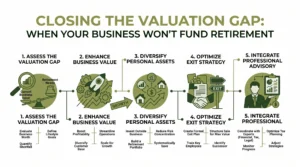
Owner overestimation of business value is nearly universal. It happens for predictable psychological and informational reasons.
The most common error is anchoring to revenue instead of earnings. Revenue is the number owners talk about and use as a shorthand for business scale. But buyers pay for earnings, not revenue. A $5 million revenue business with $300,000 in EBITDA is worth roughly $900,000 to $1.5 million. Revenue tells you nothing about value without the margin attached.
The second error is using peak-year earnings rather than sustainable run-rate earnings. A business that earned $800,000 in EBITDA during a strong year but averages $550,000 over three years will be valued on the adjusted average, not the peak. Sellers who anchor to their best year are set up for disappointment when buyers present their analysis.
The third error is ignoring buyer adjustments. Buyers will adjust owner pay to market rate and remove personal expenses from EBITDA. Owners drawing below-market salaries will see those costs added back, which can actually improve EBITDA. But owners running personal expenses through the business will see those adjustments reduce stated EBITDA.
The fourth error is not accounting for the discount buyers apply for owner dependency. If you are the main relationship holder for key customers and the operational decision-maker, a buyer is paying for a business that may not work the same way once you leave. That risk is priced in as a discount, either to the multiple or to the post-close employment structure.
What Is a Five-Year EBITDA Enhancement Plan?
A five-year EBITDA enhancement plan is a structured operational roadmap for improving the earnings number a buyer will underwrite. Every dollar of sustainable EBITDA improvement adds three to six dollars of business value, the dollar improvement times the applicable EBITDA multiple. That is the highest-return investment most business owners can make.
The enhancement plan works backward from the valuation gap. If the current business is worth $2 million and the target is $4 million, the plan must either double EBITDA or improve EBITDA enough to close the gap combined with multiple expansion strategies.
EBITDA improvement levers vary by industry. The most common include: pricing optimization, cost structure work (labor scheduling, purchasing contracts, vendor consolidation), revenue mix improvement (shifting toward higher-margin categories), and growth investment (adding sales capacity or entering adjacent markets).
The plan should be broken into 12-month milestones with specific, measurable targets. “Grow revenue by 15%” is not a plan. “Hire a dedicated outside sales rep by Q2 and target $400,000 in new commercial revenue by year-end” is a plan. Specificity creates accountability and gives buyers credible evidence to evaluate.
How Does Multiple Expansion Close the Gap?
Multiple expansion, increasing the EBITDA multiple a buyer applies, rather than just the EBITDA base, is the second lever in a gap closure strategy. The math is significant.
A business generating $500,000 in EBITDA valued at 3x is worth $1.5 million. If that same business can command a 5x multiple through structural improvements, it is worth $2.5 million without any change to EBITDA. Multiple expansion is as valuable as EBITDA growth, and often more achievable in a two to three year window.
The specific strategies that drive multiple expansion are: building recurring revenue (service contracts, retainers, subscriptions), reducing customer concentration (no single customer over 10%–15% of revenue), and transitioning key customer and supplier relationships away from the owner to team members.
Geography and market expansion can also expand multiples. A business that has grown from one market to two or three shows growth trajectory and reduced concentration risk. It becomes a more attractive candidate for buyers running a regional or national rollout.
Owner salary adjustment is a third factor. If your pay has been irregular, more in good years, less in lean years, setting it to a reliable market rate improves the quality of EBITDA. Buyers apply higher multiples to businesses where they can forecast future earnings with confidence.
David Hern CPA ABV ASA, founder of Sofer Advisors, brings a Heart of a Teacher to every engagement – translating complex valuation methodology into clear, actionable guidance that clients can act on before and after the report is delivered. With 15+ years of valuation experience, 11+ expert witness cases across multiple jurisdictions, and 180+ five-star Google reviews, David built Sofer Advisors into an Inc. 5000-recognized firm. The Sofer Difference is a four-phase process of Discovery, Diligence, Analysis, and Delivery that ensures every conclusion is defensible, documented, and tied to the specific facts of the business.
While national firms like Stout and Kroll serve large enterprise clients, Sofer Advisors specializes in middle-market businesses that require personalized attention, direct access to credentialed professionals, and a next business day response policy.
What Is the Emotional Side of Discovering a Valuation Gap?
The valuation gap is a financial problem with a large emotional dimension. Most business owners have tied their identity and sense of accomplishment to their business for years or decades. Discovering that the business is worth a lot less than expected triggers real grief alongside the financial stress.
The owners who handle this well are the ones who get a professional valuation early enough to act on it. Finding out at age 62 that your $1.5 million business cannot fund a $4 million retirement need leaves limited options. Finding out at age 55 leaves seven to ten years for the enhancement plan to work and for multiple expansion strategies to be put in place on purpose.
The discovery also creates clarity about the choice owners face: sell now at a lower price and adjust expectations, keep building for two to five more years with a plan to close the gap, or recapitalize by taking some chips off the table in a minority sale while keeping equity upside for a later full sale. The wrong answer is doing nothing because the number was surprising and uncomfortable.
Financial planners often describe the gap discovery as a forcing function. It motivates owners to build the business on purpose rather than just running it. Most business owners have 80%–90% of their net worth in a single illiquid asset. The gap discovery is often the first time that concentration risk becomes real.
What Role Does a Certified Valuation Play in Retirement Planning?
A certified business valuation, prepared by an AICPA-credentialed appraiser using standard valuation methods, is the starting point for any serious retirement planning conversation involving a business exit. Without it, you are planning around a number in your head that may not reflect market reality.
The certified valuation establishes current enterprise value. It identifies the specific factors suppressing that value below its potential. It also provides a baseline against which enhancement plan progress can be measured each year.
For estate planning, a certified valuation is also required records. If you intend to transfer ownership interests to family members or a trust, the IRS requires the transfer be documented at fair market value by a qualified appraiser. An informal estimate creates tax risk that can surface years later.
For buy-sell agreements, a certified valuation triggers the agreed-upon deal at a defensible price. Partners who relied on informal valuations often find themselves in litigation when one party exits and the formula produces a number the other side challenges.
The questions below address the most common issues business owners raise before engaging a qualified appraiser for a your business wont fund engagement.
Frequently Asked Questions
What is the valuation gap in retirement planning?
The valuation gap is the difference between what your business is currently worth (after tax) and what you need in retirement assets to fund your income goals. It is most commonly discovered when an owner receives a professional valuation for the first time and compares it to their retirement funding target.
How many Americans have $1,000,000 in retirement savings?
According to Vanguard and Federal Reserve data, fewer than 10% of American households have $1 million or more in retirement savings. Many business owners have large business equity but limited liquid retirement assets.
What is the 30-30-30-10 rule for retirement?
The 30-30-30-10 rule is a general asset allocation framework suggesting 30% in stocks, 30% in bonds, 30% in real estate, and 10% in alternatives. Business owners with most of their net worth in a single illiquid business are greatly non-compliant with this diversification framework.
What does Dave Ramsey say about LIRP?
Dave Ramsey is generally skeptical of life insurance retirement plans (LIRPs), which use cash-value life insurance as a tax-sheltered retirement savings vehicle. His position is that term life insurance plus standard retirement accounts is more efficient for most people.
How far out should I start planning for a business exit?
The minimum planning horizon for a meaningful gap closure plan is five years. Anything less leaves insufficient time for EBITDA improvements to compound and for structural changes to show up in the financial history buyers will review.
Can I close a valuation gap without growing revenue?
Yes. EBITDA margin improvement, multiple expansion strategies, and working capital optimization can all increase business value without revenue growth. Many gap closure plans achieve 50% or more of their target through margin and multiple improvement rather than top-line growth.
Should I sell my business or keep building if I have a valuation gap?
It depends on the size of the gap, your energy level, and your timeline. If the gap is large and you have five or more years with a credible improvement plan, building typically produces better economics.
How often should I get a business valuation for retirement planning purposes?
Annual valuations are ideal for owners within five years of a planned exit. At minimum, get a certified valuation before entering any exit planning conversation with a financial planner, estate attorney, or investment banker.
What is an earnout and how does it affect retirement planning?
An earnout is a contingent payment tied to post-close business performance. For retirement planning purposes, earnout proceeds should be treated conservatively until earned.
Can I partially sell my business to fund retirement without selling entirely?
Yes. Minority recapitalizations, ESOP deals, and partial PE recaps allow owners to take cash from the business without a full exit. These structures can diversify retirement savings while the owner keeps control and shares in future gains.
Related Case Studies
- Business Exit Planning Strategies Guide For Owners In 2025
- Selling A Business In Georgia Complete Exit Planning Guide 2026
- When To Start Succession Planning Your Strategic Timeline Guide
Executive Summary
- The valuation gap is the difference between current certified business value (after tax) and retirement funding target – most owners discover it later than they should
- Owners overestimate value by anchoring to revenue rather than EBITDA and to peak-year earnings rather than sustainable run-rate
- A five-year EBITDA enhancement plan – built around specific improvement levers – can close large gaps through compounding earnings improvement
What Should You Do Next?
If you suspect there is a gap between what your business is worth and what you need for retirement, the first step is measuring it precisely. David Hern CPA ABV ASA, founder of Sofer Advisors, holds dual ASA and ABV credentials recognized by the IRS, SEC, and FINRA, with 15+ years of valuation experience and 180+ five-star Google reviews. Schedule a consultation to discuss your business valuation needs.
People Also Read
- Why You Must Start Planning Your Business Exit Now With The Right Valuation Expert
- How To Boost Stakeholder Confidence Through Transparency In Business Valuation Planning
About the Author
This guide was prepared by David Hern CPA ABV ASA, founder of Sofer Advisors – a business valuation firm headquartered in Atlanta, GA serving clients across the United States. David holds dual accreditations as an Accredited Senior Appraiser (ASA) and is Accredited in Business Valuation (ABV), credentials recognized by the IRS, SEC, and FINRA. He also holds the Certified Exit Planning Advisor (CEPA) designation. With 15+ years of valuation experience, David has served as an expert witness in 11+ cases across multiple jurisdictions and built Sofer Advisors into an Inc. 5000-recognized firm with 180+ five-star Google reviews. The firm’s full W2 employee team maintains subscriptions to all major valuation databases and operates under a next business day response policy.
For professional business valuation services, visit soferadvisors.com/about-us/ or schedule a consultation at soferadvisors.com/contact-us/.
Disclaimer
This content is for informational purposes only and does not constitute professional valuation advice. Business valuation conclusions depend on specific facts and circumstances. Contact Sofer Advisors for guidance regarding your specific situation.