


Last Updated: November 2026
A 409A material event is any change that could shift the fair market value of a private company’s common stock. When one happens, the company’s current 409A valuation may no longer hold. Common triggers include a new priced financing round, a secondary stock sale, an acquisition offer, and large swings in financial results. The event matters because every option’s strike price must match fair market value on the grant date. A 409A valuation is generally treated as reasonable for up to 12 months, and a material event can end that window early.
Sofer Advisors prepares these valuations for founders, CFOs, and their advisors.
This guide explains what counts as a material event, the 12-month rule, the tax risks of skipping an update, and the documents an updated report needs.
Key Takeaways
- A material event is any change that could move the fair market value of common stock. It can end the safe harbor window before 12 months pass.
- Common triggers include a new priced financing round, secondary stock sales, an acquisition offer, and large swings in financial results.
- A 409A valuation is generally treated as reasonable for up to 12 months under IRS safe harbor rules, unless a material event occurs first.
- Granting options off a stale valuation can expose employees to income tax, a 20 percent extra federal tax, and added interest under Section 409A.
- An updated valuation needs current financials, a revised cap table, and the deal documents tied to the event.
What Triggers a 409A Material Event?
A material event is any development that could change the fair market value of a company’s common stock. The tax code does not list every trigger by name. Instead, it asks whether the new information would affect value. If the answer is yes, the old valuation may be stale.
Several events come up often. A new priced equity round is the clearest one. So is a secondary sale, where existing holders sell shares to outside buyers. An acquisition offer or signed term sheet is another. Large financial swings count too, whether the company beats its plan or falls well short. A missed product milestone or a shift in the business model can also qualify.
Each of these events gives the market new facts about the company. A funding round sets a fresh price. An acquisition offer shows what a buyer will pay. Strong or weak results change the outlook for future cash flow. When facts like these appear, the board should ask whether the current strike price still reflects fair market value.
How Do Financing Rounds Affect a 409A Valuation?
A new priced financing round is one of the strongest material events. It sets a value for the company through a real deal with outside investors. That deal is an arm’s length transaction. It gives an appraiser hard evidence about what the business is worth today.
The round prices preferred stock, not common stock. So the appraiser cannot use the headline price as the common value. Instead, the analyst uses the new preferred price as a starting point. Then the model works down to the value of common stock. This step accounts for the special rights that preferred shares carry.
Preferred stock often comes with extra features. These can include a liquidation preference and the right to convert to common. Those features make preferred shares worth more than common shares. The valuation strips out that extra value. What remains is the implied value of common stock. That figure drives the strike price for new option grants.
Does a 409A Expire if No Material Event Occurs in 12 Months?
Yes. A 409A valuation is generally treated as reasonable for up to 12 months. After that, the IRS no longer presumes it is current. A company must refresh the appraisal before it grants more options. This is true even when nothing dramatic has happened.
The reason is simple. A year is a long time for a private company. Markets move, results change, and the business grows. All of that can shift the value of common stock. A valuation from twelve months ago may no longer match today’s reality. Granting options off that old number puts the strike price at risk.
So the clock itself acts as a limit. A material event can end the window early. The passage of 12 months ends it on schedule. Either way, the company needs a new report to keep its grants on safe ground. Boards often track the expiration date and start the next valuation a few weeks ahead.
What Are the Risks of Ignoring a Material Event?
The main risk falls on employees. Section 409A applies to options priced below fair market value. If a company grants options at a stale, low strike price, the IRS can treat those options as deferred compensation that breaks the rules. The tax results are harsh.
Under Section 409A, the employee may owe income tax as the option vests, not when they exercise or sell. On top of that, the law adds a 20 percent extra federal tax. It can also add an interest charge. These costs hit the worker, not just the company. That is a heavy price for a pricing error the employee did not cause.
The company faces problems too. It handles tax withholding and reporting, so it can draw IRS scrutiny. Low or “cheap stock” pricing can also surface during an audit or a deal. Buyers and auditors look for it during due diligence. A pricing problem can slow a financing round or an acquisition. Fixing it later often means costly retroactive work. Keeping the valuation current avoids all of this.
What Documents Does a 409A Update Need?
An updated valuation needs the facts tied to the event. For a financing round or a sale, that means the signed term sheet and the final deal terms. The analyst uses these to see how new shares rank against common stock. The document also shows the price outside parties agreed to pay.
A current capitalization table is just as important. The cap table shows who owns what after the event. It captures new shares, option pools, and any dilution. Without an accurate cap table, the model cannot split value across share classes the right way. Companies should send the latest version, not an old draft.
The analyst also needs recent financial statements and updated projections. Interim financials show how the business is performing now. Projections show where management expects it to go. Together, these let the analyst judge how the event changes future cash flow. Sending complete, current documents early helps the report reflect accurate facts.
Which Events Trigger a New 409A Valuation?
Not every change ends a valuation. The test is whether the event could move fair market value. The table below shows common events and how boards usually treat them. It is a general guide. A qualified appraiser should review the specific facts in each case.
| Event | Typically a material event? | Why it matters |
|---|---|---|
| New priced financing round | Yes | Sets a fresh, arm’s length price for equity |
| Secondary sale of common stock | Often | Shows what buyers will pay for common shares |
| Acquisition offer or signed term sheet | Yes | Reveals what an outside buyer values the company at |
| Major beat or miss versus projections | Often | Changes the outlook for future cash flow |
| Missed key milestone | Sometimes | Can lower expected growth and value |
| Routine monthly operations | No | Does not, on its own, change fair market value |
| 12 months passing with no event | Yes, by time | Safe harbor window closes on schedule |
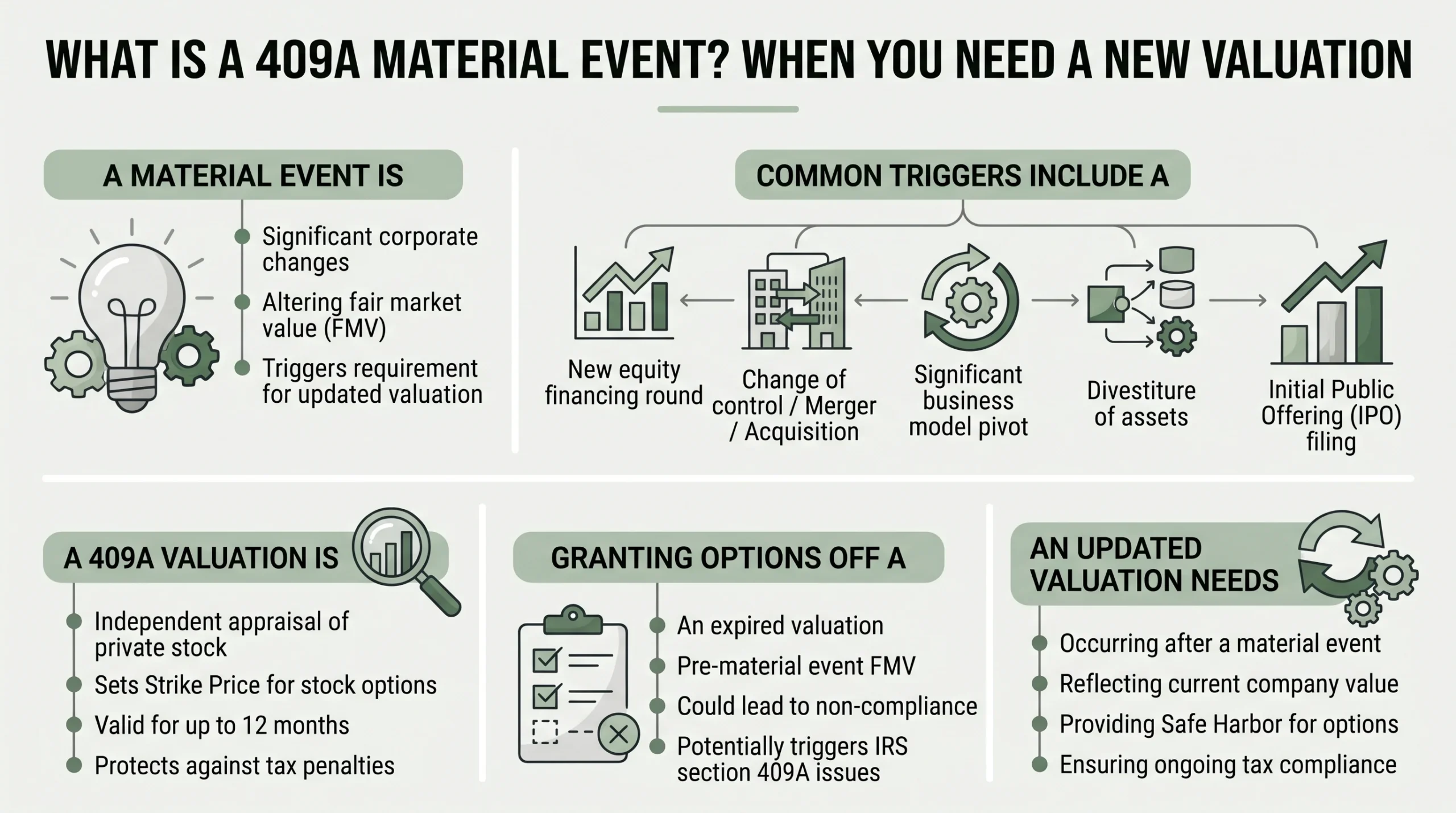
A company does not have to react to tiny changes. The goal is to catch the events that truly move value. When a clear trigger appears, the safe path is to update the report. When in doubt, a short call with an appraiser can settle the question quickly.
Frequently Asked Questions
What is a 409A material event in simple terms?
It is any change that could move the fair market value of a company’s common stock. Examples include a new funding round, an acquisition offer, or a large swing in results. When one happens, the current 409A valuation may be stale. The company should check whether it needs a new appraisal before granting more options.
How long is a 409A valuation valid?
A 409A valuation is generally treated as reasonable for up to 12 months under the IRS safe harbor. After that window, the company needs a new appraisal before it grants more options. A material event can also end the window early. Many boards start the next valuation a few weeks before the old one expires.
Does a new funding round always require a new 409A valuation?
A priced financing round is one of the strongest triggers for a new valuation. It sets a fresh price through a real deal with investors. That price is direct evidence of value, so a company almost always needs an updated appraisal after a round. The new report translates the preferred price into a common stock value.
Is a 409A valuation the same as fair market value?
No. Fair market value is a standard of value. It is the price a willing buyer and seller would agree on, as described in IRS Revenue Ruling 59-60. Section 409A is a part of the tax code. It requires companies to grant options at fair market value. The 409A valuation is the appraisal that measures that value.
What are the penalties for an incorrect 409A valuation?
If options are priced below fair market value, Section 409A can impose steep costs on employees. The worker may owe income tax as the option vests. The law can add a 20 percent extra federal tax and an interest charge. The company can also face audit scrutiny over its withholding and reporting.
What is the IRS safe harbor for a 409A valuation?
The safe harbor treats a valuation as reasonable if it uses a reasonable method applied in a reasonable way. The most common route is an independent appraisal by a qualified person. Under this presumption, the IRS carries the burden to show the value was grossly unreasonable. A written report with clear assumptions supports that protection.
What equity is exempt from Section 409A?
Some awards sit outside Section 409A. Incentive stock options under Section 422 are generally exempt when priced at fair market value. Restricted stock is taxed under Section 83 and usually falls outside 409A. Still, most common stock options and deferred pay plans are subject to the rules unless they meet a specific exemption.
Who should perform a 409A valuation?
The safe harbor favors an independent appraiser with real training and experience in valuation. That independence helps the report stand up during an audit. A qualified analyst documents the method, the inputs, and the judgment behind the value. Firms often use a specialist rather than relying on an internal estimate.
How soon after a material event should a company act?
A company should begin the update once a clear material event occurs. Waiting until the 12-month date passes is a mistake if a trigger has already changed value. The board should gather the deal documents, the updated cap table, and current financials right away. Starting early keeps new option grants on solid ground.
Related Case Studies
- How Often Do You Need a 409A Valuation Update?
- 409A Valuation for Startups: Complete Compliance Guide 2025-2026
- 409A Valuation Requirements: Complete Compliance Guide 2025
Executive Summary
A material event is any change that could move the fair market value of common stock. It can end the safe harbor window before 12 months pass. Common triggers include a new priced financing round, secondary stock sales, an acquisition offer, and large swings in financial results. A 409A valuation is generally treated as reasonable for up to 12 months under IRS safe harbor rules, unless a material event occurs first. Granting options off a stale valuation can expose employees to income tax, a 20 percent extra federal tax, and added interest under Section 409A. An updated valuation needs current financials, a revised cap table, and the deal documents tied to the event.
What Should You Do Next?
If a material event has touched your company, treat the current 409A valuation as a question, not a given. Gather the deal documents, the latest cap table, and recent financials. Then confirm whether your strike price still reflects fair market value before you grant more options. Sofer Advisors prepares independent 409A valuations, with each engagement led by David Hern CPA ABV ASA CVA. A short conversation can tell you whether an update is due.
People Also Read
- What Happens If You Skip a 409A Valuation: Penalties
- 409A vs 8-K Valuation: Key Differences for Startups
About the Author
This guide was prepared by David Hern CPA ABV ASA CVA, founder of Sofer Advisors, a business valuation firm headquartered in Atlanta, GA serving clients across the United States. David holds accreditations as an Accredited Senior Appraiser (ASA) and is Accredited in Business Valuation (ABV), credentials recognized by the IRS, SEC, and FINRA, and is also a Certified Valuation Analyst (CVA). David has served as an expert witness in dozens of cases across multiple jurisdictions, and Sofer Advisors is an Inc. 5000 honoree in 2024 and 2025 with 240+ five-star Google reviews.
For professional business valuation services, visit soferadvisors.com/about-us/ or contact Sofer Advisors at soferadvisors.com/contact-us/.
Disclaimer: This content is for informational purposes only and does not constitute professional valuation advice. Business valuation conclusions depend on specific facts and circumstances. Contact Sofer Advisors for guidance regarding your specific situation.









