


Last Updated: July 2026
A private foundation must give away a set amount each year, and that amount comes from the fair market value of its assets not used for charity, which is the price a willing buyer and seller would agree on. Sofer Advisors gives independent valuation help for the choices in this article.
Some foundations hold private-company stakes, real estate, notes, or other hard-to-sell assets. For them, valuation is more than a report task, because it shapes the payout, grant plans, cash flow, and the risk of a tax on income the foundation fails to give away.
Sofer Advisors helps managers, tax advisers, and boards reach sound value results, and we focus on closely held and complex assets. The aim is a steady process that matches the asset, the rules, and the foundation’s Form 990-PF filing dates.
Key Takeaways
- The minimum investment return starts with 5% of the net value of noncharitable-use assets.
- Traded securities and cash are measured in their own ways.
- Most noncash, noncharitable-use assets need a value each year.
- A qualified independent real estate appraisal can last five years.
- A good policy covers dates, methods, discounts, records, and changes in facts.
What is the minimum distribution requirement?
A domestic private nonoperating foundation must make qualifying distributions that generally equal its distributable amount. The starting point is the minimum investment return, the yearly figure the rules use to set the payout.
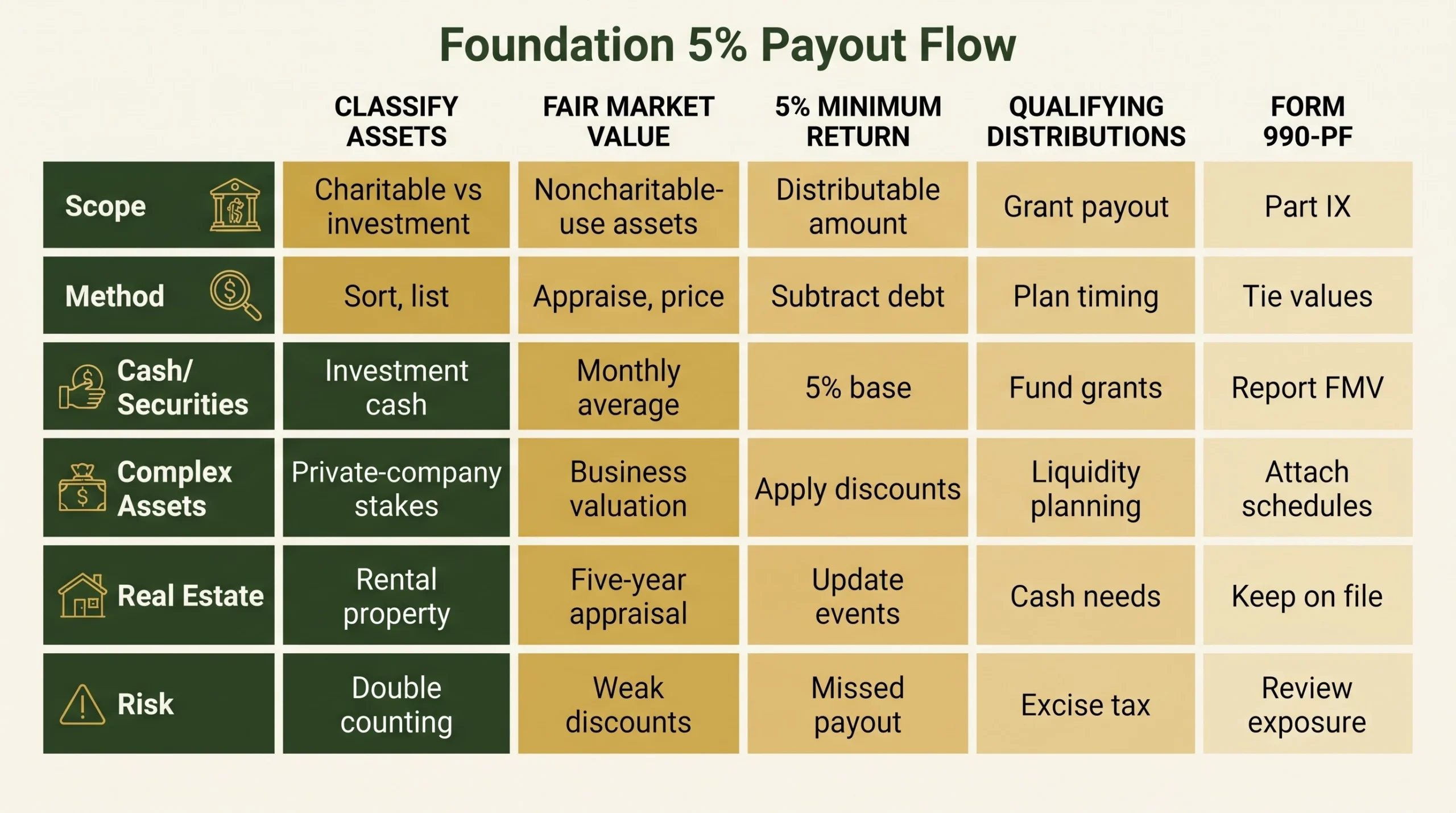
Under current IRS guidance on the minimum investment return, that return is 5% of a certain value. You take the fair market value of noncharitable-use assets, then subtract debt tied to buying those assets, and the result is the base for the 5% figure.
The distributable amount is not always exactly 5% of all assets, because the Form 990-PF instructions make changes for taxes, recoveries, and other items, and assets used directly in charity programs may drop out. Managers should line up the valuation schedule with the tax return.
Careful timing avoids surprises and supports the number filed, which matters if the return is later reviewed.
Which assets need valuation?
The math includes investment assets not used for the foundation’s exempt purpose, its charity mission. If an asset only earns income, it usually counts.
Common examples include marketable securities and investment cash, private-company stakes and investment real estate, plus partnership stakes, private funds, notes, and intellectual property. Other income-producing property counts too.
Traded securities with easy price quotes use steady market-pricing methods, while cash uses an average of monthly balances. Other assets go on Form 990-PF Part IX, line 1c at fair market value. And the IRS instructions call for a yearly value for these, though one special five-year option exists for qualified real estate appraisals.
Sorting assets well is the first real step, since a clear list stops double counting and keeps charitable-use property out of the payout base.
How are private-company interests valued?
A private-company interest is a stake in a firm whose shares do not trade freely. This usually needs a business valuation, not just a book number that often differs from market value.
The appraiser starts by naming the ownership rights, then the standard of value, the valuation date, and any limits. The work may use the income, market, or asset approach, or blend them.
The income approach turns expected cash flow into value using a rate that reflects risk and time. The market approach compares prices from public firms or past deals. The asset approach adjusts assets and debts to fair value, which fits holding companies or asset-heavy firms best.
The final figure may weigh more factors, including control, ease of sale, transfer limits, expected payouts, and the real time needed to sell. Any discount for lack of control or marketability must rest on facts, because a discount borrowed from another report is not real work.
What valuation date should a foundation use?
An asset valued each year may be used any day in the tax year. The foundation must pick a date and stick with it year to year.
This freedom does not erase one duty: you still must weigh later events. Some later facts reveal what was knowable on the valuation date, and they belong in the analysis.
A written policy should name the recurring valuation date, list the people in charge and the data sources, and set the approval steps. It should also cover assets bought or sold during the year, since assets held only part of the year get special handling under the Form 990-PF instructions.
When can real estate use a five-year appraisal?
Real estate may use a written, certified, independent appraisal. That appraisal can serve the value year and the next four tax years, so one strong report can cover a five-year span.
Three things must be true: the appraiser must be qualified and independent, widely accepted valuation methods that meet Appraisal Foundation standards must be used, and the foundation must keep the appraisal on file.
The five-year rule is an option, not a free pass, and it is no reason to ignore a big change. A foundation may swap in a newer qualified appraisal or switch to a yearly value.
Boards should think about an update after major events, such as a big lease change, a fire, rezoning, redevelopment, an environmental issue, or a large market shift that can move value fast.
Can valuation discounts reduce the distribution base?
Discounts may fit when they match how buyers would price the asset. For a private-company interest, two adjustments may apply. One is for lack of control, and the other is for lack of marketability, meaning the stake is hard to sell.
For a large block of securities, blockage may matter, since selling a big block at once can push the price down when normal quotes do not reflect an orderly sale.
The standard stays at fair market value. So the foundation should show why a discount applies, along with the evidence and how it picked the size. Special foundation rules can limit some cuts, like blockage, so the preparer and appraiser should confirm the rule before filing. A discount is not a shortcut to a lower payout; it must reflect real market behavior.
What documentation should the foundation retain?
The file should hold the engagement letter, ownership papers, financial statements, forecasts, tax returns, the capitalization table, and any governing agreements. Include market data, the appraisal report, and board approval, and tie the value to the amount on Form 990-PF.
Consistency counts, so a value used for the payout should match other recent values from a gift, redemption, financing, audit, or deal. Gaps may be fine when dates, rights, or standards differ, but the file must explain them so a later reviewer can follow the logic.
A practical annual process
- List all assets, sorting charitable-use from noncharitable-use property.
- Find debt used to buy included assets.
- Set the valuation date and gather current records.
- Get market prices for traded assets and appraisals for complex assets.
- Review discounts, ownership rights, and big later events.
- Tie appraisal results to Form 990-PF Part IX.
- Compute the distributable amount and plan qualifying distributions.
- Keep the workpapers and board approvals.
What should the valuation review compare?
A strong analysis links each big judgment to the evidence, which must be on hand as of the valuation date. The points below sum up the core choices in this article.
| Decision area | Evidence and review focus |
|---|---|
| What is the minimum distribution requirement | A domestic private nonoperating foundation generally must make qualifying distributions equal to its distributable amount. |
| Which assets need valuation | The calculation generally includes investment assets not used or held for use in carrying out the foundation’s exempt purpose. |
| How are private-company interests valued | A private-company interest normally requires a business valuation rather than a book-value calculation. |
The final report should tie these areas together, since no single input should stand alone.
How should boards govern the annual valuation process?
The board should approve a written policy that assigns the asset list and valuation calendar and covers appraiser choice and key assumptions. It should split charitable-use assets from investment assets on the return, name who ties final values to Form 990-PF, and set who tracks qualifying distributions before year-end.
Good governance needs a conflict check and a clear trail. Minutes should record the valuation date, the reports used, questions raised, and the basis for any discount. When a director, donor, or related party holds a stake, independent review matters more.
How do valuation conclusions affect liquidity planning?
An appraisal can raise or lower the asset base for the payout. A higher value may require more cash for grants, while a lower value may draw scrutiny if it leans on weak discounts. Foundations with private-company stakes should compare figures, matching the payout estimate with dividends, redemption rights, cash, and grant timing.
Liquidity planning should start before the return is done, because an illiquid foundation may need to act. It might draw money from an operating company, sell another investment, arrange an allowed redemption, or shift its grant calendar. The report should give the board lead time to weigh options with tax and legal advisers before a missed payout brings an excise tax.
Frequently Asked Questions
Is the private-foundation payout always 5%?
No. Five percent is the basic rate in the minimum investment return. The distributable amount includes changes, and the asset base leaves out some property and acquisition debt.
Does a private foundation need an appraisal every year?
Many noncash investment assets need a yearly value. Qualified real estate may use the five-year appraisal option. And the needed scope depends on the asset and current IRS instructions.
Can the foundation use book value?
Book value can help reconcile records. But it is not always fair market value, and private-company stakes, partnership stakes, and real estate often need market-based work.
Who should coordinate the work?
Management, the Form 990-PF preparer, and legal counsel should agree. So should investment advisers and the valuation specialist. And they should align on asset sorting, the valuation date, data needs, and the filing timeline.
Why does an independent valuation matter?
An independent valuation records the assumptions, evidence, and methods used. It supports the payout figure for a private foundation. And that record helps boards, owners, advisers, and reviewers see how the value was reached.
What happens if a foundation misses its required payout?
A missed payout carries a cost. It can bring an excise tax on income the foundation fails to give away. That is why liquidity planning should start before the return is done. Early planning gives the board time to draw money from an operating company, sell an investment, arrange an allowed redemption, or shift its grant calendar.
How is investment cash valued?
Cash is measured in its own way. Rather than a single year-end figure, the rules use an average of monthly balances across the tax year. This differs from traded securities, which use steady market-pricing methods, and from other complex assets, which go on Form 990-PF Part IX at fair market value.
Which discounts might apply to a private-company interest?
Two adjustments may fit. One is for lack of control, and the other is for lack of marketability, meaning the stake is hard to sell. Each discount must rest on facts and reflect how buyers would price the asset. Special foundation rules can limit some cuts, like blockage, so the preparer and appraiser should confirm the rule before filing.
Are charitable-use assets part of the payout base?
No. The calculation includes only investment assets not used for the foundation’s exempt purpose, so property used directly in charity programs drops out. A building used to run a free clinic is charitable-use property, while a rental building is held only for income counts. A clear asset list stops double counting and keeps the base accurate.
Related Case Studies
- Valuation Discounts (DLOC and DLOM) on Estate and Gift Tax Returns
- How Family Limited Partnerships Are Valued for Gift and Estate Tax
- Valuation of Closely Held Business for Estate Tax Purposes
Executive Summary
A private foundation’s required payout begins with the minimum investment return, set at 5% of the fair market value of noncharitable-use assets less the debt used to buy them. Traded securities follow market-pricing methods and cash uses an average of monthly balances, but private-company stakes, partnership interests, real estate, and other illiquid holdings usually need a fresh value each year on Form 990-PF Part IX. Qualified real estate may rely on one written, independent appraisal for the value year and the next four years, provided the appraiser is qualified and the report stays on file.
Discounts for lack of control, lack of marketability, or blockage may apply, but each must rest on evidence and reflect how buyers would price the asset, and special foundation rules can limit some cuts. A pinned valuation date, a written policy, board approval, and a documented file keep the filed number defensible. Missing the payout can trigger an excise tax, so liquidity planning should begin before the return is prepared.
What Should You Do Next?
Start before year-end and find every illiquid asset, then confirm which values are stale. Build a written schedule so the board has time to get appraisals, address cash needs, and make qualifying distributions. Coordinate the asset list, valuation date, and filing timeline with your Form 990-PF preparer and counsel rather than relying on a last-minute guess.
David Hern CPA ABV ASA, founder of Sofer Advisors provides neutral, defensible valuations for private foundations. Schedule a free consultation to discuss your situation.
People Also Read
- Do Atlanta Opportunity Zone Investors Need Appraisers? IRS Requirements Explained
- 409A Valuation Requirements: Complete Compliance Guide 2025
About the Author
This guide was prepared by David Hern CPA ABV ASAc, founder of Sofer Advisors, a business valuation firm headquartered in Atlanta, GA serving clients across the United States. David holds dual accreditations as an Accredited Senior Appraiser (ASA) and is Accredited in Business Valuation (ABV), credentials recognized by the IRS, SEC, and FINRA. He also holds the Certified Exit Planning Advisor (CEPA) designation. With 15+ years of valuation experience, David has served as an expert witness in 11+ cases across multiple jurisdictions and built Sofer Advisors into an Inc. 5000-recognized firm with 180+ five-star Google reviews. Its full W2 employee team maintains subscriptions to all major valuation databases and operates under a next business day response policy.
For professional business valuation services, visit soferadvisors.com/about-us/ or contact Sofer Advisors at soferadvisors.com/contact-us/.
Disclaimer: This content is for informational purposes only and does not constitute professional valuation advice. Business valuation conclusions depend on specific facts and circumstances. Contact Sofer Advisors for guidance regarding your specific situation.









