


Last Updated: June 2026
A fintech company is typically valued on ARR or revenue multiples ranging from 2x to 15x. The range depends on growth rate, revenue quality, unit economics, and regulatory licensing. The same $10M revenue base can support a $20M valuation or a $100M valuation. The spread is almost entirely explained by one thing: whether the revenue is sticky and recurring, or thin-margin and exposed to platform risk.
The 2021–2022 fintech bubble produced multiples with no link to fundamentals. The 2023–2024 correction reset expectations sharply. By 2026, fintech M&A has settled into a split market. High-quality software-enabled financial businesses trade at real premiums. Lending, payments, and marketplace models with weak economics trade at fractions of peak valuations. Sofer Advisors helps owners and their advisors work through exactly these questions and turn the analysis into a defensible business valuation they can act on.
The following takeaways summarize the key valuation and transaction factors covered in this guide.
Key Takeaways
- Fintech Companies Valued ARR – Fintech companies are valued on ARR or revenue multiples, with EBITDA multiples applied only to profitable businesses; growth rate and net revenue retention are the primary multiple drivers.
- Revenue Quality Subscription Vs – Revenue quality – subscription vs. interchange vs. lending spread – determines how much of a multiple the market will pay.
- Regulatory Licenses Money Transmitter – Regulatory licenses (money transmitter, bank charter, lending licenses) carry independent value and can protect or limit enterprise value.
- Unit Economics LTV/CAC Ratio – Unit economics – LTV/CAC ratio and monthly churn – are as important as top-line revenue in any serious fintech diligence.
- Public Fintech Comps Adyen – Public fintech comps (Adyen, Block, Payoneer) trade at large discounts to 2021 peaks; private multiples follow with a 12–24 month lag.
- Partner/bank Dependency Key Risk – Partner/bank dependency is a key risk factor that buyers discount at 1–3 turns of EBITDA.
Each of these factors is examined in depth in the sections that follow.
How Would You Value a Fintech Company?
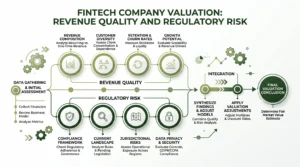
Fintech valuations use a tiered method based on stage, profitability, and business model. There is no single method. Applying the wrong framework to the wrong business produces a number no serious buyer will accept.
For pre-revenue or early-stage fintech: Venture-style valuation using comparable funding rounds, founder pedigree, market size, and technology differentiation. No formula; highly negotiated.
For growth-stage fintech with ARR but negative EBITDA: ARR multiples or forward revenue multiples, adjusted for growth rate and net revenue retention. The current market range for SaaS-adjacent fintech with 40%+ growth is 4x–8x ARR. For businesses growing 20%–40%, expect 2x–5x ARR. Below 20% growth, the multiple collapses to revenue or EBITDA territory.
For profitable fintech: EBITDA multiples ranging from 8x–15x for software-heavy, low capital intensity businesses; 6x–10x for payments and marketplace; 4x–7x for lending and credit businesses where balance sheet risk is embedded.
DCF for specific situations: Discounted cash flow is used as a cross-check and in regulated contexts (estate/gift tax, litigation). But few acquirers rely on it as a primary method. Terminal value assumptions dominate. Fintech cash flows are hard to normalize.
| Fintech Sub-Sector | Revenue Multiple | EBITDA Multiple | Key Value Driver |
|---|---|---|---|
| B2B SaaS / RegTech | 4x–10x ARR | 10x–15x | NRR, churn, expansion revenue |
| Payments (software-led) | 3x–8x revenue | 8x–12x | GMV growth, take rate, partner moat |
| BaaS / Embedded Finance | 3x–7x revenue | 8x–12x | Sponsor bank agreement, API stickiness |
| Lending (balance sheet) | 0.8x–2x revenue | 4x–7x | Credit quality, funding cost, loss rates |
| Wealth Tech / RIA-adjacent | 3x–6x AUM % or revenue | 8x–12x | AUM growth, fee compression risk |
| InsurTech | 1x–4x GWP or revenue | 5x–10x | Loss ratio, distribution model |
| Neobank / Consumer | 1x–3x revenue | 3x–6x | CAC, monthly active users, LTV |
The table above reflects mid-2026 private market M&A conditions. These are not guarantees, outliers exist in both directions.
A market multiple is a starting point, not a conclusion of value. A defensible fair market value still rests on the factors the IRS sets out for valuing closely held businesses under Revenue Ruling 59-60.
Why Does Revenue Quality Matter More Than Revenue Quantity in Fintech?
A fintech doing $10M in revenue from interchange earns about 0.2% of deal volume. It is a very different business from one earning $10M from software subscriptions at 75% gross margin. Both show “$10M revenue” on the income statement. The values are not the same.
Interchange revenue is thin, commoditized, and subject to regulatory compression. It also tracks closely with consumer spending cycles. It contracts in recessions precisely when you want it to be stable. Banks and payment processors compete hard on interchange economics. There is no pricing power.
Subscription revenue, monthly or annual SaaS fees for compliance tools, treasury management software, or financial data APIs, is sticky, recurring, and margin-rich. Buyers pay premium multiples for it. The revenue visibility enables confident DCF modeling. It also supports leverage in an LBO.
Lending revenue sits between these extremes. Net interest income can be large. But it tracks credit quality, the interest rate environment, and funding access. A fintech lender with rising default rates or higher cost of capital will see revenue compress and its multiple collapse at the same time.
Revenue quality analysis in a fintech diligence breaks down the revenue waterfall into: subscription, deal volume (interchange, take rate), spread (lending), services, and other. Each category gets its own margin analysis and growth assumption. Buyers discount low-quality revenue streams or exclude them from the multiple calculation.
How Do Regulatory Licenses Affect Fintech Valuation?
Regulatory licenses are one of the most undervalued assets in fintech, until they’re absent. At that point they become a fatal deal obstacle.
A money transmitter license (MTL) is required in most states to move money for customers. Getting MTLs in all 50 states takes 2–4 years and several million dollars in licensing fees, compliance work, and surety bonds. A fintech that has done this work has a real edge. A buyer that needs those licenses would have to spend years getting them. MTLs are typically assignable with state approval, but the transfer process is a diligence item in every fintech deal.
A bank charter, industrial loan company, national bank, or state charter, is even more valuable and harder to get. Fintech companies with bank charters have lower cost of capital, direct access to card networks, and deposit-taking ability. Charter value is hard to isolate in a valuation, but M&A premiums for charter-holding fintechs are well-documented.
Lending licenses, broker-dealer registrations, investment adviser registrations, and insurance producer licenses all carry value. That value is tied to how hard they are to get and what revenue they enable. They also carry compliance risk. A license under regulatory review or facing remediation is a liability, not an asset.
Regulatory risk is discounted, often at 1–3 turns of EBITDA, when a fintech operates under a sponsor bank arrangement (BaaS) and that relationship is the linchpin of the business. A single-bank dependency means a renegotiation or termination of that agreement could shut down the product overnight.
What Are the Key Unit Economics Metrics in a Fintech Valuation?
LTV/CAC ratio is the primary unit economics metric. A healthy B2C fintech business should have LTV/CAC above 3x. Below 2x raises questions about payback period and scalability. A B2B fintech should be above 5x given higher contract values and lower churn.
Monthly churn for consumer fintech should be below 2%. For B2B SaaS fintech, annual logo churn below 10% is the threshold. Net revenue retention, do existing customers expand spending year over year?, should be above 110% to command premium multiples. Above 120% NRR signals that expansion revenue will outpace churn. That creates a compounding growth flywheel.
Payback period, months to recover CAC from gross margin, should be under 18 months for consumer, under 24 months for enterprise B2B. Longer payback periods create cash flow drag. They also raise capital requirements that erode equity value.
Cohort analysis is how sophisticated buyers stress-test the unit economics story. They will want monthly cohort data showing revenue per cohort over time, attrition by acquisition channel, and LTV realization. A fintech that cannot produce cohort data is a red flag. It means management is not running on data or has something to hide.
David Hern CPA ABV ASA, founder of Sofer Advisors, brings a Heart of a Teacher to every engagement – translating complex valuation methodology into clear, actionable guidance that clients can act on before and after the report is delivered. With 15+ years of valuation experience, 11+ expert witness cases across multiple jurisdictions, and 180+ five-star Google reviews, David built Sofer Advisors into an Inc. 5000-recognized firm. The Sofer Difference is a four-phase process of Discovery, Diligence, Analysis, and Delivery that ensures every conclusion is defensible, documented, and tied to the specific facts of the business.
While national firms like Stout and Kroll serve large enterprise clients, Sofer Advisors specializes in middle-market businesses that require personalized attention, direct access to credentialed professionals, and a next business day response policy.
How Do Public Fintech Comparables Translate to Private Valuations?
Public fintech companies, Adyen, Block (Square), Payoneer, Flywire, WEX, nCino, trade at multiples that provide a market anchor for private valuations. But a direct application is wrong. Private companies carry:
Illiquidity discount: 20%–30% discount to public comps for lack of marketability and public market liquidity.
Size discount: Most private fintech targets are smaller than public comps. Smaller businesses are less diversified, more founder-dependent, and less credible to institutions.
Information gap: Public companies disclose audited financials quarterly. Private companies may have weaker accounting and less transparent reporting.
The typical derivation: identify 4–6 public comps in the same sub-sector. Calculate their NTM revenue or ARR multiples. Apply a 25%–40% DLOM discount. Then adjust for the specific company’s growth rate vs. the comp group.
In 2026, Adyen trades at about 7x–9x NTM revenue (compressed from 25x+ in 2022). Block trades at 2x–4x. These figures translate to private payments company multiples in the 3x–6x range depending on size and growth. A private B2B SaaS fintech with 35% growth and 90% gross margins should expect 4x–7x ARR in a competitive M&A process.
What Is a Fintech Company Worth With $500,000 in Revenue?
A fintech with $500,000 in revenue is at the very early stage of an institutional deal market. Deal size matters. Most PE and strategic buyers have minimum EBITDA thresholds ($1M+) or minimum ARR targets ($2M+) that a $500K revenue business doesn’t meet.
That said, a $500K ARR business growing at 100%+ with strong unit economics can command a venture-round valuation of $3M–$8M at seed or Series A. A $500K revenue lending business is likely worth 1x–2x revenue to a buyer, if it’s profitable. A $500K interchange-based payments business may struggle to attract institutional interest at all.
The honest answer: $500K in fintech revenue produces a valuation that depends almost entirely on trajectory, unit economics, and strategic fit, not a formula.
The questions below address the most common issues founders raise before engaging a qualified appraiser for a fintech company valuation engagement.
Frequently Asked Questions
How is a fintech company valued differently from a traditional bank?
Traditional banks are valued on price-to-book and price-to-earnings, reflecting their balance sheet assets. Fintech companies are valued on revenue or ARR multiples when in growth phase, shifting to EBITDA multiples when profitable. Fintech value comes from technology, network effects, and recurring revenue, not balance sheet assets.
What is the impact of churn on fintech valuation?
Monthly churn above 3% for a consumer fintech or annual churn above 15% for B2B disqualifies the business from premium multiple treatment. High churn means the business is constantly replacing lost customers with expensive new acquisition. LTV projections become unreliable.
Does regulatory risk discount the multiple?
Yes, materially. A fintech under regulatory review, subject to a consent order, or operating in a gray-area product will see its multiple reduced by 1–3 turns depending on severity. Buyers price in remediation costs, potential revenue limits, and management distraction.
How does a sponsor bank arrangement affect value?
Single-bank dependency is a structural risk. If the sponsor bank terminates the agreement, as occurred with several BaaS platforms in 2023–2024, the fintech may be unable to operate. Buyers will require evidence of backup banking relationships or will price the dependency risk into the multiple.
What multiples do payments companies trade at in 2026?
Software-led payments businesses trade at 3x–8x revenue in private M&A. Pure-play interchange businesses with no software moat trade at 1x–3x revenue. The spread is entirely explained by gross margin and switching costs.
How does LTV/CAC affect fundraising vs. M&A valuation?
In VC fundraising, LTV/CAC is used to project unit economics at scale. In M&A, buyers focus on realized payback period from historical cohorts, not projected LTV. Inflated LTV assumptions are a common diligence finding that leads to purchase price reductions.
What happens to fintech valuation if the founding team leaves?
Key-man risk is a significant discount factor in fintech. Technical founders or regulatory relationship holders may be hard to replace. Buyers often structure earnouts or employment agreements to retain founders post-close. A fintech without strong management depth below the CEO level will face scrutiny.
Are there specific Georgia fintech companies or ecosystem factors that affect valuation?
Atlanta has a mature fintech ecosystem, NCR Voyix, Global Payments, Fiserv, and a active startup community. Atlanta-based fintechs benefit from proximity to Fortune 500 financial services clients and an active local M&A market. But valuation is based on the business’s metrics, not its geography.
How do I increase my fintech company’s valuation before a sale?
The highest-impact levers are improving net revenue retention and reducing churn. Diversify revenue from transactional to subscription where possible. Document regulatory compliance thoroughly. None of these are quick fixes, plan 18–36 months ahead of a deal.
What is the difference between ARR and revenue multiples in fintech valuation?
ARR (annual recurring revenue) excludes one-time and transactional revenue, isolating the predictable subscription base. Revenue multiples include all sources. A fintech with $8M ARR and $3M transactional revenue will typically be valued on the $8M ARR component at a premium multiple. Transactional revenue is valued separately at a lower multiple or excluded.
Related Case Studies
- SaaS Valuation Complete Guide To Software Company Value
- Technology Company Valuation Atlanta Guide For Startups And Growth Companies
- 409A Valuation Atlanta Startup Equity Compensation Guide 2026
Executive Summary
- Fintech valuation methods differ by stage and profitability: ARR multiples for growth-stage, EBITDA multiples for profitable businesses, DCF as a cross-check.
- Revenue quality – recurring subscription vs. thin-margin interchange vs. balance sheet lending – is the dominant multiple driver.
- Regulatory licenses are transferable assets with independent value; regulatory risk is discounted at 1–3 turns.
- Unit economics (LTV/CAC, churn, NRR) are as important as top-line in any serious fintech diligence.
What Should You Do Next?
If you are considering selling, raising capital, or need a defensible valuation for tax or litigation purposes, a certified opinion from a credentialed firm protects you when the stakes are highest. David Hern CPA ABV ASA, founder of Sofer Advisors, holds dual ASA and ABV credentials recognized by the IRS, SEC, and FINRA, with 15+ years of valuation experience and 180+ five-star Google reviews. Schedule a consultation to discuss your business valuation needs.
People Also Read
- Technology Company Valuation Methods A Complete Guide
- Technology Company Valuation Atlanta Guide For Startups And Growth Companies
About the Author
This guide was prepared by David Hern CPA ABV ASA, founder of Sofer Advisors – a business valuation firm headquartered in Atlanta, GA serving clients across the United States. David holds dual accreditations as an Accredited Senior Appraiser (ASA) and is Accredited in Business Valuation (ABV), credentials recognized by the IRS, SEC, and FINRA. He also holds the Certified Exit Planning Advisor (CEPA) designation. With 15+ years of valuation experience, David has served as an expert witness in 11+ cases across multiple jurisdictions and built Sofer Advisors into an Inc. 5000-recognized firm with 180+ five-star Google reviews. The firm’s full W2 employee team maintains subscriptions to all major valuation databases and operates under a next business day response policy.
For professional business valuation services, visit soferadvisors.com/about-us/ or schedule a consultation at soferadvisors.com/contact-us/.
This content is for informational purposes only and does not constitute professional valuation advice. Business valuation conclusions depend on specific facts and circumstances. Contact Sofer Advisors for guidance regarding your specific situation.









