


Last Updated: July 2026
A sum-of-the-parts valuation values a firm by its separate parts, asking what each division would be worth on its own, whether in a spin-off or a sale to another buyer.
This method treats one firm as a set of standalone assets rather than a single unit. Analysts use it to spot when the total differs from the parts, since sometimes the whole is worth more and sometimes less. One key benefit is finding hidden value in large firms, which helps when some parts grow at a different pace than the core. Per data from Business Valuation Resources, the method applies set multiples to each unit rather than lean on a single company-wide figure. A multiple is a number tied to earnings or cash flow that analysts use to gauge value.
Sofer Advisors offers this work to help owners see true worth. The firm has 180+ five-star Google reviews and has been cited in 11+ expert witness cases in court. Every report rests on relevant rules, including standards set by the AICPA, which keeps each report strong and easy to defend.
Owners often want this work before a sale or a spin-off, and they also use it to plan for future growth. Each division has its own risks and profit margins, so one metric for the whole firm can give wrong results. This method splits those risks apart and shows a clear view of where value sits, staying a key tool for leaders who may need to defend their views to boards or buyers.
Key Takeaways
- Diverse Segment Valuation: This method fits firms with unrelated parts, where one multiple would give wrong results.
- Core Process Mechanics: Analysts value each part on its own, then add them up and adjust for firm-wide debts or assets.
- Conglomerate Discount Impact: Market data often shows combined firms trade 10 to 15 percent below the sum of their parts.
- Data and Allocation Hurdles: Thin segment data and shared costs make this work hard, since splitting joint costs is tricky.
- Strategic M&A Application: Owners can spot cheap parts of the firm, and they can also pick which parts to sell to boost results.
Each variable shapes how precise your final equity estimate will be. The sections below show how leaders can refine these sums, because good data leads to sound plans.
Why use SOTP instead of other valuation methods?
The sum-of-the-parts method, or SOTP, fits firms with mixed segments that carry their own risk levels and growth paths. A comparable company analysis, or CCA, values a firm against peers but can miss the full worth of unrelated parts.
Many firms instead run one discounted cash flow model over a complex firm. This DCF model projects future cash and discounts it to today, but one blended model hides each part’s risks and margins.
When units work in unrelated fields, one discount rate is wrong. That rate, the weighted average cost of capital, sets the value of future cash. Per data from Business Valuation Resources, SOTP splits these variables apart, and activist investors often ask for it to find parts worth selling.
How is a SOTP valuation calculated step-by-step?
You calculate SOTP by valuing each unit on its own, then adding the figures and adjusting for firm-wide debts.
Analysts start by isolating each unit that earns independently. The appraiser then adds the parts up for a first enterprise figure, since enterprise value means the worth of the whole business before debt and cash are settled.
The last step adjusts for firm-wide items left out of the unit models, such as central debt or spare cash. A careful analyst also nets out pension gaps and tax assets, which can swing the final equity figure, leaving a clean picture of value.
What are the primary challenges of SOTP analysis?
The main hurdles are thin data and shared costs. Public filings often lack fine reports for each unit, so analysts lean on estimates and struggle to see how central overhead hits each one.
Shared value between units adds more strain. Transfer pricing is the price one unit charges another inside the firm, so standalone worth gets hard to pin down. The link between transfer pricing and valuation is close, since a shift in one internal price can move the reported profit of two segments at once.
Firms may set these prices to meet accounting goals, hiding a part’s true economic strength. A defensible model documents each assumption, so a reviewer can trace how every segment figure was built.
When does SOTP reveal a ‘conglomerate discount’?
A conglomerate discount shows up when the market value of a parent firm sits below the total of its parts. This gap often forms when investors see the firm as too complex, fearing poor use of cash.
A synergy premium is the reverse case: the combined firm is worth more than its parts, from cost savings or shared operating gains. An analyst must test whether real synergies justify keeping units under one roof.
A lasting discount can draw activist investors, who may push for spin-offs. They argue split units let the market judge each one fairly, so each division gets a multiple that fits its growth.
How does SOTP impact M&A and divestiture strategy?
SOTP is a key tool to find cheap targets and plan sales that lift shareholder value. When a firm weighs a spin-off, SOTP weighs the current enterprise value against the total of each part on its own, which helps spot non-core assets.
For a buyer, SOTP justifies a price by splitting wanted parts from the rest, valuing each unit as if it stood alone. In buy-side and sell-side deals, the same segment map guides both the offer and the defense.
This sets a floor price for the firm or a part being sold. It also acts as a takeover defense, showing investors each segment’s true value to guard against a low bid.
Can SOTP be used for private company valuations?
Yes, SOTP can value a private firm with many business lines. The appraiser splits the income and risk of each part, then adds these into one value.
Private units often lack public data, a core hurdle in the work. Analysts build synthetic multiples by studying peer firms in each field. When a unit’s data is missing, the appraiser normalizes the financials, removing one-time items and owner costs to set a fair base before the final sum.
These base assumptions matter most for tax or deal work. A steady method gives a clear audit trail that holds up to review by the IRS or a buyer. Talk to a Sofer Advisors valuation specialist about which approach fits your situation.
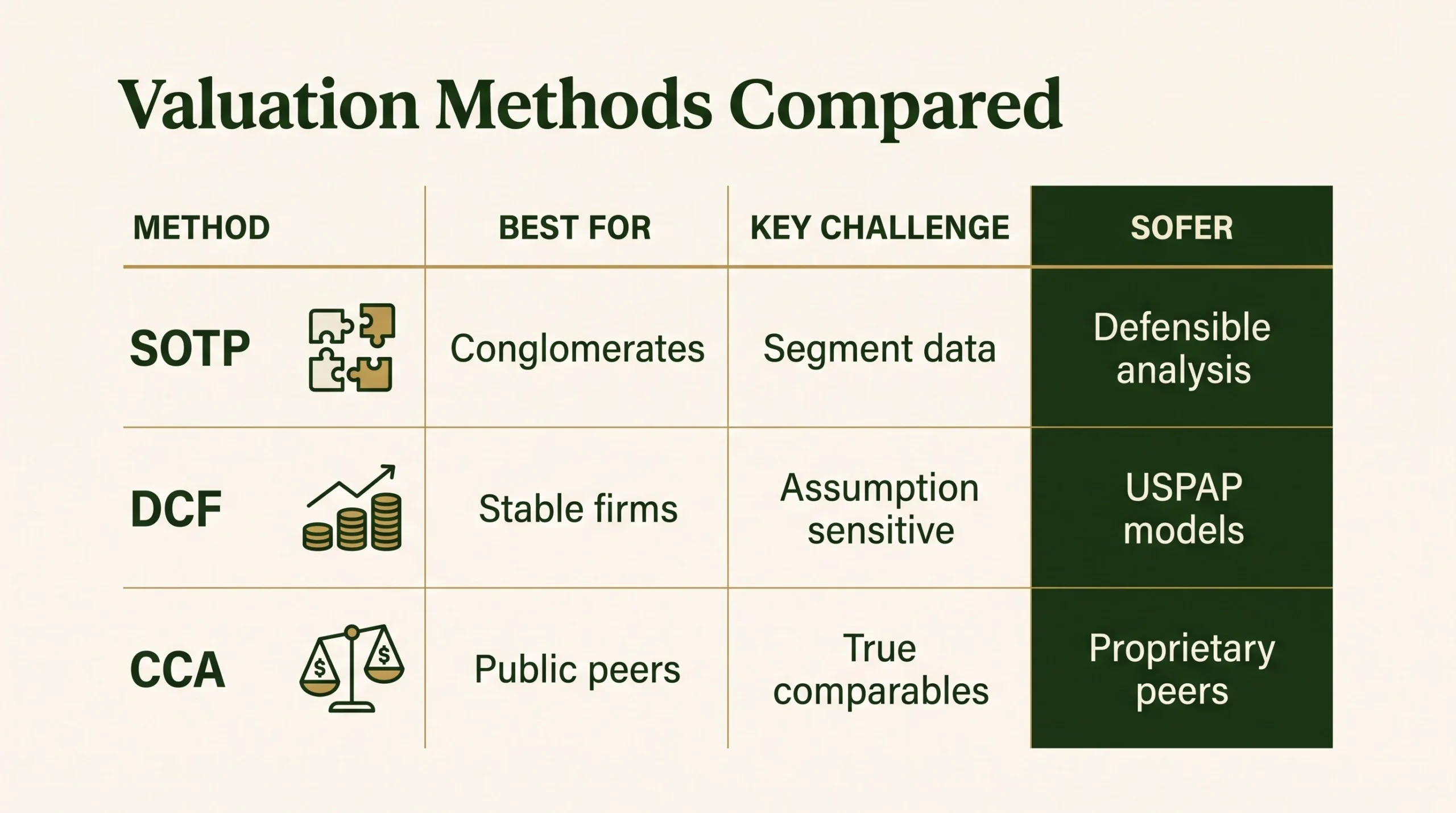
The right method depends on your assets, goal, and industry. The table below compares these methods and how Sofer Advisors handles them next to online learning sites.
| Method | Best For | Key Challenge | Sofer Advisors’ Approach |
|---|---|---|---|
| Sum-of-the-Parts (SOTP) | Conglomerates; holding companies; firms with distinct business units. | Requires detailed segment data; allocating corporate overhead correctly. | Sofer Advisors performs a defensible SOTP analysis for transactions; online sites offer self-study concepts. |
| Discounted Cash Flow (DCF) | Stable, mature companies with predictable cash flows; single-industry firms. | Highly sensitive to assumptions about growth rates and discount rates. | Sofer Advisors builds DCF models based on USPAP standards; online sites provide generic Excel templates. |
| Comparable Company Analysis (CCA) | Companies in industries with many publicly traded peers. | Finding truly comparable companies; market sentiment can distort multiples. | Sofer Advisors selects peer groups from proprietary data; online sites often use outdated or broad examples. |
Your method choice reflects your goal, whether a tax filing or an exit. Online courses show these ideas as fixed formulas, but real work adapts the model to each firm and market. Meeting the USPAP standards from The Appraisal Foundation adds strength that generic templates lack.
A strong model must weigh firm-specific risk, such as management depth or heavy reliance on a few clients. Matching the right method to your goals keeps your position clear and helps every valuation hold up in an audit or a deal.
What should the valuation review compare?
A strong analysis ties each major choice to the records and market facts on the valuation date. The review points below sum up the article’s core decision areas.
| Decision area | Evidence and review focus |
|---|---|
| Why use SOTP instead of other valuation methods | A Sum-of-the-Parts (SOTP) approach is appropriate when a firm operates through heterogeneous business segments that possess distinct risk profiles or growth trajectories. |
| How is a SOTP valuation calculated step-by-step | A Sum-of-the-Parts (SOTP) valuation is calculated by isolating each business unit, valuing them through distinct methodologies, and combining these figures while adjusting for corporate-level liabilities. |
| What are the primary challenges of SOTP analysis | The primary challenges of SOTP analysis include the difficulty of obtaining detailed segment-level financial data and the complexity of allocating joint expenses. |
The final report should tie these areas together, not treat any method or input on its own.
Frequently Asked Questions
What is the sum of the parts?
A sum-of-the-parts calculation finds the true value of a firm. It values each unit as if it stood alone. By splitting each part, the method strips away the effects of combining them. This reveals the real market worth of each platform. Sofer Advisors uses this method to find value drivers that standard combined models often miss.
What are the top 3 valuation methods?
The three main methods are the income approach, the market approach, and the asset-based approach. The income approach uses discounted future cash flows, the market approach uses multiples from peer firms or past deals. And the asset-based approach finds the net value of the firm’s holdings. Sofer Advisors picks the method, or mix of methods, that fits your reporting or deal needs.
When to use SOTP valuation?
Owners use SOTP when a firm has mixed, unrelated parts. They also use it to gauge the value of a sale. This approach works best when a steady core sits next to a fast-growth unit that the current market structure may undervalue.
Is SOTP valuation always accurate?
SOTP rests on set assumptions about each part. These cover unit profits, transfer prices, and shared costs, so it is only as good as its data. If the wrong multiples or bad cash flow estimates go into a part, the final sum will carry those errors through the whole calculation.
What is a conglomerate discount versus a synergy premium?
A conglomerate discount happens when the market values a combined firm below the sum of its parts. This often stems from investor fears about weak management or thin transparency. A synergy premium is added value from cost savings or shared gains that exist only within a combined firm. Sofer Advisors helps owners measure these factors to show if a restructure would truly create value.
How much can a conglomerate discount reduce a firm’s value?
Market data often shows combined firms trade 10 to 15 percent below the sum of their parts. This gap forms when investors see a firm as too complex, fearing poor use of cash or a lack of clear focus. A lasting discount can draw activist investors, who may push for spin-offs so the market can judge each division on its own growth.
Can SOTP value a private company?
Yes. SOTP can value a private firm with many business lines. The appraiser splits the income and risk of each part, then adds them into one final value. Private units often lack public data, so analysts build synthetic multiples by studying peer firms in each field. Sofer Advisors also normalizes the financials, removing one-time items to set a fair base.
What data problems make SOTP analysis hard?
The main hurdles are thin data and shared costs. Public filings often lack fine reports for each unit, so analysts must lean on estimates. Shared value between units adds more strain, since transfer pricing lets one unit charge another inside the firm. Firms may set these prices to meet accounting goals, which can hide the true economic strength of a part.
How does SOTP support M&A and divestiture decisions?
SOTP helps firms find cheap targets and plan sales to lift shareholder value. When weighing a spin-off, it compares the current enterprise value against the total of each part on its own, which helps spot non-core assets. For a buyer, it justifies a price and sets a floor. It also acts as a takeover defense by showing each segment’s true value.
Related Case Studies
- Holding Company Discounts: How DLOC and DLOM Apply to Holdcos
- Business Valuation for Mergers: Buy-Side vs Sell-Side
- Cross-Border M&A Valuation: Currency, Tax, and Comps Adjustments
Executive Summary
A sum-of-the-parts valuation isolates each business unit, values it with the method that best fits its risk and growth, and then adds those figures before adjusting for firm-wide debt and cash. It suits conglomerates, holding companies, and any firm whose segments differ enough that a single blended multiple would mislead. The approach often surfaces a conglomerate discount, where a combined firm trades 10 to 15 percent below the total of its parts, which can invite activist pressure for spin-offs. Its main hurdles are thin segment-level data, shared costs, and transfer pricing that clouds each unit’s standalone worth. Owners apply SOTP to M&A, divestitures, takeover defense, and private-company work, where synthetic multiples and normalized financials build a defensible base. A steady, documented method gives an audit trail that holds up before the IRS, a buyer, or a board.
What Should You Do Next?
First, map your firm into distinct units and isolate the revenue, costs, and capital each one needs. Second, gather segment-level records and flag any shared costs or transfer prices that blur a unit’s standalone worth. Third, engage a certified appraiser to build and document each segment value before you take the plan to a board, buyer, or tax authority.
David Hern CPA ABV ASA, founder of Sofer Advisors provides neutral, defensible valuations for multi-segment and conglomerate firms. Schedule a free consultation to discuss your situation.
People Also Read
- Business Valuation Services United States: Expert Guide 2025
- How Multi-Location Dental Group Practices Are Valued in 2026
About the Author
This guide was prepared by David Hern CPA ABV ASAc, founder of Sofer Advisors, a business valuation firm headquartered in Atlanta, GA serving clients across the United States. David holds dual accreditations as an Accredited Senior Appraiser (ASA) and is Accredited in Business Valuation (ABV), credentials recognized by the IRS, SEC, and FINRA. He also holds the Certified Exit Planning Advisor (CEPA) designation. With 15+ years of valuation experience, David has served as an expert witness in 11+ cases across multiple jurisdictions and built Sofer Advisors into an Inc. 5000-recognized firm with 180+ five-star Google reviews. Its full W2 employee team maintains subscriptions to all major valuation databases and operates under a next business day response policy.
For professional business valuation services, visit soferadvisors.com/about-us/ or contact Sofer Advisors at soferadvisors.com/contact-us/.
Disclaimer: This content is for informational purposes only and does not constitute professional valuation advice. Business valuation conclusions depend on specific facts and circumstances. Contact Sofer Advisors for guidance regarding your specific situation.









