


Last Updated: July 2026
Section 2032A is a rule in the federal tax code that lets an executor value real property used for farming or a small business based on its current use rather than its highest and best use, and that value applies to the federal estate tax.
The estate tax is a tax on the assets a person leaves at death, and this IRS-approved method can lower an estate’s taxable value. The property must meet strict rules for ownership and active work, since the goal is to keep family operations running by easing the cash strain that market-based appraisals often cause.
Sofer Advisors began in February 2019 and its reports have held up in more than 11 expert witness cases across Georgia, Florida, California, and New Mexico. Because rules such as the fifty percent test and the qualified use rule are technical, many owners hire experts so their data supports the needed filings. The sections below break down Section 2032A and show how it shapes estate plans for family firms.
Key Takeaways
- Current Use Valuation: Section 2032A lets families value farm or business real property at its current use. This often means a lower estate tax bill than the standard highest and best use method.
- Inflation-Indexed Reductions: The law caps how much this choice can cut the value, and for estates of people who died in 2024 the tax code limits the cut to $1,390,000.
- Strict Eligibility Criteria: To qualify, an estate must pass set asset and work tests, meeting both the 50% and 25% asset tests while owners also satisfy the active work rules.
- Recapture Period Requirements: Tax savings from this choice are not always permanent, because for 10 years selling the property or ending its qualified use can trigger a recapture tax.
- Formal Election Procedures: Taxpayers must file a formal notice on Form 706 plus a signed agreement from all parties liable for recapture tax.
Each rule ties to the entity’s history and how much each heir takes part, so the sections below examine each one in turn.
What qualifies for Section 2032A special-use valuation?
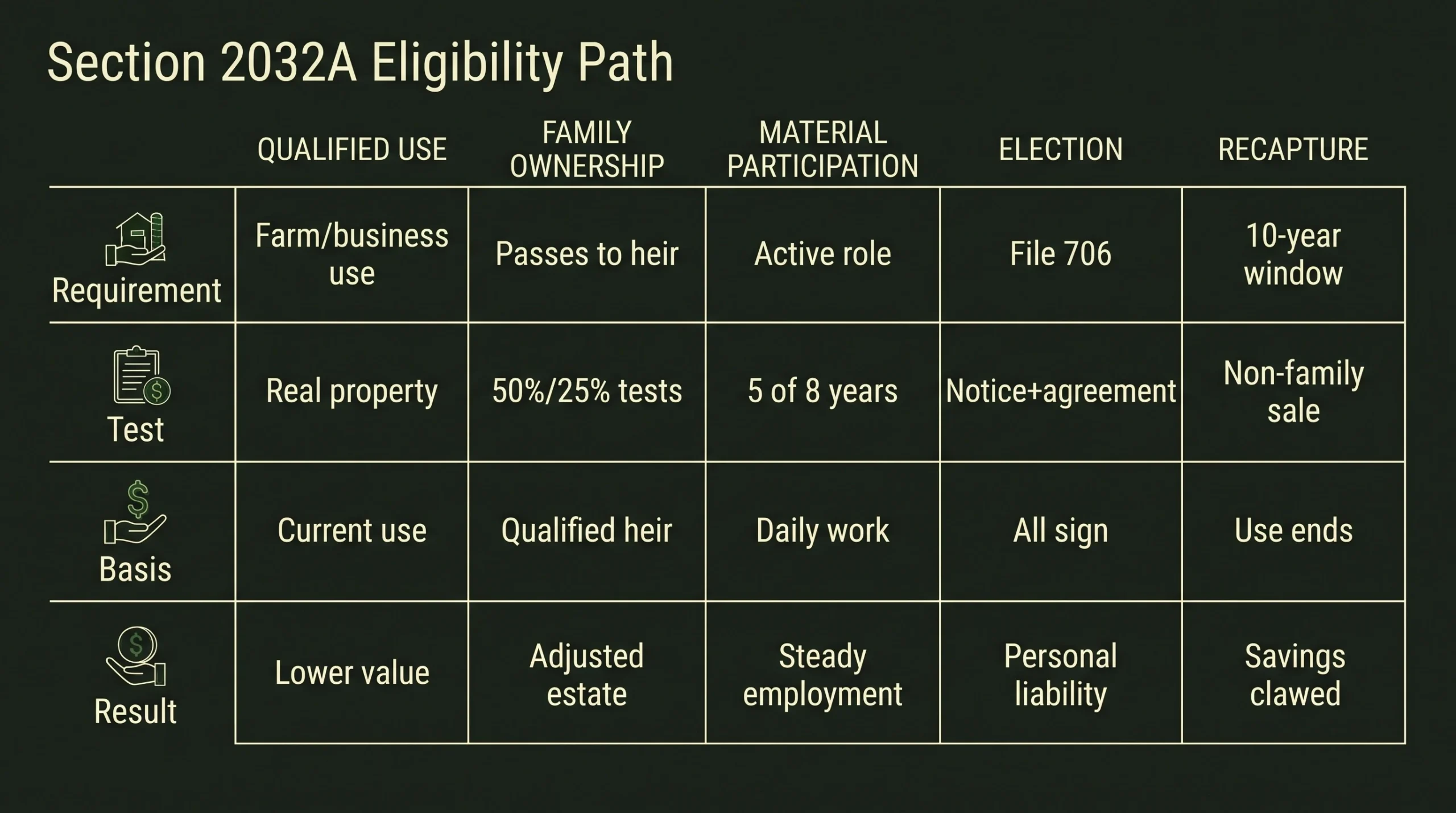
To qualify, the asset must be qualified real property that passes to a qualified heir, and the estate must meet set percentage rules. A qualified heir is a family member who takes the property. The person who died, or a family member, must have met an active work test covering at least five of the eight years before death, so a passive investor who merely held farmland will not clear the bar.
The estate must also pass the 50% and 25% tests set by the IRS. Under the 50% test, the qualified real property must be at least half of the adjusted gross estate, where adjusted value means value after subtracting certain debts. The 25% test works the same way, but the property must be at least one quarter. The IRS estate tax rules frame the baseline reporting behind these tests. Sofer Advisors offers deep skill in tax and estate valuation and often connects it to broader estate planning business valuation work. Families weighing lifetime transfers should also review how Chapter 14 rules under IRC 2701 and 2703 shape the value of interests moved between generations.
How does a special-use election reduce estate taxes?
The choice lowers estate taxes in a simple way: it values qualified real property at its current use instead of its fair market value at the highest and best use, the price a willing buyer would pay. Because that lowers the gross estate, a family farm gets valued on its crop output rather than on a possible sale for stores or homes.
For example, a farm near a growing city may carry a $3 million commercial value but only a $1.5 million farming value. The choice lets the estate report the lower amount, cutting the taxable base right away, though the statute caps the total reduction. Expert help confirms the property meets the rules and documents the fair market value for estate tax that anchors the calculation.
What are the two special-use valuation methods?
The IRS offers two methods: the farm method and the closely held business method. Both apply to estates that meet the federal rules. The farm method divides the average yearly gross cash rent for land by the average yearly interest rate for new Federal Land Bank loans, a mechanical formula that is easy to defend when the inputs are sourced with care.
The closely held business method uses a five-factor test rather than one formula. It weighs the capitalization of income and of fair rental value, where capitalization turns an income stream into a single value. Because it reflects the entity’s real economics, it needs clear data to back each factor. The right method depends on how the business makes its money.
What triggers a recapture of the tax savings?
A recapture tax can hit within 10 years of death. It applies if a qualified heir sells the property to a non-family buyer or stops the qualified use. Recapture means the government takes back the savings that came from the special-use value, keeping the land in active family use.
Recapture also happens if active work stops for more than three years, counted over any eight-year window after death. If an heir fails these work standards, the government may reclaim the skipped tax. Heirs weighing a later sale should study how a stepped-up basis at death interacts with special-use value, since the reduced estate value can lower the heir’s carryover basis and shift the capital gains math.
How is a Section 2032A election made with the IRS?
The executor files the choice on Form 706, the federal estate tax return, and attaches a formal notice of election that includes a written recapture agreement. Every person with an interest in the property must sign it, agreeing to personal liability for any recapture tax if the property fails the use rules. The Form 706 instructions spell out the schedules and attachments the notice must include.
Sometimes an estate seems to qualify but lacks full data at filing. The executor may then send a protective election to keep the right to claim the cut later, once final numbers are confirmed. Sofer Advisors often supports personal representatives through these complex filings.
When is a professional valuation needed for 2032A?
A professional valuation is a must for 2032A. It sets the property’s fair market value at its highest and best use, the baseline used to figure the special-use cut. Estates must define this baseline with care, since it proves the tax benefit fits within legal limits.
Some non-farm businesses qualify under the five-factor method, where a valuation expert confirms the adjustments needed to show current use accurately. A certified appraiser gives records that support both the baseline and the special-use value if the IRS pushes back. Credentialed analysts who follow AICPA standards bring the discipline a defensible estate filing demands.
Families must be ready for an IRS audit through the 10-year recapture period, and clear, expert-backed reports help them defend their positions.
The table below shows how professional help differs from general agency guidance.
| Feature | Sofer Advisors Tax & Estate Valuation | IRS.gov Resources | DOR.WA.gov Resources |
|---|---|---|---|
| Valuation Scope | Determines both Fair Market Value (FMV) and Special-Use Value (SUV) | Provides rules and formulas for calculation; no valuation provided | Provides general property tax assessment rules, not specific to 2032A |
| Recapture Risk Analysis | Proactive planning and analysis of potential recapture events | Defines recapture rules and penalties; offers no advisory | No guidance on federal recapture tax provisions |
| Audit Support | Provides expert defense and documented support for valuation methodology | Publishes audit technique guides for its agents to follow | Manages state-level property tax disputes, not federal estate tax audits |
General resources help you learn the rules but do not review your specific assets, so they cannot say which method saves the most tax. A skilled team studies your land use, income history, and likely operational shifts before building a position that holds up under review. Sofer Advisors uses the Heart of a Teacher approach, putting clear explanations first so families grasp each report and stay compliant through the recapture window.
What should the valuation review compare?
A solid analysis ties each major judgment to the records and to market evidence on the valuation date. The points below sum up the core decision areas.
| Decision area | Evidence and review focus |
|---|---|
| What qualifies for Section 2032A special-use valuation | What qualifies for Section 2032A special-use valuation is determined by whether the asset constitutes qualified real property passed to a qualified heir while meeting specific estate percentage requirements. |
| How does a special-use election reduce estate taxes | A special-use election reduces estate taxes by permitting the valuation of qualified real property at its current use value rather than its fair market value based on the potential highest and best use. |
| What are the two special-use valuation methods | The two special-use valuation methods provided by the IRS include the farm method and the closely held business method. |
The final report should tie these areas together rather than treat any input alone.
Frequently Asked Questions
What is the 2032 of the Internal Revenue Code?
Section 2032 covers how to value a gross estate at the date of death. It requires assets to be appraised at fair market value, with one exception: when the estate elects an alternate valuation date under 2032A or related rules. Sofer Advisors helps executors with detailed valuations that match the specific federal tax rules.
What is the correct valuation of a gift for annual exclusion purposes?
A gift must be valued at its fair market value. This is measured on the date the transfer is made. And the value sets the basis for one key check: whether the amount tops the annual exclusion set by the IRS. Sofer Advisors gives independent, third-party valuations, which keeps the reported amounts solid during an audit or review.
When can you use the alternate valuation date for an estate?
An executor may pick an alternate valuation date for the whole gross estate. But this works only under one condition: it must lower both the gross estate value and the sum of federal estate and generation-skipping transfer taxes. This date is usually six months after the death.
How is date of death valuation calculated?
This process finds the fair market value of all assets owned by the person. It uses the conditions that existed on the day of death, leaning on market data and comparable evidence for the specific asset class.
What is material participation for Section 2032A?
Active work means the person who died, or a family member, took a big role. This role is in the daily work of the farm or business, including steady employment or active choices that shape the commercial success of the entity.
How much can Section 2032A reduce an estate’s value?
The law caps how much this choice can cut the value, so the reduction is not unlimited. For estates of people who died in 2024, the tax code limits the cut to $1,390,000. This figure is inflation-indexed, meaning it adjusts over time. Sofer Advisors helps families confirm the reduction stays within these legal limits when they file.
What actions can trigger a recapture tax under Section 2032A?
A recapture tax can hit within 10 years of the death. It applies if a qualified heir sells the property to a non-family buyer or stops the qualified use. It also applies if active work stops for more than three years, counted over any eight-year window after the death. These rules keep the land in active family use.
What are the 50% and 25% asset tests for Section 2032A?
Both tests measure the qualified real property against the adjusted gross estate, using adjusted value after subtracting certain debts. Under the 50% test, the qualified real property must be at least half of the adjusted gross estate. The 25% test works the same way, but the property must be at least one quarter of that estate.
What is a protective election under Section 2032A?
Sometimes an estate seems to qualify but lacks full data at filing. So the executor may send a protective election to keep the right to claim the cut later. This placeholder shows an intent to seek special-use value once the estate confirms final numbers. Sofer Advisors often gives technical support when these filings grow complex.
Related Case Studies
- Valuation of Closely Held Business for Estate Tax Purposes
- How Family Limited Partnerships Are Valued for Gift and Estate Tax
- Valuation Discounts (DLOC and DLOM) on Estate and Gift Tax Returns
Executive Summary
Section 2032A special-use valuation is a federal estate tax election that values qualified real property at its farm or business use instead of its highest and best use. Eligibility rests on the 50% and 25% adjusted-value tests, transfer to a qualified heir, and material participation for at least five of the eight years before death. The IRS provides two routes: the farm method, which divides average gross cash rent by the average Federal Land Bank interest rate, and the closely held business method, which applies a five-factor test. The reduction is inflation-indexed and capped at $1,390,000 for 2024 deaths.
Executors elect on Form 706 and secure a recapture agreement signed by every interested party, because a sale to a non-family buyer or a halt in qualified use within 10 years can claw back the savings. A professional appraisal sets the highest-and-best-use baseline and defends the special-use figure through the recapture period.
What Should You Do Next?
First, confirm whether your estate can meet the ownership, material participation, and 50% and 25% asset tests that govern eligibility. Second, gather your operational history, property appraisals, and income data well before Form 706 is due. Third, engage a certified valuation professional to set the baseline and model the special-use reduction within legal limits.
David Hern CPA ABV ASA, founder of Sofer Advisors provides neutral, defensible valuations for Section 2032A special-use elections. Schedule a free consultation to discuss your situation.
People Also Read
- Section 1244 Stock: Ordinary Loss Treatment for Failed Businesses
- Is Goodwill Tax Deductible: Section 197 Guide
About the Author
This guide was prepared by David Hern CPA ABV ASAc, founder of Sofer Advisors, a business valuation firm headquartered in Atlanta, GA serving clients across the United States. David holds dual accreditations as an Accredited Senior Appraiser (ASA) and is Accredited in Business Valuation (ABV), credentials recognized by the IRS, SEC, and FINRA. He also holds the Certified Exit Planning Advisor (CEPA) designation. With 15+ years of valuation experience, David has served as an expert witness in 11+ cases across multiple jurisdictions and built Sofer Advisors into an Inc. 5000-recognized firm with 180+ five-star Google reviews. Its full W2 employee team maintains subscriptions to all major valuation databases and operates under a next business day response policy.
For professional business valuation services, visit soferadvisors.com/about-us/ or contact Sofer Advisors at soferadvisors.com/contact-us/.
Disclaimer: This content is for informational purposes only and does not constitute professional valuation advice. Business valuation conclusions depend on specific facts and circumstances. Contact Sofer Advisors for guidance regarding your specific situation.









