


Last Updated: July 2026
A real estate operating company valuation finds the worth of a business that manages, develops, or acquires property to earn money. This model differs from a real estate investment trust, which focuses on passive income and special tax rules. The work takes a clear read on operating cash flow, asset value, and management fees.
Sofer Advisors has seven years in business and an expert-witness record covering 11+ valuation cases across several states. It holds 180+ five-star Google reviews. It serves owners, attorneys, and CPAs who need objective, evidence-based opinions for tax planning or disputes. The approach favors transparency and long-term clarity over quick wins.
Owners and fiduciaries often need an independent view before a major deal or tax filing. Valuing these companies means reconciling the worth of internal management with the value of the real estate itself. The sections below show how to balance those value drivers in a shifting market.
Key Takeaways
- Active versus passive: a REOC creates value through active control and growth; a REIT holds property passively.
- Two-part method: analysts calculate the net asset value of the property and the enterprise value of the operating business.
- Sum-of-the-parts: this method values real estate, management services, and development arms as distinct pieces.
- Core value drivers: net operating income, cap rates, the development pipeline, and management expertise.
- Standard of value: the purpose sets the standard, such as fair market value for tax or fair value for reporting.
Each point shapes the total worth of a REOC in a formal valuation. The sections below show how these metrics and methods drive the final conclusion for owners and their advisors.
What defines a Real Estate Operating Company?
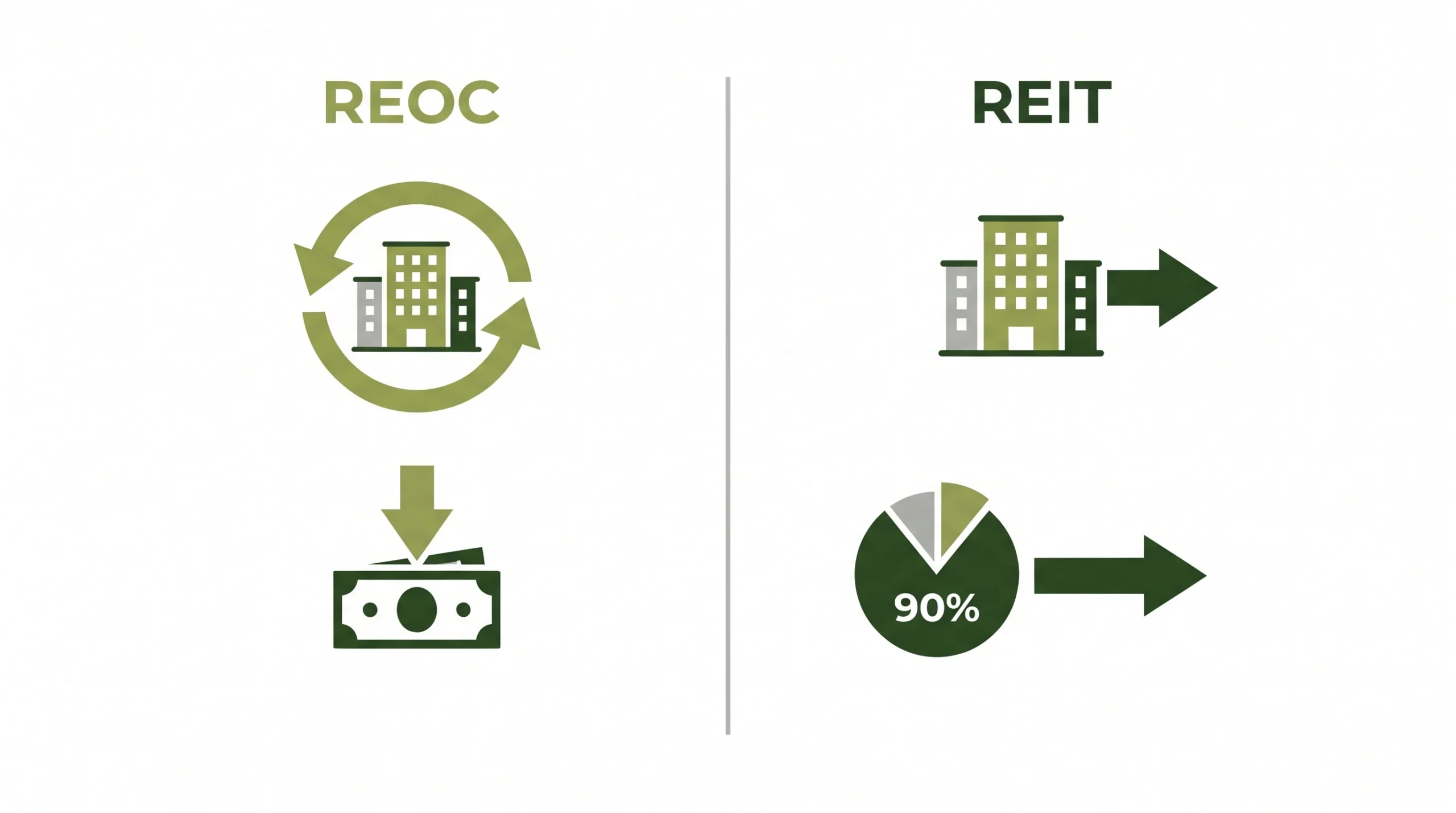
A Real Estate Operating Company, or REOC, earns its main income by actively developing and managing property, not just holding it for rent. A Real Estate Investment Trust works as a pass-through entity that sends most of its income to shareholders. A REOC instead keeps earnings and reinvests them in new projects and growth. These firms operate as C-corporations or LLCs. They build enterprise value through real estate skill, brand, and the ability to close complex deals.
That enterprise value often tops the simple sum of the property values. The market pays a premium for the recurring cash flow from active operations and services. Owners use business valuation services to separate this operating premium from the passive asset base.
Why does a REOC valuation differ from a REIT?
A REOC valuation counts the going-concern value of active operations. A REIT valuation focuses on property values and pass-through income rules. A REIT must pay out 90% of taxable income as dividends each year to keep its tax status. That rule limits the cash it keeps inside the entity. So its value often tracks the net asset value of the holdings plus the stability of the income.
A REOC faces no such payout rule. It can reinvest earnings into property improvements or new service lines to fuel growth. Because growth drives a REOC, analysts often use a discounted cash flow model to capture the present value of future benefits. The ability to retain capital shifts the focus from simple yield to long-term growth.
Which valuation methods apply to REOCs?
REOC valuation uses the income, market, and asset approaches, often combined in a sum-of-the-parts (SOTP) analysis. The income approach discounts projected net operating income at the property level. That finds the present value of future cash flow from each asset. The market approach compares the REOC to similar public companies using valuation multiples.
When a company holds assets with different risk profiles, a SOTP analysis is essential. It appraises each item on its own:
- Each individual property and its net operating income
- The management company and its fee income
- Any internal development arm and its pipeline
- Intangible drivers like brand and tenant relationships
Summing these pieces gives a full enterprise value. This keeps every segment captured to the real financial picture of the portfolio. Sofer Advisors applies SOTP so owners see exactly where value comes from.
Talk to a Sofer Advisors specialist about balancing property and operating value in a defensible report.
How are a REOC’s intangible assets valued?
A REOC’s intangible assets are valued by their contribution to cash flow, stability, and competitive position beyond the property base. Hard assets like land and buildings sit on the balance sheet. Intangibles supply the recurring revenue premium that sets a high performer apart from a basic holding company. Analysts measure these by how internal strengths create earnings above standard benchmarks.
Management expertise is often the biggest intangible driver. Skilled oversight brings better lease renewals and lower vacancy than peers. A strong brand helps secure prime locations and better financing terms. Valuable development rights add a clear path to future growth. Together these let a firm earn above-market rents, which lifts business value. Seasoned advisors isolate these returns through a multi-period earnings analysis, so the final figure reflects real operating success. Where restrictions apply, our guide to marketability discounts shows how they affect the number.
What are common reasons for a REOC valuation?
Common reasons include M&A deals, bank financing, shareholder disputes, strategic planning, and tax reporting for estate and gift purposes. Each event sets a specific standard of value. Tax reporting usually calls for fair market value, which follows IRS Revenue Ruling 59-60. Financial reporting often calls for fair value, defined under ASC 820.
Merging or selling part of an active property group needs a defensible opinion to protect all sides. A shareholder dispute prompts a third-party review to set a dissenting partner’s interest. Sofer Advisors applies rigorous, neutral analysis to clarify each stakeholder’s position. Knowing these triggers early helps owners plan for the time and cost of a formal report.
How do debt levels affect REOC value?
Debt affects REOC value mainly by adjusting equity value after you subtract total debt from enterprise value. Once the income approach sets enterprise value, debt comes out to isolate the equity holders’ worth. The share of debt in the capital structure also changes the cost of capital. Higher debt raises the risk profile, which lifts the cost of equity.
Too much debt can lower the valuation multiple, because the business carries more risk. Used well, debt funds acquisitions that open new markets. That growth can raise total enterprise value by lifting cash flow. Each owner must weigh the trade-off so the debt supports the company’s purpose. A neutral analysis finds the point where debt aids growth without adding undue risk.
Which valuation provider is best for a REOC?
Owners pick a provider based on the report’s use: tax, transaction, or litigation each need their own rigor. Large advisory practices like Alvarez & Marsal, Stout, and Kroll handle big-cap real estate deals and fairness opinions. A valuation-first firm pairs business enterprise analysis with asset-specific work. The table below compares the options.
| Provider type | Typical focus | Typical timeline |
| Sofer Advisors | Enterprise value, SOTP, and intangibles for tax, deals, and disputes | 4-8 weeks |
| Local CPA firm | Tax compliance and reporting with asset-based methods and local comps | 5-9 weeks |
| Large national firm | Big-cap M&A, fairness opinions, and public-company comparisons | 6-10 weeks |
The right provider balances your business model with the standards that govern your engagement. If you run active operations alongside real estate, a firm that combines enterprise and asset analysis gives the most defensible result. The chosen method should match the report’s purpose, since fair value for reporting differs from fair market value for estate tax. High standards matter most when facing IRS review or a shareholder dispute.
REOC valuation rewards clear data and the right method. The questions below cover what owners ask most.
Frequently Asked Questions
What is the difference between a REOC and a REIT?
A REIT is a tax-advantaged entity the IRS requires to pay out 90% of taxable income to shareholders each year, which limits reinvestment. A REOC is an active business that keeps its earnings to fund growth, acquisitions, and new services. Sofer Advisors separates these entities during analysis, because their capital structures change whether a market or income approach fits best.
How do you value a real estate LLC?
You assess the market worth of all underlying properties, then account for debt and the tax structure. The analyst decides whether the entity is a passive holding vehicle or an active business with staff and management duties. Sofer Advisors applies the right standard of value by reviewing your LLC operating agreement and historical cash flow.
Are cap rates used to value a REOC’s entire business?
Cap rates apply mainly to the underlying real estate, not the whole enterprise with its active services or staff. The asset portion may use a cap rate, but valuing the full business needs the income approach to capture intangibles and future growth. Sofer Advisors blends asset-based and income-based methods to give a complete picture of total value.
How does debt affect the valuation of a real estate operating company?
Debt sets the residual equity value and shapes the risk applied to future cash flow. A high debt-to-equity ratio often raises the cost of capital, which adjusts the discount rate in an income approach. Sofer Advisors reviews your debt service and capital structure so the valuation reflects your company’s real financial standing.
What documents are needed for a REOC valuation?
Prepare three to five years of federal tax returns, current year-to-date financials, and a detailed schedule of all real estate assets. Property appraisals, rent rolls, and organizational agreements are also essential to verify ownership and operating rights. Sofer Advisors requests these early so the analysis stays accurate.
What is a major disadvantage of a REOC compared to a REIT?
A REOC does not get the same pass-through tax benefit as a REIT, which can mean a higher entity-level tax burden. REITs avoid corporate income tax if they meet strict payout rules. Sofer Advisors weighs these tax effects to help owners see how entity choice shapes the final value.
Can an operating agreement affect a REOC valuation?
Yes. Operating agreements often hold buy-sell terms or transfer limits that can support a discount for lack of marketability. These documents set partner rights and governance, which affects how a buyer prices the interest. Sofer Advisors reviews each clause to decide whether a restriction warrants an adjustment to the final figure.
Why is a sum-of-the-parts analysis used for REOCs?
SOTP separately values the property portfolio and the active operations, so the total is not oversimplified. By isolating tangible assets and intangible business pieces, owners see exactly where value comes from. Sofer Advisors runs this analysis so every layer, from holdings to management services, gets an accurate, defensible value.
How much does a REOC valuation from Sofer Advisors cost?
A REOC valuation from Sofer Advisors runs $7,500 to $25,000, based on its published engagement data. Cost depends on the complexity of your real estate holdings and the purpose of the report. For a quote tied to your portfolio, request a valuation estimate with your rent roll and entity documents.
Related Case Studies
- Business Valuation for a Partner Buyout: A Complete Transition Guide
- Shareholder Dispute Valuation: Resolving Partner Conflicts
- Eminent Domain Business Valuation: Property and Owner Rights
Executive Summary
A REOC creates value through active management, so its valuation must weigh both the real estate and the operating business. That is why analysts use a sum-of-the-parts approach: value the portfolio, the management company, and any development arm, then combine them into an enterprise value. Unlike a REIT, a REOC keeps its earnings, which shifts the focus from yield to growth and favors a discounted cash flow model. To prepare, gather three to five years of financials, a schedule of property holdings, rent rolls, and your operating agreement. Match the standard of value to the report’s purpose, whether fair market value for tax or fair value for reporting.
What Should You Do Next?
Compile your last three to five years of financials, current property schedules, and development budgets, and confirm they align with your tax reporting. Decide the report’s purpose early, since it sets the standard of value. A qualified valuation can then combine the property and operating pieces into a defensible whole.
David Hern CPA ABV ASA, founder of Sofer Advisors, brings deep experience in business and asset-based valuations for real estate firms. Schedule a free consultation to discuss your situation.
People Also Read
- Purchase Price Allocation ASC 805 and IFRS 3: A Complete Guide
- Cost Basis vs Fair Market Value: Key Differences Explained
About the Author
This guide was prepared by David Hern CPA ABV ASA, founder of Sofer Advisors, a business valuation firm headquartered in Atlanta, GA serving clients across the United States. David holds dual accreditations as an Accredited Senior Appraiser (ASA) and is Accredited in Business Valuation (ABV), credentials recognized by the IRS, SEC, and FINRA. He also holds the Certified Exit Planning Advisor (CEPA) designation. With 15+ years of valuation experience, David has served as an expert witness in 11+ cases across multiple jurisdictions and built Sofer Advisors into an Inc. 5000-recognized firm with 180+ five-star Google reviews. Its full W2 employee team maintains subscriptions to all major valuation databases and operates under a next business day response policy.
For professional business valuation services, visit soferadvisors.com/about-us/ or contact Sofer Advisors at soferadvisors.com/contact-us/.
Disclaimer: This content is for informational purposes only and does not constitute professional valuation advice. Business valuation conclusions depend on specific facts and circumstances. Contact Sofer Advisors for guidance regarding your specific situation.









