


Last Updated: June 2026
A roofing company is worth 3x to 6x EBITDA when sold to a sophisticated buyer. The spread is driven by whether revenue is recurring commercial work or storm-chasing residential. It also depends on how much the business relies on the owner-operator. And it depends on how well the crew structure is documented and kept in place. Many roofing owners with $500,000 to $3 million in adjusted earnings assume their companies are worth 5x or more. But the better question is what adjustments a buyer will make to your EBITDA before applying any multiple.
Roofing is one of the more nuanced valuation exercises in lower-middle-market M&A. Revenue traits vary greatly across the residential storm, commercial, and new construction segments. A storm company that made $4 million in a hail year is not a $4 million business. In a quiet year, it earns $1.8 million. That is the real baseline. The adjustment for storm dependence is the first and most important step in any roofing valuation. Sofer Advisors helps owners and their advisors work through exactly these questions and turn the analysis into a defensible business valuation they can act on.
The following takeaways summarize the key valuation and transaction factors covered in this guide.
Key Takeaways
- Roofing EBITDA Multiples Range – Roofing EBITDA multiples range from 3x to 6x, with commercial/service-heavy companies at the top and storm-dependent residential companies at the lower end
- Revenue Adjustment Stripping Out – Revenue adjustment – stripping out one-time storm windfalls and applying a sustainable run-rate – is the most important step in roofing valuation
- Crew Dependency Subcontractor Reliance – Crew dependency and subcontractor reliance are the primary operational risks buyers underwrite
- Owner – operator Businesses Require EBITDA – Owner-operator businesses require EBITDA add-backs for below-market owner salary and personal expenses; buyers apply normalized pay before applying a multiple
- Fleet Equipment Vehicle Condition – Fleet, equipment, and vehicle condition affect both adjusted EBITDA and asset value available to offset purchase price
- Certified Valuation Sale Process – A certified valuation before any sale process prevents underpricing and provides a defensible baseline for negotiation
Each of these factors is examined in depth in the sections that follow.
How Do I Value My Roofing Company?
Valuing a roofing company starts with picking the right earnings metric. For smaller owner-operated shops, seller’s discretionary earnings (SDE) is more common. For managed businesses with professional management, EBITDA is the right metric. Then you apply a market multiple after adjusting for one-time revenue events and owner-specific expenses.
For companies under $1 million in SDE or adjusted EBITDA, the SDE multiple approach is standard. SDE adds back owner salary, personal benefits, depreciation, amortization, and one-time items to net income. SDE multiples for small roofing companies typically range from 2.5x to 4x. The exact position depends on customer concentration, geographic market, work mix, and whether the owner-operator will stay through the transition.
For larger companies, those generating $1 million or more in adjusted EBITDA, the EBITDA multiple framework applies. Those multiples run from 3.5x to 6x EBITDA. The exact position within that range is driven by the factors below.
| Business Profile | Earnings Metric | Typical Multiple |
|---|---|---|
| Small owner-operator, residential storm (<$750K SDE) | SDE | 2.5x–3.5x SDE |
| Mid-size owner-operated, mixed work ($750K–$1.5M SDE) | SDE or EBITDA | 3x–4.5x |
| Managed business, commercial focus ($1M–$3M EBITDA) | EBITDA | 4x–6x EBITDA |
| Service/maintenance contract base ($1M+ EBITDA) | EBITDA | 4.5x–6x EBITDA |
| Storm-only residential, high revenue volatility | Normalized EBITDA | 3x–4x normalized |
What separates a 4x business from a 6x business is almost never revenue size alone. It is the predictability of earnings and the depth of management. It is the mix of recurring versus opportunistic revenue. And it is the absence of single-point-of-failure risks.
A market multiple is a starting point, not a conclusion of value. A defensible fair market value still rests on the factors the IRS sets out for valuing closely held businesses under Revenue Ruling 59-60.
How Does Storm Revenue Affect Roofing Company Value?
Storm-chasing revenue, jobs from insurance claims after hail, wind, or other severe weather, is the most volatile revenue stream in roofing. A company that made $5 million in revenue during an active storm year but $2.2 million in a quiet year is not a $5 million company. Any competent buyer will adjust this downward. Sellers who anchor to peak revenue will face long negotiations. Many will watch deals fall apart.
Buyers adjust storm revenue in several ways. They may take a three-year to five-year average of revenue and exclude obvious outliers. They may use trough-year EBITDA as a floor for their downside scenario. Or they may apply a haircut to storm-dependent revenue and treat it as a variable rather than a baseline. The less a business depends on storm activity for its profit, the higher the applicable multiple.
Commercial roofing, upkeep contracts, re-roof schedules, and service agreements with property management companies, is the highest-value revenue type. It recurs. It is schedulable. It does not depend on weather events or insurance claims approvals. A roofing company with a commercial upkeep book generating $800,000 in annual revenue on defined service agreements is much more valuable per dollar of EBITDA than one that generates the same EBITDA mainly from storm-driven insurance claims.
New construction residential work sits in the middle. It is more predictable than storm work but depends on housing starts. Companies heavily concentrated in new construction are exposed to residential permitting cycles and builder relationships. Buyers view this as moderate risk.
The key point for roofing owners planning a sale: shifting revenue mix toward commercial upkeep and service contracts in the two to three years before a deal directly improves both adjusted EBITDA and the applicable multiple. That is a compounding benefit.
What Is the 25% Rule for Roofing, and Does It Matter in Valuation?
The 25% rule in roofing refers to the industry heuristic that subcontracted labor should not exceed 25% of total job cost. The logic is that above that threshold, margin erosion becomes large. The business also risks losing quality control, project management discipline, and direct ties with the crews doing the work.
From a valuation standpoint, heavy subcontractor reliance is a risk factor. When buyers look at a roofing company that performs 60%–70% of its installation work through subcontractors, they assess several risks. These include how durable subcontractor relationships are and the liability exposure from subcontractor safety and licensing issues. They also include margin compression from passing work through a sub network. And they include the owner’s actual control over job quality.
Buyers also look at subcontractor reliance as a potential misclassification risk. Roofing companies that have long-term subcontractors who work only for them, follow the company’s schedule, and use company equipment may face IRS or state labor department scrutiny on worker classification. That contingent liability, if found in due diligence, will either require escrow holdbacks or result in a price cut.
For valuation purposes, a roofing company that mainly uses W-2 employees is a more defensible business. It shows operational control. It reduces misclassification risk. And it proves the company can hold quality standards without depending on subcontractor crews in a tight labor market.
David Hern CPA ABV ASA, founder of Sofer Advisors, brings a Heart of a Teacher to every engagement – translating complex valuation methodology into clear, actionable guidance that clients can act on before and after the report is delivered. With 15+ years of valuation experience, 11+ expert witness cases across multiple jurisdictions, and 180+ five-star Google reviews, David built Sofer Advisors into an Inc. 5000-recognized firm. The Sofer Difference is a four-phase process of Discovery, Diligence, Analysis, and Delivery that ensures every conclusion is defensible, documented, and tied to the specific facts of the business.
While national firms like Stout and Kroll serve large enterprise clients, Sofer Advisors specializes in middle-market businesses that require personalized attention, direct access to credentialed professionals, and a next business day response policy.
How Does an Owner-Operator Structure Affect Roofing Valuation?
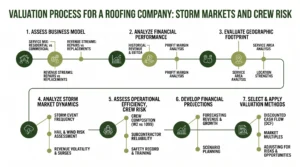
Most roofing businesses under $10 million in revenue are run by owner-operators. These owners are directly involved in sales, project management, estimating, and customer relationships. The extent of that involvement, and what happens to the business when that person leaves, is the central question in every roofing company sale.
Buyers will adjust owner pay to market rate as part of their EBITDA calculation. Say an owner-operator pays themselves $120,000 and a replacement general manager would cost $180,000. Buyers will deduct the extra $60,000 from stated EBITDA before applying a multiple. On the other side, if the owner has been drawing $300,000 from a business that would need a $180,000 manager to replace, the add-back of $120,000 raises EBITDA and improves the valuation.
But pay adjustment is the easy part. The harder question is what exact functions the owner performs that a buyer must hire for or absorb. If the owner is the main estimator for all large commercial bids, they may also be the sole relationship holder with the top three commercial clients. They may handle all insurance adjuster talks. In that case, the business faces real key-person risk. Buyers will discount for that.
Sellers who are getting their roofing businesses ready for a sale should start delegating owner-specific functions to managers or supervisors. Do this at least two to three years before the deal. Put customer relationship management in a CRM system. Train a lead estimator to handle bids on their own. These are key steps. Having an operations manager run day-to-day site management removes the key-person discount. It lets the business command the upper end of its applicable multiple range.
How Is a Roofing Business Worth With $500,000 in Sales?
A roofing company with $500,000 in gross sales is valued almost entirely on SDE, seller’s discretionary earnings, rather than revenue. At $500,000 in sales, EBITDA margins in roofing typically run between 10% and 25% after all direct costs. The actual earnings available to an owner-operator might be $50,000 to $125,000 before the owner’s salary add-back.
If the owner pays themselves $80,000 and takes home another $30,000 in benefits, SDE might be $130,000 to $235,000 at that revenue level. At a 2.5x to 3x SDE multiple, the business would be worth $325,000 to $700,000. That is a wide range. The position within it depends on the same factors as larger companies: work mix, crew structure, customer concentration, and transfer value.
A $500,000-revenue roofing company is typically acquired by an individual buyer or a regional roofing company. They use it as a crew and customer acquisition tactic. Institutional buyers and PE-backed platforms are generally not looking at businesses this size. The multiple is lower than for larger businesses. There is less management depth. The risks of customer and employee loss after close are also higher.
The practical benchmark for a $500,000 revenue business: if the business needs the owner to work full-time to generate that revenue, the enterprise value above equipment and vehicle fair market value is limited. But if the owner has a lead foreman who manages crews, the picture changes. Add a part-time office administrator handling estimates and billing. The business has more transfer value. It will command a higher multiple.
The questions below address the most common issues business owners raise before engaging a qualified appraiser for a value roofing company storm engagement.
Frequently Asked Questions
What is a roofing company worth?
Most roofing companies sell for 3x to 6x EBITDA, or 2.5x to 4x SDE for owner-operated businesses. The exact multiple depends on revenue mix, crew structure, owner dependency, geographic market, and adjusted earnings after accounting for one-time storm revenue and owner pay.
How do I maximize the value of my roofing company before selling?
Build commercial upkeep and service contract revenue. Delegate owner-specific functions to managers. Normalize crew structure toward W-2 employees. Maintain clean financial records for at least three years. Document customer and subcontractor relationships in a transferable format.
What is the 25% rule for roofing?
The 25% rule is an industry heuristic suggesting subcontracted labor should not exceed about 25% of job costs. For valuation purposes, heavy subcontractor reliance raises buyer concerns about margin quality, misclassification risk, and operational control.
How does insurance claim revenue affect roofing valuation?
Insurance claim revenue from storm work is treated as volatile and subject to adjustment by buyers. Companies heavily dependent on storm activity for EBITDA will see their adjusted earnings discounted, compressing the effective multiple.
Do roofing companies sell based on revenue or EBITDA?
Buyers underwrite on earnings, EBITDA or SDE, not revenue. A $5M revenue roofing company with 5% EBITDA margins is worth less than a $3M revenue company with 20% margins. Revenue is useful context but not the primary valuation driver.
What do roofing company buyers look for in due diligence?
Financial statements for 3–5 years, crew employee records and subcontractor agreements, customer concentration analysis, insurance and bonding records, vehicle and equipment schedules, and key contract terms with commercial accounts.
Can I sell my roofing company if I am the primary estimator and salesperson?
You can, but the key-person risk will compress the multiple unless you transition those functions before the sale or agree to an extended post-close earnout period tied to retained business performance.
What is SDE vs. EBITDA for a roofing company?
SDE adds owner salary and benefits back to net income along with depreciation, amortization, and one-time items. EBITDA adds only depreciation, amortization, interest, and taxes back to net income, assuming the owner is already being paid market rate. SDE is typically used for businesses under $1M in earnings; EBITDA applies above that threshold.
How does fleet and equipment affect roofing company value?
Equipment and vehicles can be valued separately as hard assets or factored into EBITDA analysis through depreciation adjustment. Buyers in asset-heavy roofing acquisitions may apply a lower earnings multiple but attribute value to the equipment separately. The net purchase price is similar either way.
Are Georgia and Southeast roofing companies valued differently than national averages?
The Southeast is an active storm market. Roofing companies in Georgia, Tennessee, and the Carolinas may show higher revenue volatility than companies in less storm-prone markets. Buyers apply similar fundamental frameworks but will scrutinize storm adjustment more carefully in high-hail-frequency geographies.
Related Case Studies
- Construction Company Valuation Georgia Complete Industry Guide
- How To Value Construction Company Expert Business Valuation Guide
- Selling A Business In Georgia Complete Exit Planning Guide 2026
Executive Summary
- Roofing companies sell for 3x to 6x EBITDA, with commercial/service-oriented businesses at the upper end and storm-dependent residential operators at the lower end
- Storm revenue adjustment is the most important valuation step – buyers underwrite sustainable run-rate earnings, not peak-year windfalls
- Owner-operator dependency creates key-person risk that reduces applicable multiples; delegating sales, estimating, and operations to managers is the primary value-enhancement lever
- SDE multiples of 2.5x–3.5x apply to small owner-operated shops; EBITDA multiples of 4x–6x apply to managed businesses with $1M+ in earnings
What Should You Do Next?
If you own a roofing company and are thinking about a sale in the next two to five years, a certified business valuation tells you exactly where you stand. It also shows you the most impactful improvements to make before you enter a buyer process. David Hern CPA ABV ASA, founder of Sofer Advisors, holds dual ASA and ABV credentials recognized by the IRS, SEC, and FINRA, with 15+ years of valuation experience and 180+ five-star Google reviews. Schedule a consultation to discuss your business valuation needs.
People Also Read
- Technology Company Valuation Methods A Complete Guide
- Technology Company Valuation Atlanta Guide For Startups And Growth Companies
About the Author
This guide was prepared by David Hern CPA ABV ASA, founder of Sofer Advisors – a business valuation firm headquartered in Atlanta, GA serving clients across the United States. David holds dual accreditations as an Accredited Senior Appraiser (ASA) and is Accredited in Business Valuation (ABV), credentials recognized by the IRS, SEC, and FINRA. He also holds the Certified Exit Planning Advisor (CEPA) designation. With 15+ years of valuation experience, David has served as an expert witness in 11+ cases across multiple jurisdictions and built Sofer Advisors into an Inc. 5000-recognized firm with 180+ five-star Google reviews. The firm’s full W2 employee team maintains subscriptions to all major valuation databases and operates under a next business day response policy.
For professional business valuation services, visit soferadvisors or schedule a consultation.
This content is for informational purposes only and does not constitute professional valuation advice. Business valuation conclusions depend on specific facts and circumstances. Contact Sofer Advisors for guidance regarding your specific situation.