


Last Updated: June 2026
This article is for business owners considering a sale within the next one to five years. By the end, you will know which 12 factors carry the most weight and what steps to take now to protect your exit value.
An exit readiness assessment is a structured review of a business across financial, operational, and legal dimensions to find how prepared it is for a sale or ownership transfer. Buyers apply systematic scoring models before they submit a letter of intent, and gaps in any area reduce both the price and the probability of closing. This process turns a vague idea of “what my business is worth” into a specific, defensible number backed by verified data.
Most owners assume the market values their company based on revenue alone. Buyers today, whether private equity groups, strategic acquirers, or individual investors, score dozens of variables before committing capital. Firms like Sofer Advisors, headquartered in Atlanta, GA, work with middle-market owners to close readiness gaps before the buyer conversation starts. Waiting until a deal is in motion is the most common mistake sellers make.
Key Takeaways
- Financial Documentation Quality – Buyers request three years of audited or reviewed financials, and missing records reduce offers by 10-20% on average.
- EBITDA Normalization – Adjusted earnings often differ from reported net income by 15-40%, making this the highest-impact factor in deal pricing.
- Customer Concentration Risk – If one customer represents more than 20% of revenue, most private equity buyers apply a direct discount or add an earnout clause.
- Owner Dependency – Businesses where the owner controls key client relationships typically trade at 1-2 turns lower EBITDA multiple than owner-independent companies.
- Legal and Compliance Readiness – Unresolved litigation, missing corporate records, or lapsed IP registrations can delay or kill a deal at the due diligence stage.
- Timing of the Assessment – Starting 24-36 months before a target sale date gives owners the runway needed to fix issues that take time to resolve.
Understanding these six areas is a starting point. The sections below examine each of the 12 buyer scoring factors in detail.
What Is an Exit Readiness Assessment?
An exit readiness assessment is a pre-sale audit that scores your business on the dimensions buyers use when they build their valuation models. It covers financial quality, operational stability, market position, and legal structure. The goal is to identify gaps before a buyer does, while you still have time to fix them.
The assessment is not the same as a business valuation. A business valuation produces a concluded value using the income approach, market approach, or asset approach. An exit readiness assessment identifies which improvements would change that number and by how much. Data from EY and PCE Companies confirms that prepared sellers close faster and at higher prices.
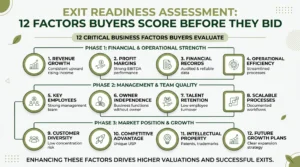
Why Do Buyers Score 12 Specific Factors?
Buyers score 12 specific factors because each one addresses a distinct source of post-acquisition risk. Paying a higher multiple requires confidence that earnings will hold after closing. The 12 factors fall into three groups: financial quality, operational stability, and structural integrity:
- EBITDA accuracy and normalization
- Revenue trend over three or more years
- Gross margin stability by product or service line
- Customer concentration as a percentage of top-5 revenue
- Recurring vs. one-time revenue mix
- Employee retention and key-person dependency
- Management depth below the owner level
- Documented processes and systems
- Intellectual property ownership and registration
- Legal entity cleanliness, including cap table
- Regulatory compliance history and open liabilities
- Technology infrastructure and data security
Buyers ask one core question: will this business perform after I write the check? A company with strong revenue but weak documentation on items 8 through 12 trades at a discount.
How Does EBITDA Normalization Change Your Price?
EBITDA normalization adjusts reported earnings to remove non-recurring items and owner-specific expenses. It produces the true run-rate earnings a buyer will use to set price. This step often changes the headline number by 15-40%, making it the highest-impact factor in exit readiness.
Common add-backs include above-market owner pay, personal vehicle expenses, one-time legal fees, and non-recurring write-offs. Buyers accept documented add-backs but challenge anything that looks aggressive. The quality of your support finds whether an add-back sticks.
EBITDA multiples in the middle market ranged from 4x to 8x for most service and manufacturing businesses. A $200,000 swing in normalized EBITDA at a 6x multiple equals $1.2 million in purchase price. Owners often under-report add-backs because they do not know what qualifies. A credentialed valuation professional captures every legitimate add-back in a format buyers cannot challenge.
What Are the 5 Ds of Exit Planning?
The 5 Ds of exit planning are five involuntary triggers that force an ownership transition: death, disability, divorce, disagreement, and distress. Planning only for a voluntary sale misses that many ownership changes happen on someone else’s timeline.
Each of the 5 Ds creates a different valuation and legal challenge. Death or disability without a buy-sell agreement can trigger forced liquidation at values well below fair market value. Divorce converts business ownership into a marital asset. Distress collapses negotiating power.
A complete exit readiness assessment addresses all five triggers. For many owners, disability is the highest-probability involuntary exit event, yet most planning conversations ignore it. Including the 5 Ds applies the same risk logic buyers use when scoring key-person dependency.
How Does Owner Dependency Lower Your Multiple?
Owner dependency lowers your multiple because buyers are not buying you. They are buying the earnings your business will generate after you leave. If customers buy from you personally, the buyer acquires elevated risk. The same is true if your technical knowledge is the only reason the business works.
Valuation professionals measure owner dependency across four dimensions. These are: customer relationships held only by the owner, proprietary processes the owner alone knows, vendor relationships tied to the owner personally, and decisions no employee can make without approval.
| Dependency Level | Customer Retention Risk | Typical Multiple Impact |
|---|---|---|
| Low (owner = less than 10% of client contact) | Minimal | No discount applied |
| Moderate (owner manages 11-30% of client relationships) | Some risk at transition | 0.5-1.0 turn discount |
| High (owner manages 31-60% of client contact) | Significant churn risk | 1.0-2.0 turn discount |
| Severe (owner is primary or sole client contact) | Deal-breaker for most PE buyers | Deal may not close |
This table reflects general patterns from middle-market transaction data. Actual discount depends on the buyer’s risk model and industry. Sellers with high dependency scores typically have 18-36 months to reduce it. The fix requires promoting a manager to handle client relationships, documenting every process, and introducing key clients to other team members.
When Should You Start Exit Planning?
You should start exit planning at least 24 to 36 months before your target exit date. Starting 48 to 60 months out is better. The timeline is driven by how long it takes to fix the problems the assessment identifies.
The sale process itself takes 9 to 18 months from engaging an investment banker to closing. If the assessment finds owner dependency or weak management depth, fixing those issues adds another 12 to 36 months. The realistic total preparation horizon is 2 to 5 years for most owners.
David Hern CPA ABV ASA, founder of Sofer Advisors, brings a Heart of a Teacher to every engagement. He explains what each readiness gap costs in dollar terms and walks owners through the steps to close it.
How Do You Fix Gaps Found in an Assessment?
Fixing gaps starts with prioritizing issues by their dollar impact on enterprise value. A $500,000 gap that takes 18 months to fix deserves more focus than a $50,000 gap you can close in a week.
The Sofer Difference is a four-phase process – Discovery, Diligence, Analysis, and Delivery – designed to give owners a clear picture of what their company is worth and why. Discovery identifies gaps and Diligence quantifies the dollar impact. Analysis ranks them by effort and return, and Delivery produces a specific action plan with timelines.
High-impact gaps include management depth, customer concentration, and owner dependency, all requiring 12 to 36 months to address. Quick fixes include cleaning up corporate records and organizing three years of financials into a clean data room. Sofer Advisors has earned 180+ five-star Google reviews by guiding owners through this process.
The answers below cover the most common topics from initial advisory conversations.
Frequently Asked Questions
What is exit readiness?
Exit readiness is the condition of a business when it is prepared for an ownership transfer with minimal disruption to value, operations, or customer relationships. A business is exit-ready when its financial records are clean, its management team can operate without the owner, and its earnings are documented and defensible. Readiness is built intentionally over a 24-to-60-month preparation window before a target sale date.
What are the 5 Ds of exit planning?
The 5 Ds are death, disability, divorce, disagreement, and distress – five involuntary triggers that force an ownership transition before the owner is ready. Each creates a different legal and valuation challenge. A buy-sell agreement funded with life and disability insurance addresses death and disability. A shareholder agreement covers disagreement. Regular valuations are the foundation for handling divorce and distress before they become financial emergencies.
What is the 80/20 rule in private equity?
The 80/20 rule in private equity states that 80% of a company’s value comes from 20% of its customers, products, or revenue streams. Buyers use this rule to assess concentration risk. If one customer or product line represents a disproportionate share of revenue, the buyer sees a fragile earnings base. Reducing that concentration before a sale expands the buyer pool and can increase the final transaction multiple.
How long does an exit readiness assessment take?
A structured exit readiness assessment typically takes four to eight weeks from engagement to delivery of a written findings report. The timeline depends on business size, availability of financial records, and the complexity of the legal review. Sofer Advisors delivers an initial summary within the first two weeks. The firm’s next business day response policy keeps the process moving.
How much does an exit readiness assessment from Sofer Advisors cost?
An exit readiness assessment from Sofer Advisors is typically scoped as part of a broader business valuation engagement, ranging from $7,500 to $25,000 depending on complexity, size, and purpose. The assessment identifies which improvements will change the concluded value and by how much. Rush engagements are available at a 25-50% premium. Schedule a free consultation to receive a scoped estimate for your situation.
What is the difference between an exit assessment and a business valuation?
A business valuation produces a concluded value as a dollar figure or range, using the income approach, market approach, or asset approach. An exit readiness assessment evaluates the same business against buyer scoring criteria and identifies gaps that would reduce that value in a sale. Most serious exit planning engagements include both, because knowing your current value without knowing how to protect it is an incomplete picture.
What regulatory standards apply to exit readiness valuations?
Formal valuations in exit planning follow USPAP and the standards of the American Society of Appraisers or the AICPA. These standards require the appraiser to be independent, disclose all assumptions, and support conclusions with market evidence. Dual-credentialed professionals holding both the ABV and ASA designations meet IRS, SEC, and FINRA standards most likely to apply in a transactional or tax context.
How does owner dependency affect sale price in practice?
Owner dependency reduces sale price by reducing the multiple buyers will pay, not by reducing the earnings base. A business with $1 million in normalized EBITDA and severe owner dependency might trade at 4x, producing a $4 million value. The same business with low dependency might trade at 6x, producing $6 million. That $2 million difference reflects buyer confidence that earnings will continue after the owner exits.
Related Case Studies
- Business Valuation For Mergers Buy Side Vs Sell Side
- Why You Must Start Planning Your Business Exit Now With The Right Valuation Expert
- Strategic Succession: Navigating Family Business Buyouts and Ownership Transfers
Executive Summary
An exit readiness assessment scores a business across 12 buyer-defined factors before a sale process begins. Financial documentation quality, EBITDA normalization, customer concentration, and owner dependency carry the largest weight. Gaps in any area reduce both the offer price and the probability of closing. Starting 24 to 60 months before a target exit date gives owners the runway to fix high-impact issues. Credentialed professionals holding dual ABV and ASA designations are the right advisors for this work.
What Should You Do Next?
Pull your last three years of financial statements and list every customer accounting for more than 10% of revenue. Count how many client relationships or decisions require your personal involvement. Those two exercises reveal your biggest gaps before you speak with an advisor.
David Hern CPA ABV ASA, founder of Sofer Advisors, has completed assessments and formal valuations for owners across healthcare, manufacturing, and professional services. With 15+ years of experience, 11+ expert witness cases, and Inc. 5000 recognition in 2024 and 2025, Sofer Advisors brings depth most regional firms cannot match. Schedule a consultation to get a clear picture of what your business is worth today and what it could be worth with preparation.
People Also Read
- Why You Must Start Planning Your Business Exit Now With The Right Valuation Expert
- What Is Impairment Testing Asset Value Assessment Guide
About the Author
This guide was prepared by David Hern CPA ABV ASA, founder of Sofer Advisors – a business valuation firm headquartered in Atlanta, GA serving clients across the United States. David holds dual accreditations as an Accredited Senior Appraiser (ASA) and is Accredited in Business Valuation (ABV), credentials recognized by the IRS, SEC, and FINRA. He also holds the Certified Exit Planning Advisor (CEPA) designation. With 15+ years of valuation experience, David has served as an expert witness in 11+ cases across multiple jurisdictions and built Sofer Advisors into an Inc. 5000-recognized firm with 180+ five-star Google reviews. The firm’s full W2 employee team maintains subscriptions to all major valuation databases and operates under a next business day response policy.
For professional business valuation services, visit soferadvisors.com or schedule a consultation.
This content is for informational purposes only and does not constitute professional valuation advice. Business valuation conclusions depend on specific facts and circumstances. Contact Sofer Advisors for guidance regarding your specific situation.