


Last Updated: September 2026
A dynasty trust business valuation is a qualified appraisal that sets the fair market value of a private business interest moved into a long-term, multi-generational trust. The value fixes the size of the gift for tax reporting. It also locks in today’s number before decades of future growth. For 2026, the federal estate and gift tax exemption sits at $15 million per person, so an accurate appraisal decides how much of the company fits inside that shelter.
That single number carries weight for generations. A dynasty trust is built to last, and the appraisal you file today supports the reported value long after the transfer. Get it right, and the family shifts wealth with a defensible record. Get it wrong, and the plan can invite an audit that undoes years of careful work.
Sofer Advisors prepares business valuations for estate and gift tax reporting across the United States. Our team focuses on the technical rules that govern these transfers. We work alongside estate attorneys and CPAs on complex trust structures. That reflects a Heart of a Teacher: we explain the value, the method, and the record behind it, so owners and their advisors can act with confidence.
Key Takeaways
- The appraisal fixes the gift value: a qualified appraisal sets the fair market value reported when a business interest funds the trust.
- The exemption is permanent: the 2026 federal exemption is $15 million per person and $30 million per couple, indexed for inflation, with no scheduled sunset.
- Discounts stretch the shelter: a discount for lack of control and a discount for lack of marketability lower the reported value, so more of the company fits inside the exemption.
- Growth escapes future tax: assets and their later appreciation sit outside the taxable estate and avoid the Generation-Skipping Transfer tax across generations.
- A wrong value invites an audit: an unsupported figure can trigger an IRS review and penalties that erode the plan.
Each point shapes how much wealth the family moves and how well the plan holds up. The sections below walk through the trust itself, the valuation methods, the discounts, and how to pick a firm that can defend the work.
What is a dynasty trust, and how does it work?
A dynasty trust is an irrevocable trust that holds and passes assets across many generations while limiting transfer taxes. When a grantor moves property into it, that property and its future growth leave the grantor’s taxable estate. The trust is designed to run for decades, and in some states for far longer, depending on local law.
Assets inside the trust also help manage the Generation-Skipping Transfer tax. When the grantor funds the trust within the available exemption, wealth can pass to grandchildren and later descendants without a fresh transfer tax at each death. How long the trust lasts depends on each state’s rule against perpetuities. This long horizon is why the funding value matters so much.
Why does a dynasty trust need a business valuation?
A dynasty trust needs a business valuation because the IRS requires a qualified appraisal to set the value of a private business interest gifted into it. That value is reported on IRS Form 709, the gift and GST tax return. The appraisal substantiates the gift and shows how the grantor arrived at the number.
The report also fixes how much of the lifetime exemption the gift uses. A clear record helps the family avoid the penalties and audits that often follow an undervalued transfer. When tax reviewers examine a filing, they lean on the appraisal to confirm the gift sits within the allowed limits. Sofer Advisors builds each report to carry that weight, tying the conclusion to recognized standards and the specific facts of the interest being moved. For a broader view, our guide to the valuation of a closely held business for estate tax covers the wider filing picture.
Which valuation methods set the funding value?
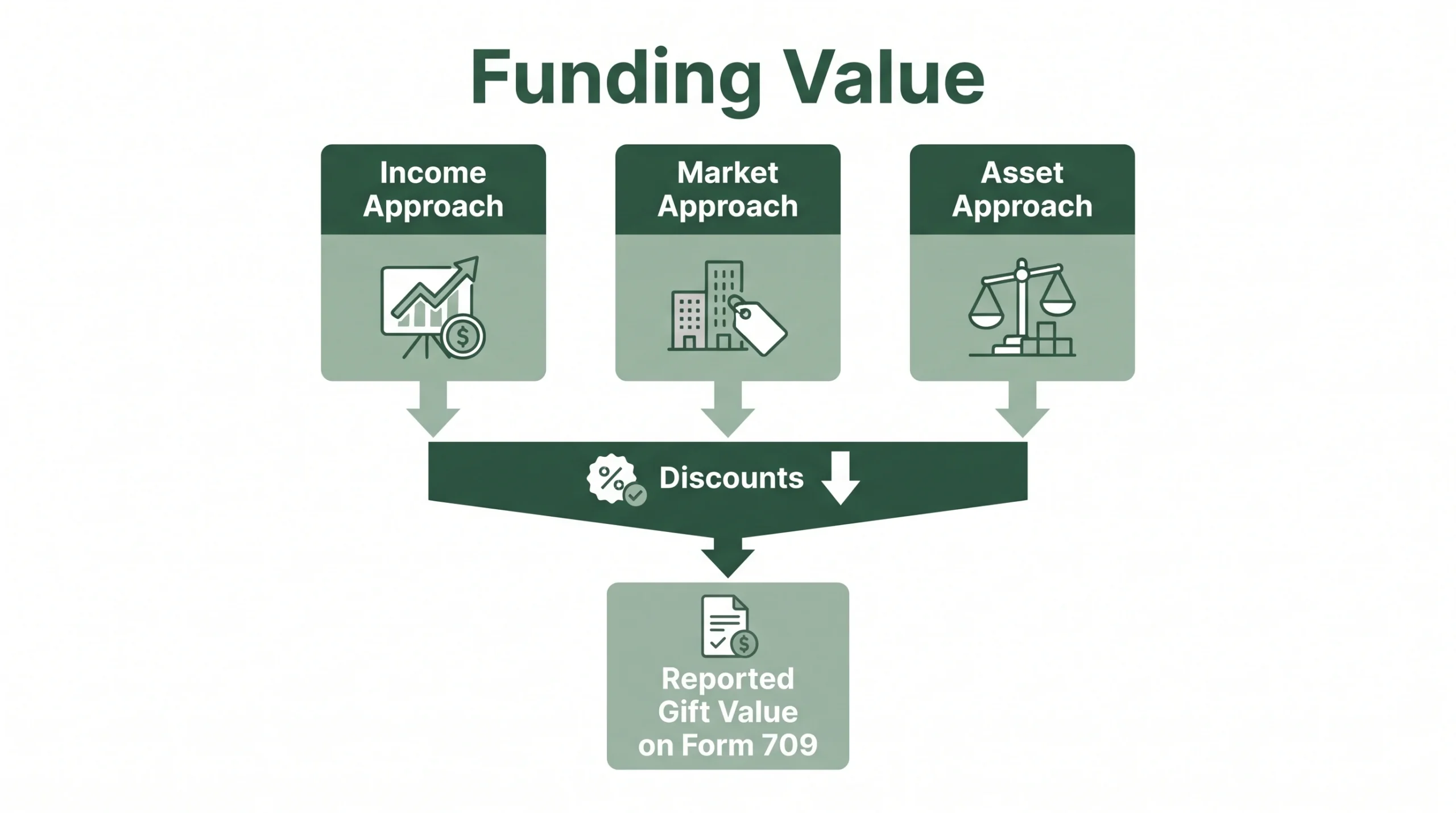
Appraisers set the funding value with three methods: the income approach, the market approach, and the asset approach. IRS Revenue Ruling 59-60 is the framework for this work. It tells the appraiser to weigh all the relevant facts, because no single formula fits every company.
The income approach estimates value from expected future cash flow. The market approach compares the business to similar companies with known pricing. The asset approach looks at the fair market value of the net holdings. A strong report blends these methods rather than leaning on one rough multiple. The right mix depends on the type of entity and how it earns. A holding company leans toward the asset view, while an operating company leans toward income.
How do valuation discounts stretch the GST exemption?
Valuation discounts lower the reported value of a non-controlling, hard-to-sell interest, so a grantor can move more of the company inside the exemption. The two common ones are the discount for lack of control and the discount for lack of marketability. Together they reduce the value of a gifted stake below its simple pro-rata share.
The discount for lack of control reflects that a minority owner cannot direct policy or declare dividends. The discount for lack of marketability reflects how hard it is to sell a private interest quickly. Both are standard in family transfers when the facts support them. By trimming the reported value, discounts let the family shift a larger slice of the business while using less of the lifetime exemption. That is how a fixed shelter reaches further. Our guide to valuation discounts on estate and gift tax returns explains how each one is measured and supported.
What are the risks of an incorrect valuation?
An incorrect valuation invites an IRS gift tax audit and accuracy-related penalties. When an appraisal misses fair market value, the IRS can contest the filing and seek more tax. A review often starts when reviewers spot a large understatement of value on a transfer.
The tax code applies accuracy-related penalties to a substantial valuation understatement, and the added cost climbs with the size of the error. Beyond the tax itself, an audit can weaken the whole plan. Fixing a flawed filing takes time and money, and it pulls focus from the family’s real goals. A defensible report is the cheapest insurance here. It ties every assumption to evidence and to recognized standards, so the number can stand when someone pushes back. This is why owners often pair the appraisal with a wider plan, such as an estate freeze strategy that locks in value early.
How do you choose a qualified valuation firm?
Choose a firm that produces an independent, credentialed report built to survive IRS review. A qualified appraiser holds a designation such as the Accredited in Business Valuation (ABV) or Accredited Senior Appraiser (ASA) credential and follows the Uniform Standards of Professional Appraisal Practice. Large national firms such as Alvarez & Marsal, Stout, and Kroll serve the biggest deals. Many family businesses want senior attention on a focused engagement instead. The table below compares the common options.
| Provider type | Primary focus | Best for |
| Sofer Advisors | Standalone, defensible appraisals for tax and estate reporting | Owners and attorneys needing a neutral report for IRS or court review |
| National advisory firm | Enterprise deals and large consolidations | Very large estates and public-company work |
| Wealth management firm | Investment planning, valuation as a side service | Families wanting one firm to manage all assets |
| Estate law firm | Drafting and administering trust documents | Families needing legal documents, then referring the appraisal out |
Independence is the deciding factor when a value will reach the IRS or a court. A firm that only appraises, and never brokers the deal, has no reason to lean the number. That is the core of The Sofer Difference, our four-step method of Discovery, Diligence, Analysis, and Delivery: we learn the business, test the facts, apply the right approaches, and hand over a report you can defend. An ASA-accredited appraiser who works to these standards gives the family the detail needed to answer later questions.
These pieces decide how much wealth the family moves and how well the record holds. The questions below cover what owners ask most before they fund a trust.
Frequently Asked Questions
What are the downsides to a dynasty trust?
The main downside is lost flexibility, since a dynasty trust is irrevocable and built to last. Once assets move in, the grantor gives up control, and the terms are hard to change if family needs or tax laws shift over the decades. Setup and ongoing costs also add up. Owners should weigh the long-term effect on liquidity before committing a business interest to the structure.
How much money should you have for a dynasty trust?
There is no fixed minimum. Most families consider a dynasty trust when their assets clearly exceed the current lifetime federal gift and estate tax exemption. The cost of setting up and running the trust has to be weighed against the tax savings for future generations. A useful test is whether the size of the estate justifies the added complexity and the yearly upkeep the trust will require.
What are the typical annual fees for a dynasty trust?
Annual fees depend on the assets, the trustee, and how often the trust needs formal accountings. Trustees usually charge a fee tied to the assets they manage, and legal and accounting work adds to the total. A trust holding an active business often costs more to administer than one holding only marketable securities. Families should map these ongoing costs during planning, not after the trust is funded.
How does a dynasty trust avoid estate tax?
A dynasty trust avoids estate tax by removing assets and their future growth from the grantor’s taxable estate at the time of transfer. Because the trust is built to span generations, the assets are not taxed in each beneficiary’s estate as they pass away. Proper allocation of the Generation-Skipping Transfer exemption at funding is what keeps later transfers free of that separate tax.
How much does a tax and estate business valuation cost?
A tax and estate business valuation from Sofer Advisors typically costs between $7,500 and $25,000. The price depends on the complexity of the entity and the work needed for a defensible analysis. These engagements generally run four to eight weeks. For a quote tied to your situation, contact us for a free consultation.
Can you sell a business held in a dynasty trust?
Yes, a business held in a dynasty trust can be sold, but the deal must be structured so proceeds stay in the trust or pass out under its terms. The trustee holds a duty to act in the beneficiaries’ best interest during any sale. An independent valuation sets a fair price for the transaction and helps show the sale met both fiduciary and IRS expectations.
What is the Generation-Skipping Transfer (GST) tax?
The Generation-Skipping Transfer tax is a federal tax on transfers to people at least two generations below the donor, such as grandchildren. It stops families from skipping a generation to dodge a round of estate tax. A dynasty trust manages this tax by using the grantor’s GST exemption at funding, which shelters later transfers to younger descendants.
Who signs off on a business valuation for a trust?
The trustee is usually the party that reviews and accepts a business valuation, since the trustee is the fiduciary for the trust. The grantor and legal counsel often review the report too, to confirm it fits the estate plan and the tax filings. A qualified appraiser signs the report itself, which is what gives the value its standing with the IRS.
How often should a business interest in a dynasty trust be re-valued?
A business interest should be re-valued whenever there is a major transaction, a new distribution, or a tax law change that calls for updated reporting. A yearly appraisal is not always required, but periodic updates help the trustee track performance and meet reporting duties. Using a consistent method across periods keeps a clear, defensible record of value for everyone involved.
Related Case Studies
- Estate Freeze Strategies: How Valuations Lock In Today’s Value
- Valuation Discounts (DLOC and DLOM) on Estate and Gift Tax Returns
- How Family Limited Partnerships Are Valued for Gift and Estate Tax
Executive Summary
Funding a dynasty trust with a family business starts with a qualified appraisal that sets the fair market value of the gifted interest. That figure is reported on Form 709 and fixes how much of the exemption the transfer uses. For 2026, the permanent federal exemption is $15 million per person and $30 million per couple, indexed for inflation. Discounts for lack of control and lack of marketability lower the reported value, so more of the company fits inside the shelter. Growth then compounds outside the taxable estate and the GST tax. An independent, credentialed report is the record that keeps the plan defensible for generations.
What Should You Do Next?
Review your estate plan and flag any business interest that still sits outside a tax-advantaged structure. Confirm your transfer strategy fits the current $15 million exemption and that you hold a recent, qualified appraisal to support the gift filing. Then coordinate the appraisal with your estate attorney so the value and the trust documents line up before you fund.
David Hern CPA ABV ASA, founder of Sofer Advisors, brings deep experience defending valuations for complex trust and estate transfers. Schedule a consultation to discuss your specific situation.
People Also Read
- Selling a Business Interest to an IDGT: Mechanics and Valuation
- Chapter 14 Rules: How IRC 2701 and 2703 Affect Family Transfers
About the Author
This guide was prepared by David Hern, CPA, ABV, ASA, founder of Sofer Advisors, a business valuation firm headquartered in Atlanta, GA, serving clients across the United States. David holds dual accreditations as an Accredited Senior Appraiser (ASA) and is Accredited in Business Valuation (ABV), credentials recognized by the IRS, SEC, and FINRA. He also holds the Certified Exit Planning Advisor (CEPA) designation. With 15+ years of valuation experience, David has served as an expert witness in 11+ cases across multiple jurisdictions and built Sofer Advisors into an Inc. 5000-recognized firm with 180+ five-star Google reviews. Its full W2 employee team maintains subscriptions to all major valuation databases and operates under a next-business-day response policy.
For professional business valuation services, visit soferadvisors.com/about-us/ or contact Sofer Advisors at soferadvisors.com/contact-us/.
Disclaimer: This content is for informational purposes only and does not constitute professional valuation advice. Business valuation conclusions depend on specific facts and circumstances. Contact Sofer Advisors for guidance regarding your specific situation.









