


Last Updated: October 2026
A 409A valuation is an independent appraisal of the fair market value of a private company’s common stock. Companies get one to comply with Section 409A of the Internal Revenue Code. The value sets the strike price for stock options, which must be at or above fair market value on the grant date. Most 409A engagements run from $2,500 to $9,000, depending on company stage and cap-table complexity.
The team at Sofer Advisors prepares independent 409A reports for startups and their boards, backed by Inc. 5000 recognition in both 2024 and 2025. Getting this right protects employees from steep tax penalties on deferred compensation. The IRS also gives a safe harbor: when a qualified, independent party performs the valuation, the price is presumed reasonable, which shifts the burden to the IRS to prove otherwise.
This guide covers what triggers a 409A, how it is calculated, why the value is deliberately conservative, what it costs, and how often you need to refresh it.
Key Takeaways
- Purpose: a 409A sets the fair market value of common stock, which fixes a defensible option strike price.
- Safe harbor: refresh the valuation at least every 12 months, or sooner after a material event.
- It is conservative: common stock value sits well below the latest preferred price or a strategic sale price.
- Non-compliance is costly: employees can face immediate tax, a 20% penalty, and interest.
- Cost: most 409A engagements run from $2,500 to $9,000, depending on stage and cap-table complexity.
Each point below connects to keeping your option grants compliant, and the sections that follow work through them one at a time.
Why Is a 409A Valuation Important to Understand?
A 409A valuation protects both the company and its employees, and the rules make it the practical standard. IRC Section 409A governs deferred compensation and sets the penalties for a mispriced option. The IRS safe harbor presumes a report reasonable when a qualified, independent party prepares it. The AICPA practice aid on valuing privately held company equity securities guides the method itself. A weak or stale report can break the safe harbor, expose employees to tax and a 20% penalty, and leave the company defending the price in an audit.
What Triggers the Need for a 409A Valuation?
The main trigger is the plan to grant stock options to employees. The company needs a fair market value for its common stock to set the strike price. A formal, independent valuation lets the company defend that price if the IRS asks.
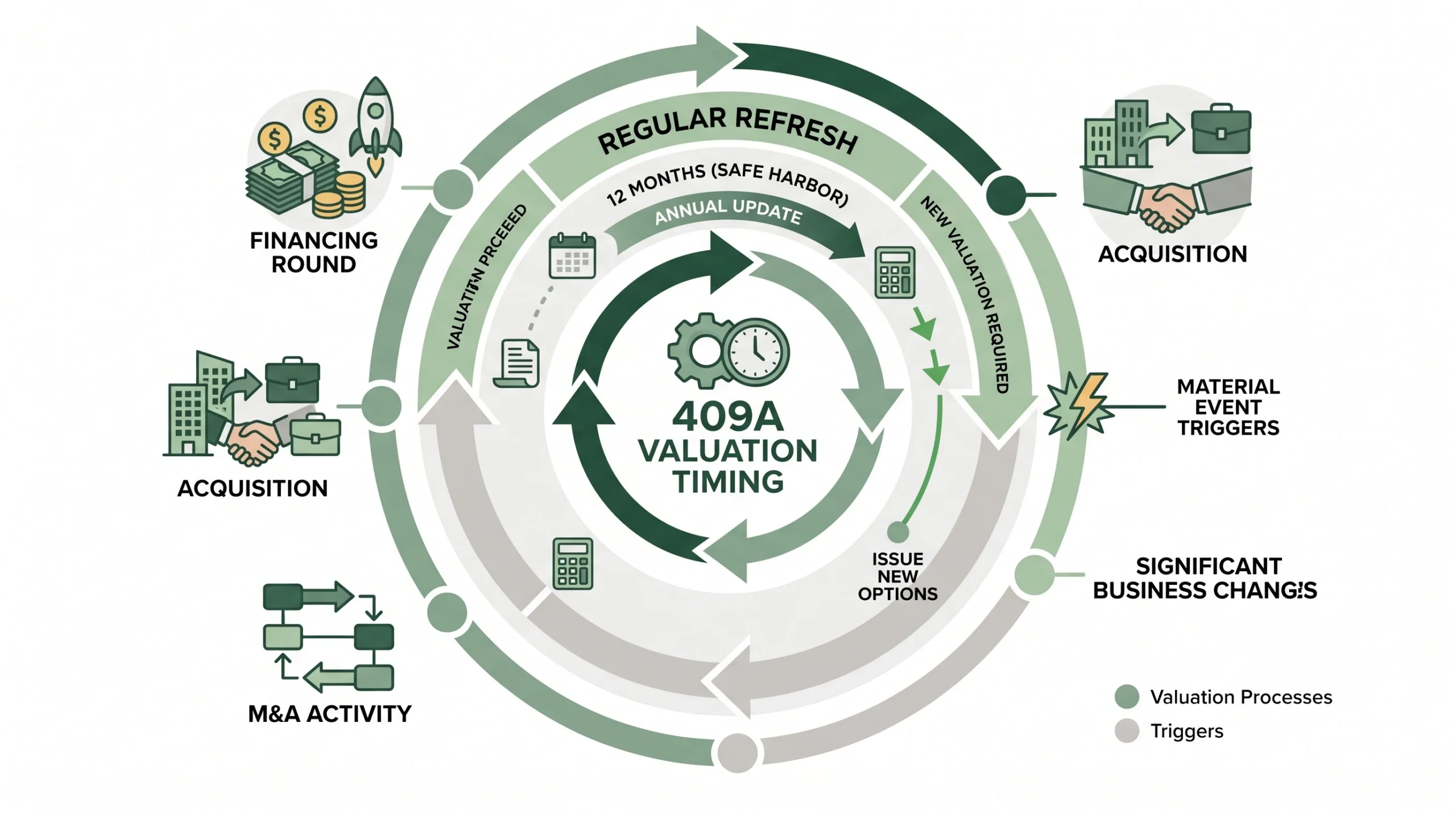
After the first grant, the company must refresh the valuation at least every 12 months to keep its safe harbor. A material event can force an earlier refresh. A priced financing round, an acquisition offer, or a major change in the business can all move the value enough to require a new report.
How Is a 409A Valuation Calculated?
The analyst first estimates the company’s total value, or enterprise value, using the income, market, or asset approach. Then comes allocation. The analyst spreads that value across the share classes to reflect the rights that preferred stock holds over common.
Two models are common for the allocation. The Option Pricing Model values each share class based on volatility and time to a liquidity event. The Probability-Weighted Expected Return Method, or PWERM, models exit scenarios such as a sale or an IPO and weights them. After setting a per-share common value, the analyst applies a discount for lack of marketability, since private shares are hard to sell quickly. The size of that discount depends on how close the company is to a liquidity event. A company near an IPO carries a smaller discount than an early-stage startup with no clear exit.
Choosing the right allocation model and defending the marketability discount is easier with an independent appraiser. Talk to a Sofer Advisors valuation specialist about the method that fits your cap table.
Why Is a 409A Value So Conservative?
A 409A value is usually far lower than the price a buyer or investor might pay for the whole company. There is a clear reason. A 409A values common stock, which is junior to preferred. Preferred holders get paid first and hold extra rights, so common is worth less per share.
The gap can be large. A recent priced round sets the preferred price, and the common 409A value often lands at a fraction of it. A strategic sale can be larger still, because a buyer may pay for cost savings and market access that a 409A does not assume. It is common to see a company’s 409A come in many times below a later sale price. That is the standard working as intended. The 409A measures fair market value for options, not the premium a specific buyer might pay.
A quick example makes the gap clear. Say a startup raises a round that prices preferred stock at $10.00 per share, implying a post-money value of $100,000,000. The 409A might set common stock near $2.50 per share, after accounting for preferred rights and a marketability discount. If the company later sells to a strategic buyer for $400,000,000, that sale price dwarfs both figures. None of these numbers conflict. Each measures a different thing at a different time.
What Data Does a 409A Valuation Need?
A clean 409A starts with a current cap table that lists every share class and its rights. The analyst also needs recent financial statements and a forward forecast, since the income approach relies on expected cash flow. For a company that has raised capital, the latest term sheet and the preferred terms matter a great deal.
Other inputs round out the picture. These include the option plan details, any recent secondary sales of stock, and notes on upcoming events such as a planned raise. Secondary sales can be strong evidence of value, so the analyst reviews them closely. Good inputs shorten the timeline and make the final report easier to defend.
What Are the Risks of a Non-Compliant 409A?
A non-compliant 409A breaks the safe harbor. The IRS can then treat the options as taxable deferred compensation. That forces tax in the year the options vest, not when the employee exercises them.
The cost to employees is steep. They can face immediate income tax on the full spread, a 20% federal penalty tax, and an interest charge. State penalties can add more. During an audit, the burden of proof sits with the company. A report with weak logic or stale methods raises the risk of an adverse finding, so an independent report built under Section 409A is the practical protection.
How Do 409A Providers Compare?
The right provider depends on how much rigor and audit defense you need. Automated software is cheap and fast for simple cap tables. Independent valuation firms give deeper analysis for tax compliance and audit defense. Large national firms such as Alvarez & Marsal, Stout, and Kroll usually take 409A work on inside a bigger deal, such as an IPO, while Sofer Advisors focuses on partner-led 409A reports for venture-backed startups, with expert witness testimony in 11+ cases behind its work. The table below shows the trade-offs.
| Provider type | Typical cost | Best for |
|---|---|---|
| Independent valuation firm (e.g. Sofer Advisors) | $2,500 to $9,000 | Complex cap tables, a coming round, or real audit-risk concern |
| Automated software platform | Lower, subscription-based | Early-stage startups with simple cap tables and tight budgets |
| Large national firm | Much higher | Late-stage firms where the 409A rides inside a larger transaction |
Sofer Advisors works through a four-phase process it calls The Sofer Difference, moving from Discovery to Diligence to Analysis to Delivery. Software is quick for simple structures, but it may lack depth when an auditor questions an assumption, so an independent firm documents the logic behind each one. That practice reflects the Heart of a Teacher approach, which focuses on explaining the reasoning behind a value rather than handing over a bare number.
Frequently Asked Questions
Is a 409A the same as a fair market valuation?
Yes, in substance. A 409A determines fair market value, the IRS standard, applied to a private company’s common stock for Section 409A. Fair market value is the federal standard used for tax purposes. Some states use a separate fair value standard for matters like shareholder disputes, and the two are not the same, so the right standard depends on the purpose. Sofer Advisors applies the correct standard for your filing and documents why it fits.
What is the difference between a business valuation and a 409A valuation?
A business valuation measures the value of the whole company across all share classes. A 409A is a specific appraisal of the fair market value of common stock, set under Section 409A to support an option strike price. The 409A focuses on one junior share class, not the entire enterprise, so the two figures rarely match. Sofer Advisors prepares both and explains how each number is used, so the board is not caught off guard.
Is a 409A valuation legally required?
It is not a direct mandate for every company, but it is essential for any firm issuing options to employees. Without an independent valuation, the IRS can assume the common stock is worth more than the strike price, which triggers penalties for employees under Section 409A. A valid report secures the safe harbor and shifts the burden of proof. Sofer Advisors delivers that independent report so your grants rest on defensible ground.
How often do I need a 409A valuation?
At least once every 12 months, and sooner after a material event such as a priced round or an acquisition offer. The 12-month rule keeps the safe harbor in place for the grants you issue in that window. A material change can shorten that window and force an earlier refresh before the next grant. Sofer Advisors tracks these triggers with you so a valid report is always in place.
Why is my 409A value lower than my last funding round?
Because a 409A values common stock, while a funding round prices preferred stock. Preferred holds senior rights and gets paid first in a sale or wind-down, so common is worth less per share. A common value well below the preferred price is normal and expected, not a sign of a problem with the business. Sofer Advisors shows how preferred rights and a marketability discount produce that gap in the report.
Who should perform a 409A valuation?
A qualified, independent party should perform it. Using an independent appraiser is what earns the safe harbor presumption of reasonableness under the IRS rules. A report prepared in-house, without that independence, is far easier for the IRS to challenge, and the employees carry the penalty if the price is too low. Sofer Advisors provides that independence, with credentialed appraisers who can defend the report if an examiner asks.
How long does a 409A valuation take?
Most 409A reports take about one to three weeks once the analyst has a complete cap table and financials. A simple early-stage company can move faster, while a late-stage firm with a complex structure, or one missing records, takes longer. Planning ahead of a grant date keeps you from rushing the work and weakening the report. Sofer Advisors sets a clear timeline up front so the report is ready before your grant date.
Can I perform a 409A valuation myself?
You can, but it rarely pays off. A valuation done in-house does not earn the safe harbor, so the IRS can challenge it more easily and the burden of proof stays with you. If the price is found too low, your employees face the tax and the 20% penalty. An independent, qualified appraisal shifts that burden to the IRS, which is the main reason companies use one. Sofer Advisors supplies that independent, defensible report.
How much does a 409A valuation from Sofer Advisors cost?
Most 409A engagements run from $2,500 to $9,000. The fee depends on your stage, the complexity of your cap table, and the quality of your records, so an early-stage company with a simple structure sits near the low end. Sofer Advisors quotes a flat fee up front, so the cost is clear before the work begins, with no hourly surprises. Request a free estimate for a range specific to your company.
Related Case Studies
- How Often Do You Need a 409A Valuation Update?
- Do I Need a Business Valuation? 10 Situations That Require One
- 409A Valuation Cost: Pricing Guide for Startups
Executive Summary
A 409A valuation sets the fair market value of a private company’s common stock under IRC Section 409A, which fixes a defensible option strike price. When a qualified, independent party prepares it, the IRS safe harbor presumes the price reasonable. The analyst estimates enterprise value, allocates it across share classes using the Option Pricing Model or PWERM, then applies a marketability discount, so common stock lands well below the preferred price. Refresh the report every 12 months, or sooner after a material event. Non-compliance exposes employees to immediate tax and a 20% penalty. Most engagements run $2,500 to $9,000.
What Should You Do Next?
Map your 409A to your grant schedule and your funding timeline, and build the 12-month refresh into your annual calendar. Gather your cap table, recent financials, and any term sheets before the engagement starts, since clean inputs speed the work. Flag any funding or deal talks early, so a valid report is always in place before the next grant. This guide was prepared by David Hern CPA ABV ASA, founder of Sofer Advisors, an Inc. 5000 firm specializing in neutral third-party valuations for private companies. Schedule a free consultation to discuss your specific situation.
People Also Read
- 409A Valuation Methods: OPM, PWERM, and Hybrid Compared
- What Happens If You Skip a 409A Valuation: Penalties
About the Author
This guide was prepared by David Hern CPA ABV ASA, founder of Sofer Advisors, a business valuation firm headquartered in Atlanta, GA serving clients across the United States. David holds dual accreditations as an Accredited Senior Appraiser (ASA) and is Accredited in Business Valuation (ABV), credentials recognized by the IRS, SEC, and FINRA. He also holds the Certified Exit Planning Advisor (CEPA) designation. With 15+ years of valuation experience, David has served as an expert witness in 11+ cases across multiple jurisdictions and built Sofer Advisors into an Inc. 5,000-recognized firm with 180+ five-star Google reviews. Its full W2 employee team maintains subscriptions to all major valuation databases and operates under a next business day response policy.
For professional business valuation services, visit soferadvisors.com/about-us/ or contact Sofer Advisors at soferadvisors.com/contact-us/.
This content is for informational purposes only and does not constitute professional valuation advice. Business valuation conclusions depend on specific facts and circumstances. Contact Sofer Advisors for guidance regarding your specific situation.









