


Last Updated: June 2026
This article is for landscaping owners preparing to sell, refinance, or bring in a partner. By the end, you will know the three main valuation methods, the multiple buyers apply, and steps to raise your number before going to market.
A landscaping business valuation is a formal process that finds the fair market value of a lawn care or landscape company. It matters because buyers, lenders, and partners need a defensible number before any deal closes. For a landscaping owner planning a sale, knowing your value before negotiations begin is the difference between a strong deal and leaving money on the table.
Landscaping is a contract-driven industry, and that changes how buyers think about price. A company with 80% of revenue from maintenance agreements looks very different from one built on one-time jobs. Sofer Advisors, headquartered in Atlanta, GA, helps middle-market landscaping owners understand that gap. The difference between contract and project revenue can shift your multiple by one to three turns.
Key Takeaways
- Recurring Revenue Drives Multiples – Annual maintenance contracts can lift EBITDA multiples from 3x to 5x or higher.
- EBITDA Is the Starting Point – Most buyers apply a 3x-5x multiple to adjusted EBITDA to set a price range.
- Contract Concentration Hurts – If one client makes up more than 20% of revenue, buyers will discount the price.
- Owner Dependency Lowers Your Multiple – Buyers pay less when the business cannot run without the founder on-site.
- Formal Valuations Open Doors – A credentialed appraisal from a CPA ABV or ASA supports SBA loans and partner buyouts.
- Timing Changes Outcomes – Landscaping businesses that sell after two or three years of documented growth command the highest multiples.
Each factor interacts with the others. The sections below explain how buyers weigh them and what you can do to improve your outcome.
What Methods Apply to Landscaping Valuation?
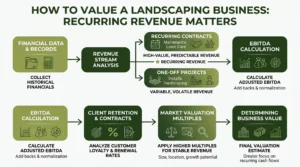
Three main approaches apply when valuing a landscaping company. Knowing each one helps you understand where a buyer’s offer comes from – and whether it is fair.
The income approach converts your earnings into a value. Appraisers use capitalization of earnings or discounted cash flow (DCF). DCF projects future cash flows and discounts them to today. Capitalization of earnings suits stable businesses with steady recurring income.
The market approach compares your company to recent sales of similar businesses. Databases from platforms like midstreet.com and bizbuysell.com track sale prices for green industry deals. Your appraiser pulls comparable transactions and adjusts for size, geography, and contract mix.
The asset approach adds up the fair market value of your trucks, trailers, and mowers. For a going concern, this method sets a floor rather than the final price. A buyer who pays only asset value ignores the customer base and crew systems you built.
Most appraisers use two or three methods together. They weight each result based on which best fits the facts. The final value reflects that weighted conclusion.
Why Does Recurring Revenue Change Your Price?
Recurring revenue is the single biggest driver of premium pricing in landscaping. Here is why buyers pay more for it.
A maintenance contract locks in future cash flow. Buyers can model that revenue forward with confidence. Project revenue must be re-sold every season. That uncertainty means higher risk and a lower multiple. A lower multiple means a lower price for you.
Think about two companies, each with $500,000 in revenue. Company A earns 75% from maintenance agreements. Company B earns 75% from one-time installs. A buyer might apply a 4.5x multiple to Company A and a 3.0x multiple to Company B. On identical earnings, that gap creates a very different price.
Buyers also look at retention inside the recurring base. A portfolio with 90% annual renewal rates is worth more than one at 70%. Each point affects the risk assessment and the discount rate in a DCF analysis.
You can improve your recurring revenue before going to market. Convert project clients to maintenance agreements. Offer multi-year contracts with modest discounts. These steps make your revenue story more compelling to buyers.
Goodwill is closely tied to this. When your contracts transfer with the business, that value becomes enterprise goodwill. Buyers pay for enterprise goodwill. They discount personal goodwill, which leaves with the owner.
How Do EBITDA Multiples Work in Landscaping?
EBITDA stands for earnings before interest, taxes, depreciation, and amortization. It is the most common measure buyers use to price a landscaping company.
Buyers apply a multiplier to your adjusted EBITDA to reach an enterprise value. That multiplier typically falls between 3x and 6x. Smaller companies under $1 million in revenue often trade at 3x-4x. Mid-market firms with $2 million or more in EBITDA can reach 5x-6x.
Here is what moves multiples in landscaping:
- Recurring maintenance contracts as a share of total revenue
- Customer retention rate over three or more years
- Geographic spread across multiple routes or markets
- Management depth, meaning the company runs without the owner present
- Clean financial records with three full years of tax-reconciled books
Buyers apply add-backs before they calculate your EBITDA. Add-backs are personal or one-time expenses run through the business. Common examples include excess owner salary and non-recurring legal fees. Each valid add-back raises your adjusted EBITDA and your total price.
Sites like axial.net track lower middle-market deal activity. They confirm that contract-heavy landscaping companies command premiums over project-based peers. Knowing your adjusted EBITDA before an offer puts you in a stronger position at the table.
The appraiser reconciles all three methods into a single conclusion. A credentialed appraiser documents every weighting decision. That documentation holds up during SBA underwriting and due diligence.
What Factors Lower a Landscaping Valuation?
Several risk factors push landscaping business value down. Knowing them gives you time to fix the most damaging ones before you sell.
Customer concentration is the most common discount trigger. When one client makes up 20% or more of revenue, buyers see a single point of failure. If that client leaves after the sale, earnings drop fast. Buyers offset that risk with a lower multiple or earn-out provisions tied to client retention.
Owner dependency runs a close second. If crews call you for every decision, the business is not fully transferable. Buyers discount heavily for this. Building a field operations manager reduces that dependency before you list.
Other common value reducers include:
- Aged or poorly maintained equipment that needs replacement soon
- Verbal-only customer relationships with no signed contracts in place
- Revenue declining over the most recent two fiscal years
- High crew turnover or reliance on a small number of key employees
Each issue reduces a buyer’s confidence in future cash flows. Higher perceived risk means a lower EBITDA multiple. Addressing two or three of these factors before listing can recover meaningful value.
David Hern CPA ABV ASA, founder of Sofer Advisors, brings a Heart of a Teacher to every engagement. He translates complex valuation findings into clear action plans that owners can act on right away.
When Should You Get a Formal Valuation?
You do not need to be selling to benefit from a formal valuation. Several situations make a credentialed appraisal the right move.
Exit planning is the most common trigger. If you plan to sell within three to five years, a valuation now shows you where you stand. It gives you time to fix value gaps before buyers arrive. Owners who wait often leave money behind because they did not know what to fix.
SBA loans over $250,000 require a third-party appraisal. If you are buying a landscaping competitor, the lender needs an independent report to approve financing. That report must be prepared by a qualified appraiser with ASA or ABV credentials.
Buy-sell agreements between partners need a current valuation to set a fair price if a partner exits. Without one, disputes can stall a transition.
Estate planning for owners transferring shares to family requires a formal appraisal. The IRS expects a qualified appraisal meeting Revenue Ruling 59-60 standards for gift and estate tax purposes.
The Sofer Difference is a four-phase process – Discovery, Diligence, Analysis, and Delivery – designed to give landscaping owners a clear picture of what their company is worth and why. Sofer Advisors completes most standard engagements in four to eight weeks. Each phase builds on the last for a defensible conclusion.
These five sections cover the main drivers of landscaping business value. The questions below address scenarios owners ask about most often before a transaction.
Frequently Asked Questions
How do I value my landscape business?
You value a landscape business by choosing a method – income, market, or asset – and applying it to your financial data. Most appraisers start with adjusted EBITDA and apply a market-derived multiple. They also run a DCF analysis to check the result. The income and market approaches carry the most weight for a profitable landscaping company. A credentialed appraiser reconciles both into a single conclusion that buyers, lenders, and courts can rely on.
How much is a business worth with $500,000 in sales?
Revenue alone does not set value. Profitability and contract mix matter more. A landscaping company with $500,000 in revenue and a 20% EBITDA margin produces about $100,000 in earnings. At a 4x multiple, that implies a value near $400,000. Recurring contracts push the multiple higher. Project-only revenue holds it lower. Owner dependency and customer concentration affect where in the range your number lands.
How much is a landscaping business worth?
Most landscaping businesses sell for 3x to 5x adjusted EBITDA, or 0.5x to 1.0x of annual revenue for smaller firms. Mid-market companies with $1 million or more in EBITDA and strong recurring revenue can reach 5x-6x. Size, profitability, contract quality, and management depth all shape the final number. A formal appraisal gives you the only reliable, defensible answer for a real transaction.
How much does a valuation from Sofer Advisors cost?
A business valuation from Sofer Advisors typically ranges from $7,500 to $25,000, depending on complexity, purpose, and business size. Most standard engagements complete in four to eight weeks. Rush engagements are available at a 25 to 50% premium. All reports meet IRS, SBA, and AICPA documentation standards. Schedule a free consultation to receive a scoped estimate for your specific situation.
What is adjusted EBITDA in a landscaping context?
Adjusted EBITDA is your operating earnings after adding back personal or one-time expenses. Common add-backs in landscaping include above-market owner salary, personal vehicle costs, and one-time legal fees. Buyers use adjusted EBITDA rather than reported net income because it shows the true earning power of the business. A higher adjusted EBITDA, multiplied by a market multiple, produces a higher enterprise value at closing.
What is the difference between enterprise value and equity value?
Enterprise value is the total value of the business, including all debt. Equity value is what you receive after paying off loans and liabilities. If your landscaping company has an enterprise value of $1.2 million and carries $200,000 in equipment loans, your equity value is about $1.0 million. Most purchase negotiations start with enterprise value and then adjust for debt at closing. Knowing both numbers before you negotiate prevents costly surprises.
How does customer concentration affect my sale price?
A single customer making up more than 20% of revenue signals risk to buyers. If that client leaves after closing, the buyer’s return on investment drops fast. Buyers respond with a lower multiple or an earn-out tied to that client staying for one to two years. Reduce concentration risk by growing other accounts before going to market. Diversifying to 15 or more clients, with none above 15%, strengthens your valuation position.
What credentials should my valuation appraiser hold?
Look for a CPA with the ABV (Accredited in Business Valuation) designation from the AICPA Forensic and Valuation Services, or an ASA (Accredited Senior Appraiser) from the American Society of Appraisers. Both require rigorous testing and ongoing education. For SBA or IRS purposes, the appraiser must meet USPAP requirements. Sofer Advisors holds dual ABV and ASA credentials, satisfying IRS, SEC, and FINRA standards for formal appraisal work.
When is the best time to get a landscaping valuation?
The best time is 12 to 24 months before any planned sale, partner change, or ownership transfer. An early valuation gives you time to act on the findings. Owners who treat valuation as part of exit planning consistently achieve stronger sale prices and better deal terms. A proactive valuation creates a baseline for measuring the impact of improvements you make before you list.
Related Case Studies
For more on how Sofer Advisors approaches landscaping valuation, review these related resources:
- How Do You Determine What a Business Is Worth – Complete Guide
- Cost Approach Vs Income Approach Complete Guide
- What Is Goodwill in Business Valuation
Executive Summary
A landscaping business valuation finds fair market value by applying income, market, and asset methods to your financial data. Recurring maintenance contracts are the top driver of premium pricing. EBITDA multiples typically range from 3x to 5x. Strong contract revenue, low customer concentration, and a management team that runs without the owner push multiples toward the high end. Sofer Advisors, with 180+ five-star Google reviews and Inc. 5000 recognition, provides credentialed appraisals meeting IRS, SBA, and FINRA standards. Owners who get a valuation early have time to close value gaps before negotiations begin.
What Should You Do Next?
Start by pulling three years of financial statements and your customer contract list. Separate recurring maintenance revenue from project revenue. Then get a formal valuation to establish your baseline before buyers arrive.
David Hern CPA ABV ASA, founder of Sofer Advisors, has 15+ years of valuation experience and served as an expert witness in 11+ cases. Schedule a consultation to find out what your landscaping business is worth today.
People Also Read
- Why You Must Start Planning Your Business Exit Now With The Right Valuation Expert
- What To Expect During A Business Valuation Step By Step Process
About the Author
This guide was prepared by David Hern CPA ABV ASA, founder of Sofer Advisors – a business valuation firm headquartered in Atlanta, GA serving clients across the United States. David holds dual accreditations as an Accredited Senior Appraiser (ASA) and is Accredited in Business Valuation (ABV), credentials recognized by the IRS, SEC, and FINRA. He also holds the Certified Exit Planning Advisor (CEPA) designation. With 15+ years of valuation experience, David has served as an expert witness in 11+ cases across multiple jurisdictions and built Sofer Advisors into an Inc. 5000-recognized firm with 180+ five-star Google reviews. The firm’s full W2 employee team maintains subscriptions to all major valuation databases and operates under a next business day response policy.
For professional business valuation services, visit soferadvisors.com or schedule a consultation.
This content is for informational purposes only and does not constitute professional valuation advice. Business valuation conclusions depend on specific facts and circumstances. Contact Sofer Advisors for guidance regarding your specific situation.