


Last Updated: June 2026
A commercial cleaning company is typically valued using a multiple of Seller’s Discretionary Earnings (SDE) for owner-operated businesses or EBITDA for larger operator-managed companies. Owner-operated commercial cleaning businesses with strong recurring contract revenue sell for 2.5x–4x SDE. Larger commercial cleaning platforms, those above $3M in revenue with management depth, trade at 3x–5x EBITDA. The specific multiple depends heavily on contract quality, customer concentration, labor turnover, and how dependent the business is on the owner.
The cleaning industry is one of the most active sectors in the small business M&A market. Buyers range from private equity rollup platforms and franchise systems to independent operators and local competitors. That activity means there is real comparable deal data. Buyers know what they are looking at. Sellers who understand the valuation mechanics before they go to market negotiate better. Sofer Advisors helps owners and their advisors work through exactly these questions and turn the analysis into a defensible business valuation they can act on.
The following takeaways summarize the key valuation and transaction factors covered in this guide.
Key Takeaways
- Owneroperated Commercial Cleaning Companies – Owner-operated commercial cleaning companies typically sell for 2.5x–4x SDE. Management-run platforms trade at 3x–5x EBITDA.
- Recurring Contract Revenue 1+ – Recurring contract revenue with 1+ year terms is the single strongest value driver in commercial cleaning valuations.
- Client Concentration 20 One – Client concentration above 20% in one account is a discount factor. Above 40% is a material risk that affects deal structure.
- Ownerdependency Owner Maintains Key – Owner-dependency – when the owner maintains all key client relationships – compresses multiples and requires transition planning.
- Labor Cost Management Turnover – Labor cost management and turnover rate directly affect EBITDA margins and so the valuation baseline.
- Franchise Systems Command Different – Franchise systems command different multiples than independents. The franchisor approval process affects deal timing.
Each of these factors is examined in depth in the sections that follow.
How Do You Value a Commercial Cleaning Company?
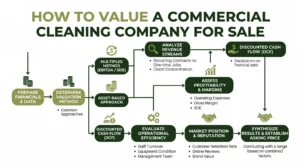
Commercial cleaning valuations use one of two primary income-based approaches. The choice depends on the size and structure of the business.
For owner-operated businesses under $3M in revenue, the Seller’s Discretionary Earnings method is standard. The owner works in the business full-time. SDE starts with net income and adds back owner pay (salary and benefits), depreciation and amortization, interest, one-time expenses, and other non-cash items. The result is the total economic benefit available to a new owner-operator. That figure is then multiplied by a market-derived multiple, typically 2x–4x for commercial cleaning.
For larger businesses with a management team in place, the EBITDA method is more fitting. This applies when a general manager, operations manager, and supervisory staff handle client relationships independent of the owner. EBITDA reflects the earnings available to an investor who replaces the owner without hiring a full-time manager. EBITDA multiples of 3x–5x apply at the $3M–$10M revenue level.
The asset approach is used as a floor, calculating the value of equipment, vehicles, and supply inventory, but rarely drives deal price for businesses with recurring revenue. Buyers are acquiring cash flow, not equipment.
| Revenue Level | Typical Method | Multiple Range | Implied Value |
|---|---|---|---|
| Under $300K revenue | SDE | 1.5x – 2.5x SDE | $75K – $300K |
| $300K – $1M revenue | SDE | 2x – 3.5x SDE | $150K – $700K |
| $1M – $3M revenue | SDE or EBITDA | 2.5x – 4x | $400K – $1.5M |
| $3M – $10M revenue | EBITDA | 3x – 5x | $900K – $4M+ |
| $10M+ revenue / platform | EBITDA | 4x – 7x | $4M+ |
A market multiple is a starting point, not a conclusion of value. A defensible fair market value still rests on the factors the IRS sets out for valuing closely held businesses under Revenue Ruling 59-60.
How Much Is a Business Worth With $500,000 in Sales?
A commercial cleaning company with $500,000 in annual revenue is valued on SDE, not on revenue. Revenue is a starting point. What matters is the cash flow available to the owner-operator after all expenses are paid.
A typical owner-operated cleaning business at $500K revenue might carry labor costs of 40%–55% of revenue. Supplies and equipment run 5%–8%. Vehicle costs run 3%–5%. Insurance and bonding run 2%–4%. Overhead runs 5%–10%. After those costs, the owner might net $60,000–$120,000 in SDE before adding back owner pay. If the owner takes a $60,000 salary, SDE might total $120,000–$180,000.
At a 2.5x–3.5x SDE multiple, that business is worth $300,000–$630,000. The specific multiple depends on contract quality, how much revenue is recurring vs. one-time, whether the owner can be replaced, and how long the business has operated.
A common mistake sellers make is anchoring on revenue. A $500K-revenue business with a 70% labor cost and no recurring contracts might generate only $40,000 in SDE. That implies a value of $80,000–$140,000. The revenue number is irrelevant without knowing the margin.
How Much Is a Commercial Cleaning Business Worth With $100,000 in Sales?
At $100,000 in annual revenue, a commercial cleaning business is almost always valued using SDE. The buyer pool is typically an individual operator rather than a PE firm or rollup platform. The buyer is acquiring a client list, equipment, and revenue stream they will service themselves.
At $100K revenue, SDE in a well-run operation might be $30,000–$55,000. At 1.5x–2.5x SDE, the implied value is $45,000–$140,000. The lower multiple at this size reflects limited scale, reduced client spread, higher owner-dependency, and the fact that the buyer must replace the owner’s labor.
At this revenue level, seller financing is common. A buyer who can finance 20%–30% in cash and have the seller carry the rest over 3–5 years is a typical deal structure. Lenders are rarely involved at this size.
What Are the Biggest Value Drivers in Commercial Cleaning?
- Recurring Contract Revenue. Contracts with 1-year, 2-year, or multi-year terms, with auto-renewal and termination notice requirements, are the foundation of value. A business with 80% of revenue under annual contracts is worth measurably more than one where most clients are month-to-month. Month-to-month arrangements are discounted. They have no structural barrier to client departure.
- Client Concentration. A client that represents 30%+ of revenue is a significant valuation risk. If that client leaves, the business loses 30%+ of its revenue base overnight. PE buyers and experienced acquirers will note any client above 20% of revenue. They factor a concentration discount into their offer. Sellers who can diversify below 20% per client before going to market improve both their multiple and their deal structure.
- Labor Cost and Turnover. Cleaning is a labor-intensive business. Labor typically represents 40%–60% of revenue. High turnover, which is common in janitorial services, creates constant recruiting, training, and supervisory costs that suppress margins. Buyers look at turnover rate as a proxy for quality. Businesses with low turnover, stable crews, and established supervisory systems command higher multiples.
- Owner Dependency. If the owner is the primary relationship holder for major accounts, the business faces key person risk. A new owner who cannot maintain those relationships loses clients. Buyers discount heavily for owner-dependency. Some won’t close without a meaningful transition period and earnout tied to revenue retention.
- Equipment and Fleet Condition. Buyers want clean, well-maintained equipment and vehicles. Deferred maintenance is a discount factor. Equipment that needs immediate replacement reduces the net proceeds to the seller.
David Hern CPA ABV ASA, founder of Sofer Advisors, brings a Heart of a Teacher to every engagement – translating complex valuation methodology into clear, actionable guidance that clients can act on before and after the report is delivered. With 15+ years of valuation experience, 11+ expert witness cases across multiple jurisdictions, and 180+ five-star Google reviews, David built Sofer Advisors into an Inc. 5000-recognized firm. The Sofer Difference is a four-phase process of Discovery, Diligence, Analysis, and Delivery that ensures every conclusion is defensible, documented, and tied to the specific facts of the business.
While national firms like Stout and Kroll serve large enterprise clients, Sofer Advisors specializes in middle-market businesses that require personalized attention, direct access to credentialed professionals, and a next business day response policy.
Franchise vs. Independent Commercial Cleaning Valuation
Franchise cleaning businesses, Coverall, Jani-King, Jan-Pro, and others, have a different valuation dynamic than independent operations. The franchise brand provides client acquisition support and operational systems. But it also imposes royalty fees (typically 8%–12% of gross billings). Those fees directly suppress SDE and so the valuation.
From a buyer’s perspective, the franchise provides a validated system, training, and brand recognition. From a seller’s perspective, the royalty burden compresses margins. Resale also requires franchisor approval. This adds time and process to the deal.
Independent commercial cleaning businesses without royalty burden tend to generate higher SDE margins. So they command comparable or higher absolute values than franchised units at the same revenue level. Independent operators typically have fewer built-in client acquisition systems. They may also have higher owner-dependency. Neither model is better by default, the question is which structure the specific business has used well.
What Do PE Rollup Buyers Look For in Commercial Cleaning?
Private equity rollup buyers are active in commercial cleaning. They target businesses as add-ons to larger janitorial or commercial services platforms. These buyers typically target businesses above $2M–$3M in revenue. They want a spread client base (no client above 15%–20% of revenue). They want management depth or a willingness by the owner to stay for 12–24 months post-close. They want multi-year contracts and a documented operational system.
PE buyers pay at the higher end of the multiple range, sometimes above 5x EBITDA for strong platforms. They are buying for portfolio fit, not just standalone cash flow. If your business fits a specific platform’s geographic footprint or service specialization, you may command a platform premium. This is why running a process that includes both PE and strategic buyers produces better results than accepting the first offer from the first buyer who calls.
The questions below address the most common issues business owners raise before engaging a qualified appraiser for a commercial cleaning company valuation engagement.
Frequently Asked Questions
How do you value a commercial cleaning company?
Start with SDE (for owner-operated businesses) or EBITDA (for management-run operations). Apply a market multiple of 2x–5x depending on revenue size, contract quality, concentration risk, and owner dependency. The resulting figure is the enterprise value before adjustments for working capital, equipment condition, and deal structure.
What is a fair multiple for a cleaning business?
Owner-operated commercial cleaning companies typically sell at 2.5x–3.5x SDE. Larger, management-run platforms trade at 3x–5x EBITDA. Premium multiples apply to businesses with multi-year contracts, spread client bases, and strong management teams. Distressed businesses with high concentration or month-to-month clients sell at 1.5x–2x SDE or less.
Does commercial cleaning sell for more than residential cleaning?
Generally yes. Commercial cleaning contracts tend to be larger, more stable, and multi-year. This creates a more predictable revenue base. Residential cleaning businesses are often more owner-dependent and carry higher client turnover. PE buyers active in rollups almost always target commercial, not residential.
How do recurring contracts affect the sale price?
Recurring contracts with defined terms and renewal clauses are the primary value driver in cleaning company sales. A business where 80%+ of revenue is under annual contracts can command a 0.5x–1x multiple premium over a business with mostly month-to-month arrangements.
What is SDE and how is it calculated for a cleaning company?
SDE stands for Seller’s Discretionary Earnings. It is calculated as net income plus owner’s salary and benefits, plus depreciation and amortization, plus interest, plus any one-time or non-recurring expenses. It represents the total cash benefit to a full-time owner-operator. For a cleaning company at $500K revenue, SDE might range from $80,000 to $180,000 depending on the margin structure.
How does client concentration affect a cleaning business sale?
Any single client representing more than 20% of revenue is flagged in due diligence. Above 40%, concentration is a significant deal risk. Buyers may require a portion of the purchase price in escrow. They may structure an earnout tied to client retention, or simply reduce the headline price. Sellers who diversify their client base below 20% per client before going to market get better outcomes.
What affects labor costs in commercial cleaning valuation?
Labor as a percentage of revenue is the primary margin lever in cleaning businesses. Companies with well-trained, stable crews and lower turnover generate higher EBITDA margins and so higher valuations. High turnover inflates recruiting and training costs. It also creates inconsistent service quality, which risks client loss, both of which suppress value.
Does insurance and bonding affect value?
Yes. Buyers want to see current general liability insurance (minimum $1M per occurrence), commercial auto coverage, workers’ compensation, and janitorial service bond. Gaps in coverage or recent claims create underwriting concerns and may reduce purchase price or require escrow holdbacks.
Related Case Studies
- How Do You Determine What A Business Is Worth Complete Guide
- Small Business Valuation Georgia What Every Owner Should Know
- Selling A Business In Georgia Complete Exit Planning Guide 2026
Executive Summary
- Commercial cleaning companies are valued at 2.5x–4x SDE for owner-operated businesses. Management-run platforms above $3M in revenue trade at 3x–5x EBITDA.
- Recurring contract revenue, client spread, and management depth are the primary value drivers.
- Client concentration above 20% per account compresses multiples. Concentration above 40% typically changes deal structure.
- A $500K-revenue cleaning company with healthy SDE is worth about $300K–$630K. The exact value depends on margins, contracts, and owner-dependency.
What Should You Do Next?
If you are considering selling a commercial cleaning business or want to understand what your company is worth before you make that decision, a certified valuation gives you a defensible starting point for negotiation. David Hern CPA ABV ASA, founder of Sofer Advisors, holds dual ASA and ABV credentials recognized by the IRS, SEC, and FINRA, with 15+ years of valuation experience and 180+ five-star Google reviews. Schedule a consultation to discuss your business valuation needs.
People Also Read
- Technology Company Valuation Methods A Complete Guide
- Technology Company Valuation Atlanta Guide For Startups And Growth Companies
About the Author
This guide was prepared by David Hern CPA ABV ASA, founder of Sofer Advisors – a business valuation firm headquartered in Atlanta, GA serving clients across the United States. David holds dual accreditations as an Accredited Senior Appraiser (ASA) and is Accredited in Business Valuation (ABV), credentials recognized by the IRS, SEC, and FINRA. He also holds the Certified Exit Planning Advisor (CEPA) designation. With 15+ years of valuation experience, David has served as an expert witness in 11+ cases across multiple jurisdictions and built Sofer Advisors into an Inc. 5000-recognized firm with 180+ five-star Google reviews. The firm’s full W2 employee team maintains subscriptions to all major valuation databases and operates under a next business day response policy.
For professional business valuation services, visit soferadvisors.com/about-us/ or schedule a consultation at soferadvisors.com/contact-us/.
This content is for informational purposes only and does not constitute professional valuation advice. Business valuation conclusions depend on specific facts and circumstances. Contact Sofer Advisors for guidance regarding your specific situation.