


Last Updated: June 2026
This article is for owners planning to sell within one to three years. You will learn which value drivers move the needle most, how to sequence improvements across an 18-month window, and what buyers examine most closely during diligence.
Pre-sale value enhancement refers to the planned process of improving a business’s financial performance, operational structure, and risk profile in the 12 to 18 months before a sale. It matters because buyers pay multiples of earnings, so even a modest increase in verified annual profit can add hundreds of thousands of dollars to the final price. Owners who treat this as a structured program typically receive 20 to 40 percent more at closing than those who sell without preparation.
Most business owners spend years building their companies, then only weeks preparing to sell. That gap costs real money. Sofer Advisors, headquartered in Atlanta, GA, works with middle-market business owners across the United States to identify value gaps and close them before a sale goes to market.
Key Takeaways
- Start 18 Months Out – Businesses beginning preparation 18 months before listing typically receive 20 to 40 percent more than those starting within 90 days of going to market.
- EBITDA Is the Multiplier – A $50,000 increase in annual EBITDA can add $200,000 to $350,000 in enterprise value at typical middle-market multiples of 4x to 7x.
- Owner Dependency Kills Deals – Buyers discount heavily when one person holds all key relationships, often reducing the multiple by 1x to 3x.
- Clean Financials Command Premiums – Three years of reviewed or audited financial statements reduce buyer risk and support a higher multiple at close.
- Valuation Before Listing Is Essential – An independent business valuation 12 to 18 months out gives you a baseline, reveals hidden discounts, and sets a defensible asking price.
Each of these factors interacts with the others during a buyer’s due diligence process.
What Is Pre-Sale Value Enhancement?
Pre sale value enhancement is a structured improvement program completed before going to market. Think of it as the business equivalent of renovating a home before listing. You find what buyers care about most, fix what is broken, and document what is working well. The goal is to reduce perceived risk and increase verified earnings so a buyer can justify paying a higher multiple.
Buyers set price by applying an EBITDA multiple to adjusted earnings. If your EBITDA is $800,000 and the market multiple is 5x, enterprise value is $4,000,000. Raise EBITDA to $1,000,000 and reduce one key risk factor, and the multiple may rise to 6x, producing $6,000,000. That is a 50 percent gain from preparation on the same underlying business.
Platforms like bizquest.com and vspltd.ca show that comparable businesses in the same industry trade at very different multiples. The difference is almost always the quality of financial documentation, management depth, and the predictability of cash flow.
Why Does Owner Dependency Reduce Value?
Owner dependency reduces value because buyers are acquiring a business, not a job. When the business cannot run without the current owner, the buyer faces transition risk they price as a discount. Most buyers apply a 1x to 3x EBITDA reduction when one person controls key customer relationships, vendor contracts, or technical knowledge. On a $1,000,000 EBITDA business, that discount is $1,000,000 to $3,000,000 in lost sale price.
The solution is to document and delegate in a planned way. Start by mapping every function you perform personally. Then transfer each one to a named employee or department. Buyers want key accounts to have working relationships with at least two members of your team.
Private equity groups require a leadership team that can operate the business after closing. If your company has no controller, no operations manager, and no sales leader, you are limiting your buyer universe to owner-operators who pay lower multiples. Written SOPs give buyers confidence the business can be replicated and scaled.
How Do You Build an 18-Month Roadmap?
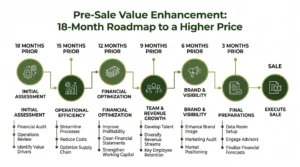
The most effective 18-month roadmap runs in three phases: foundation in months 1 through 6, performance improvement in months 7 through 12, and sale readiness in months 13 through 18. Trying to do everything at once results in incomplete work on the most important items.
During the foundation phase, the first step is a baseline valuation from an advisor operating under ASA and AICPA standards. That valuation identifies the top three to five value gaps and sets a measurable target. Without a baseline, owners focus on the wrong things and arrive at the sale process with the same problems they started with.
Here are the core actions for the performance improvement phase:
- Reduce customer concentration by adding new accounts, targeting no single customer above 20 percent of revenue.
- Convert project-based revenue to retainer formats, aiming for 30 percent or more of total revenue in contracted form.
- Build or hire into management gaps so the business can operate 60 to 90 days without the owner’s direct involvement.
- Engage a CPA to review and normalize three years of financial statements, removing personal expenses and one-time items.
The sale readiness phase prepares the quality of earnings package, organizes the data room, and engages an M&A advisor. A second valuation at month 15 to 16 sets the final asking price anchor. A buyer who sees two years of improving margins will pay a higher multiple than one who sees a single quarter of cleanup.
What Financial Metrics Do Buyers Examine?
Buyers examine five areas in every deal: revenue quality, margin profile, working capital trends, capital expenditure history, and debt structure. Problems in any area trigger price reductions or earnouts.
The table below shows how the same EBITDA produces different valuations based on revenue quality and risk factors.
| Risk Factor | Low-Risk Profile | High-Risk Profile | Multiple Impact |
|---|---|---|---|
| Revenue Type | 70%+ recurring or contracted | Primarily project-based | +1x to +2x for recurring |
| Customer Concentration | No customer over 10% | Top customer at 35% | -1x to -2x for concentration |
| Owner Dependency | Strong management team | Owner-dependent operations | -1x to -3x for dependency |
| Margin Trend | Expanding over 3 years | Flat or declining | +0.5x to +1x for expansion |
| Financial Documentation | 3 years reviewed statements | Tax returns only | -0.5x to -1x for weak docs |
Working capital is a common deal surprise. Rising receivables or building inventory can lead to a working capital adjustment at closing that reduces your net proceeds. EBITDA normalization – adjusting reported earnings to reflect true ongoing earning power – forms the foundation of price discussions. The IRS requires income-based valuations to rest on verifiable, normalized financial data.
What Are the Key Value Drivers to Improve?
Every business has core value drivers that buyers assess during due diligence. Improving these before a sale is at the heart of any effective pre-sale program. The most impactful in the middle market are revenue quality, customer concentration, management depth, and documented systems.
Here are the primary value drivers buyers evaluate in most middle-market transactions:
- Revenue quality and predictability – Recurring revenue, subscription models, and long-term contracts command higher multiples than project-based or transactional revenue.
- Customer diversification – No single customer should represent more than 15 to 20 percent of revenue for a clean sale at full market value.
- Management team depth – A capable second tier of leaders is a premium feature, especially for private equity acquirers.
- Documented operating procedures – Written SOPs and training materials show the business can be replicated and scaled.
- Gross margin trends – Stable or improving margins signal pricing power. Declining margins invite scrutiny and lower offers.
These drivers are not equally weighted in every sale. Your industry, deal size, and buyer type all influence which items matter most.
How Does Sofer Advisors Support Pre-Sale Prep?
Sofer Advisors approaches pre-sale preparation through a structured four-phase process. The Sofer Difference – built on Discovery, Diligence, Analysis, and Delivery – gives owners a clear picture of where they stand, what needs to change, and how much value those changes can create.
David Hern CPA ABV ASA, founder of Sofer Advisors, brings a Heart of a Teacher approach to every engagement, breaking down EBITDA normalization, multiple selection, and discount rate analysis into actionable terms that owners and transaction attorneys can use. He holds dual ABV and ASA credentials recognized by the IRS, SEC, and FINRA, and the firm has earned 180+ five-star Google reviews.
Sofer Advisors specializes in the middle market where personalized attention and a next business day response policy make a measurable difference in outcomes. The firm’s Inc. 5000 recognition in 2024 and 2025 reflects consistent growth built on client results.
Frequently Asked Questions
What is the 3 3 3 rule in sales?
The 3 3 3 rule in sales is a prospecting framework used by some M&A advisors: contact 3 buyers per week, follow up 3 times per contact, and manage 3 active conversations at once. In a business sale context, it helps maintain deal momentum without burning the buyer market. It is not a formal valuation standard but a practical pipeline tool for transaction advisors running structured sale processes.
How much is a business worth with $500,000 in sales?
Revenue alone does not set value. A company with $500,000 in sales could be worth anywhere from $150,000 to over $2,000,000 depending on EBITDA margin, growth rate, industry, and risk profile. A service business with 20 percent EBITDA margins and a 4x multiple is worth about $400,000. A technology business with recurring revenue might command 6x to 8x EBITDA. Margin quality matters far more than top-line revenue when setting value.
What does value enhancement mean in a business context?
Value enhancement means taking deliberate, documented steps to increase what a buyer will pay before bringing a business to market. It includes improving financial documentation, reducing customer concentration, building management depth, and resolving operational issues that trigger a buyer discount. The goal is to close the gap between current value and potential value. An 18-month window gives most owners enough time to make credible improvements that hold up under scrutiny.
How much does a pre-sale valuation from Sofer Advisors cost?
A standard business valuation from Sofer Advisors typically ranges from $7,500 to $25,000 depending on size and complexity. For pre-sale planning, most engagements fall in the $10,000 to $18,000 range and complete within 4 to 8 weeks. A baseline valuation at the start of the 18-month window and a second near the end is the most common approach. Schedule a free consultation to receive a scoped estimate.
How long does pre-sale value enhancement take?
Most meaningful value enhancement takes 12 to 24 months to complete and document. Changes made in the final 3 to 6 months before sale are treated as cosmetic by buyers. Financial improvements need at least two years of statements to be credible. Owner dependency takes time to reduce because relationship transfers happen gradually. An 18-month timeline gives owners enough runway to address the top value gaps without rushing.
What is a quality of earnings report and why does it matter?
A quality of earnings report is a CPA-prepared analysis that normalizes EBITDA by removing non-recurring items, adding back owner-specific expenses, and adjusting for one-time events. It forms the foundation of the purchase price discussion. Buyers and lenders rely on normalized EBITDA to decide how much they can pay and how much acquisition debt the business can support. A seller-prepared report reduces surprises in diligence and strengthens your negotiating position.
What customer concentration level triggers a buyer discount?
Buyers typically apply a discount when a single customer exceeds 20 percent of total revenue. At 30 percent or more, the discount can reach 1x to 2x EBITDA, and some buyers require an earnout tied to that customer’s retention. The concern is post-acquisition performance risk if that account is lost. Reducing concentration by developing new accounts improves both the multiple a buyer will pay and the deal structure they offer.
How does EBITDA normalization affect the asking price?
EBITDA normalization adjusts reported earnings to reflect the true ongoing earning power of a business. Common adjustments include adding back above-market owner pay and excluding one-time costs like legal settlements. Each dollar of legitimate add-back flows into normalized EBITDA and gets multiplied by the buyer’s multiple. A business reporting $800,000 in EBITDA that normalizes to $1,100,000 at a 5x multiple rises in value from $4,000,000 to $5,500,000.
Related Case Studies
- Sofer Advisors: Business Valuation for Exit Planning
- Sofer Advisors: Strategic Succession and Ownership Transfers
- Business Valuation For Mergers Buy Side Vs Sell Side
Executive Summary
Pre sale value enhancement is a structured 18-month process that addresses the financial, operational, and structural factors buyers use to price risk into their offers. The core improvement areas are financial documentation, customer concentration, owner dependency, revenue predictability, and management depth. Owners who begin early – with a formal baseline valuation and phased improvements – achieve higher sale prices and better deal terms. Every improvement must hold up under buyer due diligence, because undocumented value does not transfer.
What Should You Do Next?
Start by commissioning a baseline business valuation to understand where your company stands and which gaps will most impact your sale price. Use that valuation to build a phased 18-month improvement plan with milestones for financial documentation, revenue diversification, and management development. Measure your progress with a second valuation before going to market.
David Hern CPA ABV ASA, founder of Sofer Advisors works with business owners across the country to build and execute pre-sale value roadmaps backed by formal, credentialed appraisals. Schedule a consultation to discuss your situation and get a scoped estimate.
People Also Read
- What Is Impairment Testing Asset Value Assessment Guide
- Saas Valuation Complete Guide To Software Company Value
About the Author
This guide was prepared by David Hern CPA ABV ASA, founder of Sofer Advisors, a business valuation firm headquartered in Atlanta, GA. David holds dual accreditations as an Accredited Senior Appraiser (ASA) and is Accredited in Business Valuation (ABV), credentials recognized by the IRS, SEC, and FINRA. He also holds the Certified Exit Planning Advisor (CEPA) designation. With 15+ years of experience, David has served as an expert witness in 11+ cases and built Sofer Advisors into an Inc. 5000-recognized firm with 180+ five-star Google reviews.
For professional business valuation services, visit soferadvisors.com or schedule a consultation.
This content is for informational purposes only and does not constitute professional valuation advice. Business valuation conclusions depend on specific facts and circumstances. Contact Sofer Advisors for guidance regarding your specific situation.