


Last Updated: October 2026
An adequate disclosure gift tax return is a Form 709 that gives the IRS enough detail to understand a reported gift and the value placed on it. Meeting the standard starts the three-year statute of limitations, after which the IRS can no longer revalue the gift. The data point matters: once that three-year clock runs out, the reported value becomes permanent. The filing must describe the asset, the parties, and the valuation method in full.
The team at Sofer Advisors prepares these valuations for owners, CPAs, and estate attorneys, backed by Inc. 5000 recognition in both 2024 and 2025. If the disclosure falls short, the clock never starts, and the IRS can challenge the value decades later. For families transferring interests in a closely held business, a complete filing is a core defensive step.
This guide explains what adequate disclosure requires under the Treasury Regulations, why a qualified appraisal matters, how the statute of limitations works, and the mistakes that leave a return open. The goal is simple: file once, start the clock, and give the estate certainty.
Key Takeaways
- Starts the clock: a Form 709 with adequate disclosure begins the three-year window for the IRS to challenge a gift’s value.
- Strict rules: Treasury Regulation Section 301.6501(c)-1(f) requires a full description of the asset and the valuation method used.
- Appraisal needed: hard-to-value assets need a qualified appraisal to satisfy the disclosure standard.
- Open-ended risk: inadequate disclosure leaves the gift open to revaluation, tax, interest, and penalties years later.
- Team effort: a strong filing pairs a valuation specialist with a tax attorney or CPA who handles the legal reporting.
Each point below builds on the one before it, from the legal standard to the records that satisfy it. The sections that follow examine each in detail.
Why Is Adequate Disclosure Important to Understand?
Adequate disclosure decides whether the IRS audit window ever closes, and the rules are specific. Treasury Regulation Section 301.6501(c)-1(f) sets what a return must contain: a full description of the asset, the parties, and the valuation method. For a hard-to-value interest, the IRS weighs that value against Revenue Ruling 59-60, the framework for closely held stock, and expects any appraisal to follow USPAP. A filing that misses these marks stays open to revaluation, extra tax, interest, and penalties for years.
What Defines Adequate Disclosure for the IRS?
Adequate disclosure means giving the IRS enough to understand and review the gift. Under Treasury Regulation Section 301.6501(c)-1(f), the return must identify the nature of the transfer, the parties involved, and the method used to set the reported value. The goal is a clear path for an examiner to follow the logic. When the standard is met, the three-year limit begins. When it is not, the position stays open with no time limit at all. Closure is the entire point, and it is available only through a complete, well-supported filing.
Why Is a Qualified Appraisal Crucial?
A qualified appraisal is the main way to satisfy the disclosure rules for a hard-to-value asset, and private company stock is the classic example. The report analyzes the factors that drive value and builds a defensible position the IRS can test against Revenue Ruling 59-60. To count as qualified, the work must follow USPAP, which keeps the analysis independent and grounded in data. The report must also explain any discount for lack of marketability or lack of control. Those discounts are common for private stock, but they draw scrutiny, so a documented case is what lowers the risk of a challenge. This reflects the Heart of a Teacher approach, which explains the reasoning behind a number rather than simply stating it.
How Does the Gift Tax Statute of Limitations Work?
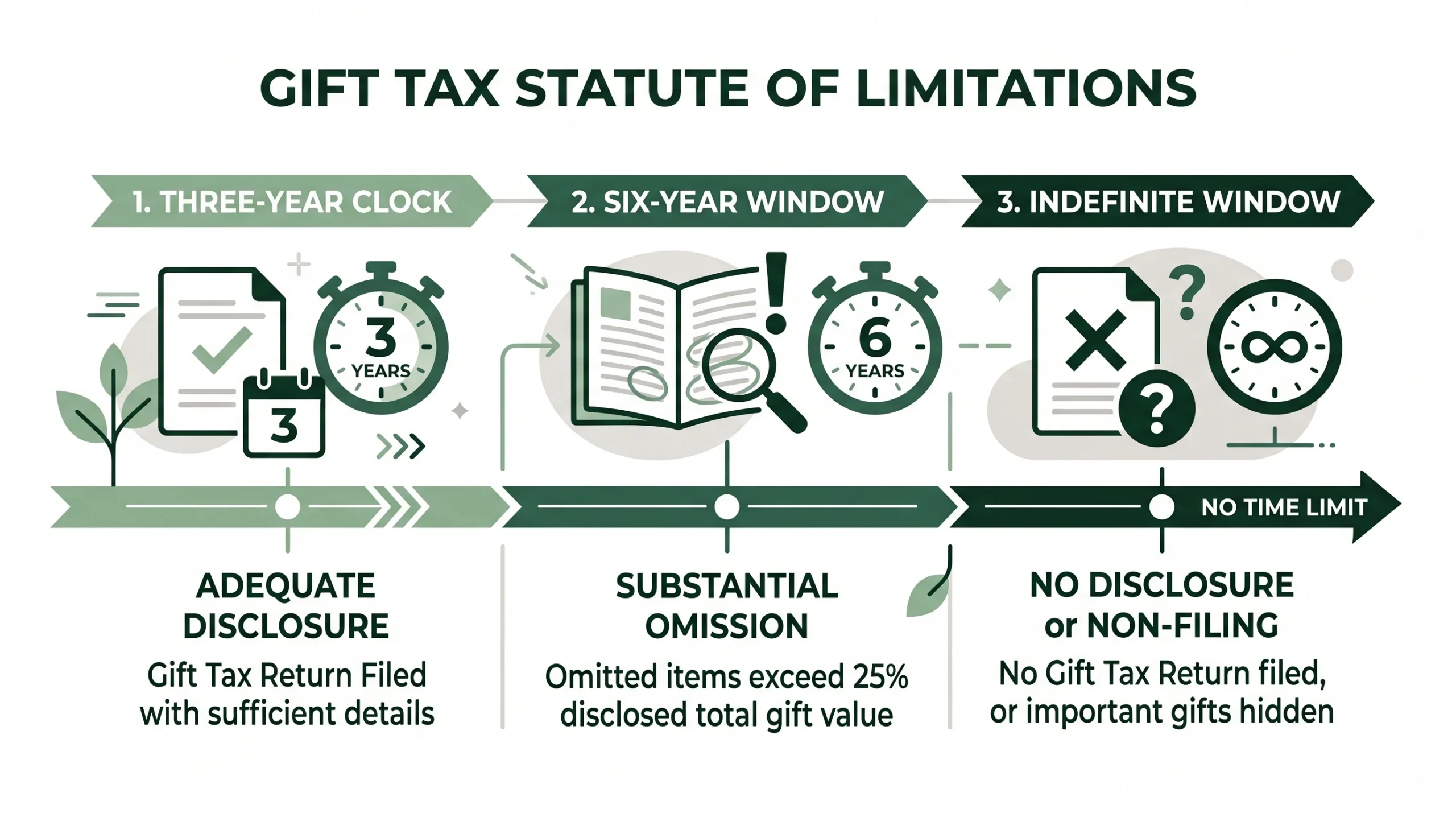
The three-year clock starts only when a donor files a Form 709 with adequate disclosure. That filing sets the deadline for the IRS to question the reported value, and without enough detail, the window never opens. Two exceptions extend the period. If a taxpayer omits more than 25 percent of the total gifts for the year, the window grows to six years. In cases of fraud, or where disclosure is missing entirely, the period is unlimited, and the IRS can revisit the transfer at any point, often during an estate review.
Understanding which standard applies to your transfer is easier with a specialist reviewing the facts. Talk to a Sofer Advisors valuation specialist about the appraisal your filing needs.
How Do the Professional Roles Compare?
A strong gift tax filing usually needs two kinds of expertise working together. A valuation specialist quantifies the asset, while a tax attorney or CPA manages the legal reporting and strategy. The table below shows how the tasks divide.
| Task in a gift tax filing | Valuation specialist | Tax attorney or CPA |
|---|---|---|
| Determine fair market value | Prepares the defensible appraisal report | Reviews it for legal soundness and tax strategy |
| Apply valuation discounts | Supports DLOM and DLOC with market data | Argues the legal basis and precedent |
| Defend value in an audit | Serves as expert witness on the methodology | Leads the legal response to the IRS |
Owners also choose among valuation providers. Larger national firms such as Alvarez & Marsal, Stout, and Kroll serve big public companies with broad advisory teams. Sofer Advisors focuses on defensible, partner-led gift and estate valuations for closely held and middle-market businesses, with expert witness testimony in 11+ cases behind its reports. It works through a four-phase process it calls The Sofer Difference, moving from Discovery to Diligence to Analysis to Delivery, so each appraisal arrives with a clear trail of evidence the IRS can follow.
What Are Common Mistakes on Form 709 Disclosures?
The most common mistake is incomplete reporting, which prevents the three-year clock from ever starting. Many filers fail to attach the full appraisal, describe the valuation method, or support a discount with market data. A vague asset description is another frequent error, and a line that simply reads shares in a family business invites a follow-up request. The return should name the entity, the class of interest, and the percentage transferred. Specific, complete detail is what satisfies the standard and avoids a second round of questions from the agency.
How Does the Lifetime Exemption Fit In?
Gifts above the annual exclusion draw against the lifetime exemption, which is $15 million per person for 2026, set by the 2025 tax law and indexed for inflation. The 2025 law made that exemption permanent, so there is no sunset date to plan around. Most large family business transfers use the exemption rather than paying tax out of pocket, which is why the reported value matters so much. If the IRS later revalues the gift upward, the donor can lose more exemption than planned. Adequate disclosure locks the value in after three years, turning a planning estimate into a settled number.
Frequently Asked Questions
How does the IRS know you gave a gift?
The main source is the donor’s own Form 709, filed to report gifts above the annual exclusion. Third parties can also provide clues, such as banks reporting large transfers or an entity issuing a Schedule K-1 that shows an ownership change. Real estate deeds recorded with a county add another trail. A complete, well-documented filing keeps the reported gift aligned with the records the IRS already sees, and Sofer Advisors builds that documentation into every valuation report.
Do you have to disclose gifts on taxes?
You must file Form 709 when a gift to one recipient exceeds the annual exclusion for the year, currently $19,000 per recipient. The return does not always mean tax is due; it tracks cumulative lifetime transfers against your exemption. Gifts to a spouse who is a U.S. citizen or to a qualified charity are generally exempt from the filing. Keeping accurate records avoids reporting errors, and Sofer Advisors supplies the valuation detail each taxable transfer requires.
Can my parents gift me $100,000 without paying gift tax?
Usually yes, with no immediate tax. The amount above the annual exclusion applies against each parent’s lifetime exemption, which is $15 million per person for 2026 under the 2025 tax law. They still must file Form 709 to report the excess, even though no tax is due at the time. If any part of the gift is an interest in a business, Sofer Advisors can appraise it so the reported value is fully supported.
What is the annual gift tax exclusion for 2026?
For 2026, the annual gift tax exclusion is $19,000 per donor per recipient, per the IRS. Gifts up to that amount do not reduce the lifetime exemption and need no return. A married couple can combine their exclusions to give $38,000 to the same recipient. Amounts above the exclusion draw against the $15 million lifetime exemption and must be reported. Sofer Advisors values any business interest that moves above the exclusion so the Form 709 figure holds up.
What happens if I don’t file a gift tax return for a taxable gift?
The statute of limitations never starts, so the transfer stays open to audit indefinitely. The IRS can later assess the tax plus interest and penalties, often during an estate review. A missed filing can also undermine the whole estate plan, since the gifted value is never settled. Filing on time, with a complete appraisal, closes the window and gives the family certainty. Sofer Advisors prepares the valuation that lets a late or corrective return stand on solid ground.
Does adequate disclosure prevent an IRS audit?
No. It does not stop an audit, but it starts the three-year limit on challenges to the reported value. The IRS may still review the return, yet a thorough, well-supported filing makes it far harder to revalue the gift years later. The quality of the appraisal and the completeness of the disclosure are the real defense, not the filing alone. Sofer Advisors produces reports built to withstand that review, with every discount tied to market evidence.
How long does it take to get a valuation for a gift tax return?
A standard business valuation usually takes four to eight weeks from the start of the engagement. The timeline depends on the entity’s complexity, the quality of the financial records, and how many interests are involved. It allows time for due diligence and a report that meets USPAP standards. Because many gifts are made near year-end, the work should start early. Sofer Advisors scopes the engagement up front so the report is ready well before the filing deadline.
How much does a gift tax valuation cost?
A business valuation for gift tax reporting usually ranges from $7,500 to $25,000. The fee depends on the complexity of the interest, the number of entities, and the level of documentation the filing needs. A flat scope is quoted up front, so the cost is clear before any work begins, with no hourly surprises. Sofer Advisors sets the scope first, then quotes a fixed price. Request a free estimate for a range specific to your engagement.
Related Case Studies
- Adequate Disclosure on Form 709: Starting the Statute of Limitations
- Estate Planning Business Valuation Georgia: Gift & Tax Compliance Guide
- Valuation Discounts (DLOC and DLOM) on Estate and Gift Tax Returns
Executive Summary
Adequate disclosure is what starts the three-year statute of limitations on a reported gift. Under Treasury Regulation Section 301.6501(c)-1(f), a Form 709 must describe the asset, the parties, and the valuation method, and a hard-to-value interest needs a qualified appraisal that follows USPAP and Revenue Ruling 59-60. For 2026, the lifetime exemption is $15 million per person and the annual exclusion is $19,000. A complete filing closes the audit window after three years; an incomplete one leaves it open with no limit. Most gift tax valuations run $7,500 to $25,000 over four to eight weeks. The first step is to gather the appraisal, entity documents, and financial statements from the transfer year.
What Should You Do Next?
Review which gifts from the current and prior years still lack a complete Form 709, and confirm each reported value rests on a qualified appraisal. Gather the appraisal, the entity’s operating or partnership agreement, and the financial statements from the transfer year, since a clean file supports a defensible disclosure. This guide was prepared by David Hern CPA ABV ASA, founder of Sofer Advisors, an Inc. 5000 firm specializing in neutral third-party valuations for estate and gift tax reporting. Schedule a free consultation to discuss your specific situation.
People Also Read
About the Author
This guide was prepared by David Hern CPA ABV ASA, founder of Sofer Advisors, a business valuation firm headquartered in Atlanta, GA serving clients across the United States. David holds dual accreditations as an Accredited Senior Appraiser (ASA) and is Accredited in Business Valuation (ABV), credentials recognized by the IRS, SEC, and FINRA. He also holds the Certified Exit Planning Advisor (CEPA) designation. With 15+ years of valuation experience, David has served as an expert witness in 11+ cases across multiple jurisdictions and built Sofer Advisors into an Inc. 5,000-recognized firm with 180+ five-star Google reviews. Its full W2 employee team maintains subscriptions to all major valuation databases and operates under a next business day response policy.
For professional business valuation services, visit soferadvisors.com/about-us/ or contact Sofer Advisors at soferadvisors.com/contact-us/.
This content is for informational purposes only and does not constitute professional valuation advice. Business valuation conclusions depend on specific facts and circumstances. Contact Sofer Advisors for guidance regarding your specific situation.









