


Last Updated: June 2026
This article is for S corp owners preparing for a sale, their CPAs, and M&A attorneys. You will learn what an F reorganization requires, why private equity buyers insist on it, how the two-tier structure is built, and how the Form 8594 allocation affects your after-tax proceeds.
A f reorganization s corp sale is a tax-free entity conversion that reshapes an S corporation into a two-tier holding structure before the business is sold. Buyers require this because it lets them acquire the operating subsidiary as an asset purchase, gaining a stepped-up basis in every asset at deal price. For sellers, this often means a higher offer and capital gain treatment on most proceeds.
Missing this step costs buyers millions in lost deductions. Sofer Advisors, based in Atlanta, GA, works with middle-market S corp owners to document value and protect what they keep after closing. PE buyers routinely include F reorganization requirements in their letters of intent. Sellers who understand the economics negotiate from a stronger position.
Key Takeaways
- Buyer-Driven Requirement – PE buyers request F reorganizations in most S corp deals to get stepped-up asset basis without a direct taxable asset sale.
- Tax-Free Conversion – Under IRC Section 368(a)(1)(F), the conversion produces no gain when IRS continuity requirements are satisfied.
- Two-Tier Structure – A new S corp HoldCo owns 100% of an operating LLC; the buyer acquires only the LLC.
- Buyer Tax Value – A $10 million deal with $6 million in intangibles generates 15 years of IRC Section 197 amortization for the buyer.
- Timing Is Critical – The conversion must complete 30 to 60 days before closing to avoid deal delays.
- Personal Goodwill Opportunity – Sellers who document personal goodwill can cut effective tax rates on that portion of proceeds by up to 20 percentage points.
The sections below examine these points in detail.
What Is an F Reorganization Exactly?
An F reorganization, under IRC Section 368(a)(1)(F), is a “mere change in identity, form, or place of organization” of a corporation. It lets an S corp convert to a holding structure without recognizing gain. It also preserves the S election. The IRS codified the mechanics in Revenue Ruling 2008-18 and Revenue Procedure 2009-39.
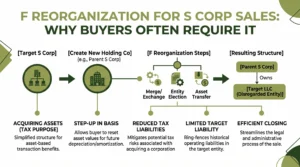
The mechanics follow a defined path. The original S corp becomes the transferor entity. A new S corp forms as HoldCo. The original entity converts into a single-member LLC – a disregarded entity for tax purposes. HoldCo sits above OpCo LLC and holds all historical equity and liabilities.
Not every conversion qualifies. All shareholders must receive the same proportionate HoldCo interest as in the original entity. The reorganization needs a valid business purpose, and IRS continuity requirements must hold throughout. Coordinate with your CPA and attorney before signing any letter of intent.
Why Do Buyers Require This Structure?
Buyers require an F reorganization because it gives them asset-purchase tax treatment from a stock deal. Private equity firms need to depreciate and amortize acquired assets at deal price. The seller’s historical cost basis is often near zero for assets fully depreciated years ago.
When a buyer acquires S corp stock directly, they inherit the seller’s inside basis in every asset. Equipment bought for $200,000 a decade ago and now fully depreciated carries zero future deductions. That gap gets priced into the offer.
An F reorganization changes this. The buyer acquires OpCo as an asset purchase, and every asset gets a new basis at deal price. For a deal with $6 million in intangibles, that means 15 years of IRC Section 197 amortization. Buyers model this benefit into their offers. Sellers who understand the buyer’s economics can capture a meaningful price premium.
How Does the Conversion Process Work?
The F reorganization follows a defined sequence. Skipping any step can invalidate the conversion or trigger an unplanned taxable event.
The conversion involves five steps:
- Form a new HoldCo – usually a new S corporation in the same state as the original entity.
- Transfer all existing S corp stock to HoldCo in exchange for 100% of HoldCo shares.
- Convert the original S corp to a single-member LLC treated as a disregarded entity.
- Confirm the S election carries to HoldCo under IRS continuity rules.
- File IRS Form 8869 if the parties want to retain a qualified subchapter S subsidiary structure.
Each step creates state filing obligations. Some states process LLC conversions in 24 hours; others take two to three weeks. Loan covenants may require bank consent. Operating licenses tied to the original entity need updating. Sellers who start 90 days before closing have a workable buffer.
What Are the Tax Outcomes for Sellers?
Tax treatment hinges on how gain is split between capital gain and ordinary income. That split is the biggest variable in proceeds.
For most S corp owners, the OpCo sale produces long-term capital gain when held more than 12 months. Inventory, receivables, and recaptured depreciation still produce ordinary income. The Form 8594 allocation under IRC Section 1060 controls how each dollar is taxed.
The table below compares outcomes across three deal structures for a $5 million S corp:
| Deal Structure | Gross Proceeds | Est. Blended Tax Rate | Est. Net Proceeds |
|---|---|---|---|
| Straight Stock Sale | $5,000,000 | 23.8% | $3,810,000 |
| Direct Asset Sale | $5,000,000 | 28-32% blended | $3,400,000 – $3,600,000 |
| F Reorganization Asset Sale | $5,150,000* | 23.8-26% | $3,840,000 – $3,930,000 |
*Assumes a 3% premium from sharing the buyer’s tax benefit.
Personal goodwill adds another layer. Value tied to the owner’s relationships and expertise can be sold at long-term capital gain rates. This bypasses the entity. An independent valuation documenting this can cut the effective tax rate on that portion by up to 20 percentage points. That savings is meaningful on any middle-market deal.
What Mistakes Do Sellers Make Most Often?
The most common mistake is starting too late. Most sellers first hear about the F reorganization from the buyer’s attorney after signing the letter of intent. The deal timeline is set, and the seller must rush a conversion that should have started earlier.
The second error is ignoring loan documents. Lenders often treat an entity conversion as a default or require prior written consent. Converting without notifying the bank can trigger acceleration. Three other errors appear regularly:
- Forming a C corp as HoldCo, which kills pass-through treatment and creates double-tax exposure on proceeds.
- Failing to update operating licenses and professional certifications tied to the original entity name.
- Skipping an independent valuation to document personal goodwill before the buyer sets the allocation.
The IRS scrutinizes Form 8594 allocations where large personal goodwill amounts appear. A supported valuation is far harder to challenge than one that looks tax-driven. The documentation cost is small relative to the tax savings at stake on deals above $3 million.
When Should You Involve a Valuation Advisor?
Engage a valuation advisor 12 to 18 months before closing. A valuation at that stage tells you what your business is worth and surface value drivers. It also sets a defensible baseline for the Form 8594 negotiation.
A Heart of a Teacher approach means breaking allocation decisions into plain terms your advisors can act on. The IRC Section 1060 allocation controls the tax outcome for both sides. Value in short-life assets benefits the buyer. Value in goodwill benefits the seller. Knowing this before meeting a buyer changes the negotiation.
The Sofer Difference is a four-phase process – Discovery, Diligence, Analysis, and Delivery. It gives owners a clear picture of what their company is worth. Larger firms like Alvarez and Marsal and Kroll serve the enterprise market. For the middle-market, a specialist with dual ABV and ASA credentials produces better results. These credentials are recognized by the IRS, SEC, and FINRA. The appraiser who designs your analysis writes the report and stands behind it if an IRS review follows.
The questions below cover what S corp owners ask most often. These answers offer general guidance only.
Frequently Asked Questions
What is an F reorganization in an S corp sale?
An F reorganization in an S corp sale is a tax-free entity conversion under IRC Section 368(a)(1)(F). A new S corp HoldCo forms above the original entity, which converts into an operating LLC. Buyers request this structure because it lets them acquire the LLC as an asset purchase. They gain stepped-up tax basis in all acquired assets without requiring the seller to recognize gain at conversion.
Why do private equity buyers require F reorganizations?
PE buyers require F reorganizations to get a full step-up in asset basis. Buying S corp stock directly means inheriting the seller’s historical cost basis. For older assets, that basis is often near zero. The F reorganization lets the buyer acquire the LLC at a deal-price basis. This generates depreciation and amortization deductions that improve investment returns. Sellers who understand this can negotiate a price premium.
Does an F reorganization trigger taxes for the seller?
The conversion itself is tax-free under Section 368(a)(1)(F) when IRS continuity requirements are met. The taxable event occurs when the buyer purchases the operating LLC. The seller then recognizes gain on each asset class under the Form 8594 allocation. Most gain qualifies for long-term capital gain rates. Recaptured depreciation, inventory, and certain receivables still produce ordinary income regardless of how the deal is structured.
How long does an F reorganization take to complete?
An F reorganization typically takes 30 to 60 days from start to completion. State filing timelines vary. Some states process LLC conversions in 24 hours while others take two to three weeks. Loan covenants, licenses, and landlord consents can add time. Sellers who start 90 days before the target close date have a workable buffer. Waiting until after the letter of intent is signed frequently delays closing.
What is personal goodwill and how does it affect the sale?
Personal goodwill is value tied directly to the owner. It covers client relationships, expertise, and reputation that would not transfer with the business. In an F reorganization deal, the owner can sell personal goodwill at long-term capital gain rates. This bypasses the entity. An independent valuation documenting this creates a defensible record. It can reduce the effective tax rate on that portion of proceeds by up to 20 percentage points.
What is a Section 338(h)(10) election and how does it compare?
A Section 338(h)(10) election lets buyers get asset purchase tax treatment when acquiring S corp stock. Both parties must consent. The seller recognizes gain as if assets were sold rather than stock. Both mechanisms produce similar tax results for the buyer. F reorganizations generally give buyers more post-closing structural flexibility and a cleaner holding structure. Your tax advisor should model both options before finalizing deal terms.
How much does a business valuation from Sofer Advisors cost for an F reorganization deal?
A business valuation for an F reorganization deal typically ranges from $7,500 to $25,000. The fee depends on business size, asset complexity, and whether a purchase price allocation under ASC 805 is also needed. Most standard engagements complete within four to eight weeks. Rush engagements carry a 25 to 50 percent premium. Schedule a free consultation for a scoped estimate for your situation.
How does the purchase price allocation work after an F reorganization?
After closing, buyer and seller each file IRS Form 8594. It shows how the purchase price is allocated across seven asset classes under IRC Section 1060. Each class carries different tax rates for the seller and different depreciation timelines for the buyer. Buyers prefer short-life depreciable assets while sellers prefer goodwill. An independent valuation supporting each class creates a defensible record in the event of an IRS inquiry.
Can all S corporations complete an F reorganization before a sale?
Most S corporations can, but certain factors create complications. S corps with multiple classes of stock or existing qualified subchapter S subsidiary elections face added steps. Heavy regulatory requirements add further hurdles. Multi-shareholder S corps require all owners to receive proportionate HoldCo interests matching their original holdings. Your CPA and attorney should review the shareholder agreement, state requirements, and licensing rules before starting the conversion. This avoids unexpected delays.
Related Case Studies
- Business Valuation For Mergers Buy Side Vs Sell Side
- How to Determine What a Business Is Worth: Complete Guide
- Why You Must Start Planning Your Business Exit Now With the Right Valuation Expert
Executive Summary
An F reorganization s corp sale lets buyers capture asset-purchase tax treatment from a stock deal. The conversion is tax-free under IRC Section 368(a)(1)(F), but the operating LLC sale triggers capital gain on each asset class. Sellers who engage a credentialed advisor early – to document personal goodwill and negotiate the Form 8594 allocation – protect more of their proceeds. ABV and ASA credentials recognized by the IRS, SEC, and FINRA give middle-market owners defensible documentation before they sign.
What Should You Do Next?
Get an independent valuation before a buyer sets the allocation terms. Know what your personal goodwill is worth and confirm with your CPA and attorney that the F reorganization fits your deal structure. David Hern CPA ABV ASA, founder of Sofer Advisors guides business owners through M&A valuations and purchase price allocations. Schedule a consultation to discuss your S corp sale.
People Also Read
- Medical Practice Valuation Atlanta Healthcare Sale Transition Guide
- Why You Must Start Planning Your Business Exit Now With The Right Valuation Expert
About the Author
This guide was prepared by David Hern CPA ABV ASA, founder of Sofer Advisors – a business valuation firm headquartered in Atlanta, GA serving clients across the United States. David holds dual accreditations as an Accredited Senior Appraiser (ASA) and is Accredited in Business Valuation (ABV), credentials recognized by the IRS, SEC, and FINRA. He also holds the Certified Exit Planning Advisor (CEPA) designation. With 15+ years of valuation experience, David has served as an expert witness in 11+ cases across multiple jurisdictions and built Sofer Advisors into an Inc. 5000-recognized firm with 180+ five-star Google reviews. The firm’s full W2 employee team maintains subscriptions to all major valuation databases and operates under a next business day response policy.
For professional business valuation services, visit soferadvisors.com or schedule a consultation.
This content is for informational purposes only and does not constitute professional valuation advice. Business valuation conclusions depend on specific facts and circumstances. Contact Sofer Advisors for guidance regarding your specific situation.