


Last Updated: June 2026
This article is for business owners, litigation attorneys, and financial advisors who need to understand how breach of contract damages are measured. After reading it, you will know which damage categories apply, how lost profits are calculated, and what makes a damages opinion hold up in court.
Breach of contract damages business refers to the financial harm a company suffers when another party fails to perform their contractual obligations. This entitles the harmed party to monetary recovery. These damages compensate the injured business for actual economic losses, not punishment. Courts and arbitrators rely on credentialed financial experts to calculate those losses in a defensible, methodologically sound way.
Getting the number right is critical. Underestimating damages leaves money on the table. Overreaching without support destroys credibility with judges and juries. Business owners, attorneys, and CFOs face this problem across many situations. These include commercial disputes, vendor failures, partnership breakdowns, and acquisition disagreements. Sofer Advisors, headquartered in Atlanta, GA, provides expert damages analysis for business disputes across the United States, drawing on dual ASA and ABV credentials recognized by the IRS, AICPA, and FINRA.
Key Takeaways
- Expectation Damages Are the Standard – Courts most often award expectation damages, which put the injured party in the position they would have been in had the contract been performed, typically measured in dollars of lost profit.
- Three Core Methods Apply – Lost profits calculations rely on the before-and-after method, the yardstick method, or a discounted cash flow (DCF) projection, each suited to different fact patterns.
- Mitigation Is a Legal Obligation – An injured party must take reasonable steps to reduce their loss. Failure to mitigate can reduce or eliminate recoverable damages in most jurisdictions.
- Expert Witness Testimony Is Usually Required – Courts in commercial disputes routinely require a credentialed CPA, ABV, or ASA to present and defend the damages calculation under Daubert or Frye standards.
- Foreseeability Limits Recovery – Only damages that were reasonably foreseeable at the time of contracting are recoverable. Consequential damages that were not contemplated by both parties may be excluded.
- Documentation Drives the Outcome – The strength of a damages claim depends on financial records, contracts, projections, and industry data. Weak records produce weak recovery even in strong liability cases.
What Are the Types of Contract Damages?
Courts recognize several categories of damages. Which ones apply depends on the contract, the breach, and the jurisdiction. Expectation damages are the most common. They restore the injured party to the economic position the contract promised – the benefit of the bargain. Reliance damages apply when expectation damages cannot be calculated with certainty. They reimburse costs the injured party incurred in reliance on the contract. Restitutionary damages return any benefit the breaching party received unjustly. Punitive damages are rarely awarded in contract cases.
The distinction between direct and consequential damages matters greatly. Direct damages flow naturally from the breach. Consequential damages require proof that the breaching party knew they could result, or should have known. Many contracts include limitation-of-liability clauses that cap or exclude consequential damages entirely. The governing contract must be reviewed first. The category of damages sought determines what financial evidence must be produced.
How Are Lost Profits Calculated?
Lost profits represent the most common form of expectation damages. The calculation starts with a but-for revenue projection – what the business would have earned had the contract been performed – then subtracts costs to produce the lost profit figure.
Courts accept three primary methods:
- Before-and-After Method – Compares financial performance during a comparable period before the breach to performance after. This works best when the business has a strong operating history.
- Yardstick Method – Uses a comparable business or industry benchmark as a proxy for what the injured party would have earned. It is applied when pre-breach data is limited or when a new business lacks historical performance.
- Discounted Cash Flow (DCF) Method – Projects future lost earnings and discounts them to present value using a rate that reflects business risk. Used for longer-term contracts or multi-year revenue streams.
Each method has strengths and weaknesses. A credentialed expert often applies more than one to test consistency. Growth rate assumptions, comparable period selection, and method choice are all areas opposing experts attack.
What Is the “But-For” World Standard?
The “but-for” world is the financial expert’s core analytical framework. It asks what the business would have earned but for the breach. The expert reconstructs a hypothetical performance trajectory using real financial data, industry benchmarks, and economic evidence. The difference between the but-for world and actual results is the measured loss.
Building the but-for world is not guesswork. Experts rely on pre-breach financial statements, budgets, signed contracts, and industry data. Courts expect this analysis to meet reasonable certainty standards. The existence of damage must be proven, though the precise amount may be estimated. Courts accept approximations where the breach makes precise calculation impossible. This principle is sometimes called the “wrongdoer rule.” It prevents a breaching party from escaping liability because their conduct made it hard to measure harm.
What Limits Recovery for Breach Damages?
Several legal doctrines reduce or eliminate recovery even when liability is clear. Mitigation requires the injured party to take reasonable steps to reduce their loss. A company that sat idle and let avoidable losses accumulate may see its award cut greatly.
Foreseeability caps consequential damages at what both parties reasonably anticipated when they signed. Courts trim claims for losses beyond what the breaching party could have foreseen. Speculative future profits with no historical basis rarely survive challenge.
| Limiting Doctrine | Effect on Recovery | Key Question |
|---|---|---|
| Mitigation | Reduces avoidable losses | Did the claimant take reasonable steps? |
| Foreseeability | Caps consequential damages | Were these losses contemplated at signing? |
| Certainty | Excludes speculative losses | Is there a reasonable factual basis? |
| Contractual limitation clause | Caps or excludes damages | What does the contract say? |
| Comparative fault | Reduces damages proportionally | Did the claimant contribute to the harm? |
An experienced damages expert reviews the contract, the pre-breach conduct, and the post-breach response before forming an opinion. Ignoring any one of these doctrines can produce a figure that a court reduces at trial.
How Does a Financial Expert Build a Damages Opinion?
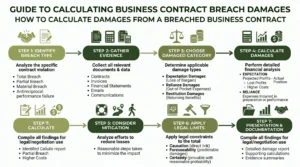
A credentialed financial expert follows a structured process. Document review – financial statements, tax returns, contracts, and market data – comes first. The expert then builds the but-for model, selects the appropriate method, and tests the assumptions against available data. Every number is traced to a source document or recognized benchmark. Growth rates are anchored to historical averages or industry norms. Discount rates reflect business risk, consistent with AICPA Forensic and Valuation Services guidelines. Federal courts apply the Daubert standard, requiring the method be reliable, tested, and subject to peer review.
What sets The Sofer Difference apart is the four-phase process – Discovery, Diligence, Analysis, and Delivery – applied to every engagement. Each phase ensures the conclusion is complete and presented in a format counsel and the court can follow without a finance degree.
When Should You Hire a Damages Expert?
The best time to retain a financial expert is before the complaint is filed. Early retention allows the expert to identify which damage categories are supported, estimate a realistic range, and flag limitations that affect recovery. Attorneys who engage a damages expert late often find the claim was built around numbers the expert cannot fully support.
Pre-filing expert involvement also helps attorneys craft document requests that target the right financial information. Courts set expert disclosure deadlines that cannot be missed. Missing Rule 26 requirements can result in the expert being excluded entirely.
David Hern’s Heart of a Teacher approach shapes how the firm engages with legal teams. Complex financial methods – DCF, capitalization of earnings, EBITDA normalization – are explained in plain language. Juries can follow them without a finance background.
Frequently Asked Questions
What is the difference between expectation and reliance damages?
Expectation damages put the injured party in the position the contract promised – they recover the profit they would have made. Reliance damages reimburse costs incurred in preparing to perform. They apply when expectation losses are too speculative to calculate. Courts prefer expectation damages because they fully compensate for the breach. Reliance recovery is available when historical data cannot support a profit projection.
How much does a business damages analysis from Sofer Advisors cost?
A business damages analysis from Sofer Advisors typically ranges from $7,500 to $25,000 for standard commercial disputes. The fee depends on case complexity, volume of financial records, and whether expert testimony is required at trial. Most standard engagements are completed within four to eight weeks. Rush engagements carry a 25 to 50 percent premium. Schedule a free consultation to get a scoped estimate.
How long does it take to prepare a damages expert report?
Most commercial damages reports take four to eight weeks from the date all financial documents are received. Complex cases involving multiple entities or significant normalization work can take ten to twelve weeks. Rush timelines are possible but require all documents immediately and involve more fees. The most common cause of delays is incomplete financial records from either party.
Can a new business recover lost profits?
New businesses face a higher burden than established ones. Without operating history, a profit projection must rest on a signed contract, business plan, or comparable business benchmarks. Courts have allowed new business recovery where a contract promised specific revenue. The yardstick method is most commonly applied to new ventures. Appraisers with ABV or ASA designations are trained to apply this method under AICPA forensic standards.
What is the difference between lost profits and lost business value?
Lost profits compensate for earnings that would have been generated during the damage period. Lost business value compensates for the reduction in the company’s overall worth caused by the breach. Some cases involve both. A breach that permanently reduces earnings may also reduce sale value, giving rise to a diminished value claim alongside a lost profits claim. These are separate calculations requiring distinct methods.
How does mitigation affect the damages calculation?
Mitigation reduces recoverable damages by the amount of loss the injured party could have reasonably avoided. If a business owner could have found a replacement customer or vendor and did not try, the avoidable portion of the loss is deducted from the award. The breaching party bears the burden of proving failure to mitigate. Courts require only reasonable steps, not extraordinary ones.
What financial records does the damages expert need?
A damages expert typically needs three to five years of financial statements, tax returns, and management accounts. The expert also needs the governing contract, purchase orders, customer invoices, and correspondence about the breach. For a before-and-after analysis, monthly revenue and cost data are essential. For a DCF model, forward projections help establish what management expected. Gaps in the records will be exploited by opposing experts.
What standards govern a business damages expert?
Financial experts in commercial litigation work under the AICPA Forensic and Valuation Services practice standards and USPAP for appraisers holding ASA credentials. Federal courts evaluate expert testimony under the Daubert standard, which requires that the method be testable, subject to peer review, and accepted in the relevant professional community. An ABV or ASA credential shows the expert has met recognized competency standards in business valuation.
Can contract language limit what damages I can recover?
Yes. Many commercial contracts include limitation-of-liability clauses that cap damages or exclude consequential damages entirely. Courts generally enforce these clauses unless they are unconscionable or violate public policy. Your attorney should review the governing contract before engaging a damages expert. An expert who ignores these clauses produces an opinion that courts will reduce or exclude. The contract must frame the analysis before financial modeling begins.
How do courts evaluate competing expert opinions on damages?
Courts apply a gatekeeping function under Daubert or Frye to assess whether each expert’s method is reliable. The jury weighs competing opinions based on the quality of evidence, the soundness of the method, and the credibility the expert projects. Experts who explain their method clearly and have defended prior opinions in deposition and at trial perform best. This firm has provided expert witness testimony in 11+ cases.
Related Case Studies
- Shareholder Dispute Valuation Atlanta Resolving Georgia Business Partner Conflicts
- How to Determine What a Business Is Worth: Complete Guide
- Business Valuation For Mergers Buy Side Vs Sell Side
Executive Summary
Breach of contract damages are calculated by measuring the financial difference between what the injured party was promised and what they received. Expectation damages, lost profits, and diminished value are the three most common claims. Credentialed experts use the before-and-after method, the yardstick method, or a DCF model to quantify those losses. Legal doctrines including mitigation, foreseeability, and certainty limit recovery and must be built into the analysis from the start.
What Should You Do Next?
Review your contract to identify which damage categories apply and whether any limitation clauses reduce your potential recovery. Gather your financial statements, tax returns, and breach documentation before your first expert consultation. Set a timeline with litigation counsel that allows enough time for a credentialed expert report before your disclosure deadline.
David Hern CPA ABV ASA, founder of Sofer Advisors, provides defensible damages analysis for commercial disputes, with 15+ years of valuation experience and expert witness service in 11+ cases across multiple jurisdictions. Schedule a consultation to discuss your breach of contract claim and get a scoped estimate for your specific situation.
People Also Read
- Why You Must Start Planning Your Business Exit Now With The Right Valuation Expert
- What To Expect During A Business Valuation Step By Step Process
About the Author
This guide was prepared by David Hern CPA ABV ASA, founder of Sofer Advisors – a business valuation firm headquartered in Atlanta, GA serving clients across the United States. David holds dual accreditations as an Accredited Senior Appraiser (ASA) and is Accredited in Business Valuation (ABV), credentials recognized by the IRS, SEC, and FINRA. He also holds the Certified Exit Planning Advisor (CEPA) designation. With 15+ years of valuation experience, David has served as an expert witness in 11+ cases across multiple jurisdictions and built the firm into an Inc. 5000-recognized firm with 180+ five-star Google reviews.
For professional business valuation services, visit soferadvisors.com or schedule a consultation.
This content is for informational purposes only and does not constitute professional valuation advice. Business valuation conclusions depend on specific facts and circumstances. Contact Sofer Advisors for guidance regarding your specific situation.