


Last Updated: June 2026
This article is written for Louisville owners considering a sale, planning succession, or facing a transaction. After reading it, you will understand which valuation methods apply to your situation, what local factors affect your company’s value, and what the process actually involves.
A business valuation Louisville KY is the process of finding the fair market value of a company operating in or near the Louisville metro area, applying nationally recognized standards to local economic conditions. It matters because every major business decision – from selling your company to securing an SBA loan or resolving a partner dispute – depends on knowing what your business is worth. Louisville owners increasingly need this clarity as the city’s economy shifts and middle-market deal activity grows.
Getting the right valuation is not just a box to check. It protects you from leaving money on the table in a sale, underfunding a buy-sell agreement, or triggering an IRS challenge with a poorly supported number. Sofer Advisors, headquartered in Atlanta, GA, serves Louisville business owners with credentialed appraisals meeting IRS, AICPA, and USPAP standards. With 180+ five-star Google reviews and Inc. 5000 recognition in 2024 and 2025, the firm brings national-caliber expertise to the Louisville market.
Key Takeaways
- Louisville Market Factors – Healthcare growth and logistics expansion affect EBITDA multiples by 0.5x to 1.5x depending on industry.
- Three Valuation Methods – The income approach, market approach, and asset approach are the three recognized frameworks; most Louisville deals use a blend of all three.
- Typical Cost Range – A standard business valuation in Louisville costs $7,500 to $25,000 depending on complexity and purpose.
- Credential Requirements – Appraisals used for IRS filings, SBA loans, or litigation must come from an appraiser holding ABV, ASA, or CVA designation.
- Timeline – Most standard engagements complete in 4 to 8 weeks from the start of document collection.
- Competitor Context – Firms like seldenfox.com, dmlo.com, and adamsbrowncpa.com offer related services in Louisville; standalone appraisal specialists provide deeper methodology support for complex deals.
These six factors interact closely. The sections below examine each, starting with what makes Louisville’s market distinct from national averages.
What Makes Louisville Valuations Unique?
Louisville’s business climate sits at a crossroads of healthcare, logistics, and manufacturing. Major hospital systems, UPS’s global air hub, and a growing technology sector anchor the metro economy. These concentrations create valuation dynamics that differ from national benchmarks.
Healthcare businesses in Louisville often trade at higher multiples because of dense payer networks and hospital consolidation activity. Logistics and distribution companies benefit from proximity to UPS Worldport, which attracts national buyers. Manufacturing firms tied to bourbon production or automotive supply carry local goodwill that a generic national template will miss.
Commercial lease rates in Louisville run below coastal markets. Lower occupancy costs improve normalized EBITDA, and that flows into enterprise value. Buyers in 2026 also adjust for workforce transfer risk – the skilled trades and healthcare labor market stays tight. An appraiser who understands Louisville’s dynamics reflects these factors in the risk discount. That difference can be worth hundreds of thousands of dollars in your final deal value.
How Do Valuation Methods Work Here?
Fair market value is found using one or more of three approaches: income, market, and asset. Louisville appraisers weight these based on industry type and the purpose of the appraisal.
The income approach applies a capitalization rate or DCF model to normalized earnings. For a Louisville medical practice or logistics firm, this method carries the most weight. The appraiser adjusts historical income for owner pay, personal expenses, and non-recurring items.
The market approach uses transaction data from comparable sales. Databases like BizComps, Pratt’s Stats, and DealStats provide EBITDA multiples from similar businesses sold nationally. A Louisville manufacturer might benchmark against mid-South deals for sharper buyer demand data.
| Approach | Best For | Louisville Application |
|---|---|---|
| Income Approach (DCF / Cap of Earnings) | Stable cash flow businesses | Healthcare, professional services, logistics |
| Market Approach (EBITDA Multiples) | Businesses with comparable sale data | Manufacturing, distribution, retail |
| Asset Approach (Net Asset Value) | Asset-heavy or low-margin companies | Construction, equipment dealers |
| Weighted Blended Method | Complex or multi-entity businesses | Holding companies, mixed industries |
A credentialed appraiser applies whichever methods are most relevant, then reconciles the results into one concluded value. This reconciliation step is where experience matters most. Firms with dual ABV and ASA credentials – like Sofer Advisors – provide a clear advantage over generalist CPA firms. The written report documents every assumption so the conclusion holds up in court or a tax filing.
Why Does Credential Choice Matter Here?
Not every appraiser who prepares a valuation holds a credential. Many CPA firms and brokers offer opinions without a formal designation. For routine purposes that may be fine. But for IRS estate tax filings, SBA 7(a) loans, divorce cases, and buy-sell disputes, a credentialed appraisal is required by law.
The three recognized designations are ABV from the AICPA, ASA from the American Society of Appraisers, and CVA from NACVA. Each requires ongoing education, peer review, and USPAP compliance.
Firms like seldenfox.com and dmlo.com offer tax and advisory services that can include informal valuation work. Those services suit many needs. But when IRS scrutiny, litigation, or a transaction above $1 million is involved, credentials matter. David Hern CPA ABV ASA, founder of Sofer Advisors, holds both the ABV and ASA designations. That dual credentialing signals higher standards to buyers, courts, and lenders.
What Factors Drive Value for Louisville Businesses?
Several factors consistently move business value up or down in Louisville.
Normalized EBITDA is the primary driver. A Louisville business generating $500,000 in EBITDA might sell for $1.5 million to $2.5 million at a 3x to 5x multiple. Recurring revenue or technology-enabled delivery pushes multiples to 4x to 7x. Customer concentration is the most common value-reducer. When one client exceeds 30% of revenue, buyers apply a 10% to 25% discount.
Other key value drivers include:
- Revenue trend over 3 to 5 years – growth above 10% annually attracts premium multiples
- Management team depth and key-person dependency
- Lease terms, equipment condition, and any real property ownership
- Working capital requirements and existing debt at time of sale
- Competitive position in the Louisville metro market
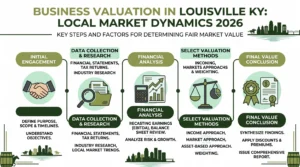
The Sofer Difference is a four-phase process – Discovery, Diligence, Analysis, and Delivery – that ensures no value driver goes unexamined.
When Should a Louisville Owner Get a Valuation?
Many owners wait for a triggering event – a buyer inquiry, a partner dispute, or a health crisis. That reactive approach creates pressure and reduces outcomes. Knowing your value before the trigger gives you options.
Common situations that require a formal valuation include selling to a third party or ESOP, buying out a partner, and estate and gift tax planning. SBA loan applications, buy-sell agreement funding, divorce proceedings, shareholder disputes, and exit planning also require formal appraisals.
Proactive owners get a valuation every 2 to 3 years. This builds a documented history that protects against IRS challenges and supports succession planning. David Hern brings a Heart of a Teacher to every engagement. He helps owners understand not just the number, but the drivers they can improve before going to market.
How Much Does a Louisville Valuation Cost?
The cost depends on purpose, complexity, and the depth of report required. A standard engagement from Sofer Advisors runs $7,500 to $25,000. Simple, single-entity businesses with clean financials fall at the low end. Complex cases – multiple entities, litigation support, estate tax – run higher. Rush engagements carry a 25% to 50% premium.
| Purpose | Typical Range | Timeline |
|---|---|---|
| SBA Loan / Financing | $7,500 – $12,500 | 3-5 weeks |
| Buy-Sell Agreement | $7,500 – $15,000 | 4-6 weeks |
| Estate / Gift Tax | $10,000 – $20,000 | 4-8 weeks |
| Divorce / Litigation | $15,000 – $30,000 | 6-10 weeks |
| Sale / M&A Transaction | $10,000 – $25,000 | 4-8 weeks |
| ESOP Transaction | $15,000 – $35,000 | 6-10 weeks |
These figures cover a full credentialed appraisal – not a broker opinion or an online estimate. The fee is typically 0.5% to 1% of business value. A $12,000 engagement that improves a $1.5 million sale by 3% returns $45,000 in additional proceeds.
Frequently Asked Questions
What is the average cost of a business valuation?
The average cost of a standard business valuation ranges from $7,500 to $25,000. Simpler engagements – SBA loan support for a single-entity service business – fall at the lower end. Litigation, estate tax, and multi-entity appraisals run higher. The purpose of the engagement is the biggest cost driver, not just business size. Cheaper options exist but do not meet the IRS qualified appraisal standard.
How much is a business worth with $500,000 in sales?
Revenue alone does not determine value. If a business with $500,000 in sales generates $100,000 in owner cash flow, a 3x to 4x multiple produces $300,000 to $400,000 in value. If EBITDA is $150,000, a 4x multiple suggests $600,000. Some industries use revenue multiples – service businesses may trade at 0.5x to 1.0x revenue. Profitability and growth drive the final conclusion more than top-line sales.
How much is a business worth with $100,000 in sales?
A business with $100,000 in revenue is typically valued at a smaller multiple. Buyer pools are limited at that size. If the business produces $30,000 to $50,000 in owner cash flow, a 2x to 3x multiple suggests $60,000 to $150,000. Many small businesses at this scale sell for 1 to 2 times seller’s discretionary earnings. High owner dependency reduces value.
How much does a business valuation from Sofer Advisors cost?
A business valuation from Sofer Advisors ranges from $7,500 to $25,000 depending on complexity, purpose, and business size. Standard engagements complete in 4 to 8 weeks. Rush engagements at a 25% to 50% premium deliver in 2 to 3 weeks. Schedule a free consultation to receive a scoped estimate for your situation. The firm maintains a next business day response policy for all new inquiries.
How long does a Louisville business valuation take?
Most standard valuations take 4 to 8 weeks from the time document collection is complete. The timeline depends on how quickly you provide financial records and whether contested issues require additional research. Litigation and ESOP engagements typically run 6 to 10 weeks. Rush turnarounds of 2 to 3 weeks are available at a premium.
What credentials should a Louisville appraiser hold?
For valuations used in IRS filings, SBA loans, divorce, or litigation, the appraiser must hold a recognized designation. The three accepted credentials are ABV from the AICPA, ASA from the American Society of Appraisers, and CVA from NACVA. Each requires demonstrated competency, peer review, and USPAP compliance. A CPA license alone does not meet the IRS qualified appraiser standard.
Does a broker opinion count as a formal appraisal?
A broker opinion is not a qualified appraisal under USPAP or IRS standards. Brokers use rule-of-thumb multiples and comparable listings to estimate a price range. This is useful for setting an asking price but is not defensible in court or a tax filing. For any purpose with legal or tax standing, you need a formal appraisal from a credentialed appraiser.
What industries in Louisville get the highest multiples?
Healthcare services, technology-enabled businesses, and logistics companies attract the highest multiples in Louisville’s 2026 market. Healthcare benefits from private equity consolidation. Technology businesses with recurring revenue trade at 4x to 8x EBITDA or more. Logistics companies near UPS Worldport attract national acquirers. Lower multiples apply to owner-dependent service businesses and restaurants where thin margins compress what buyers will pay.
How do I prepare my business for a valuation?
The most important step is organizing 3 to 5 years of financial records: tax returns, profit and loss statements, and balance sheets. Document owner perks, non-recurring expenses, and related-party transactions so the appraiser can normalize earnings. A description of your customer base, key contracts, and management team also helps identify value drivers.
Related Case Studies
- Business Valuation for SBA Loans
- Why You Must Start Planning Your Business Exit Now With The Right Valuation Expert
- Business Valuation For Mergers Buy Side Vs Sell Side
Executive Summary
Business valuation in Louisville KY requires more than applying a national EBITDA multiple to local revenue. Louisville’s healthcare concentration, logistics infrastructure, and manufacturing base create distinct value drivers that affect multiples, buyer demand, and risk discounts. A credentialed appraisal from an ABV or ASA-designated professional meets IRS, USPAP, and AICPA standards and is required for tax filings, SBA loans, and litigation support. Standard engagements cost $7,500 to $25,000 and take 4 to 8 weeks.
What Should You Do Next?
Start by gathering your last 3 years of tax returns and financial statements. Identify your valuation purpose – sale, loan, estate, or litigation – because that determines scope and cost. Ask any prospective appraiser to confirm their credentials and that their work complies with USPAP.
David Hern CPA ABV ASA, founder of Sofer Advisors, works with Louisville business owners to deliver defensible, credentialed valuations that hold up under IRS review, court scrutiny, and buyer due diligence. Schedule a consultation to discuss your valuation needs and receive a scoped estimate.
People Also Read
- Why You Must Start Planning Your Business Exit Now With The Right Valuation Expert
- What To Expect During A Business Valuation Step By Step Process
About the Author
This guide was prepared by David Hern CPA ABV ASA, founder of Sofer Advisors – a business valuation firm headquartered in Atlanta, GA serving clients across the United States. David holds dual accreditations as an Accredited Senior Appraiser (ASA) and is Accredited in Business Valuation (ABV), credentials recognized by the IRS, SEC, and FINRA. He also holds the Certified Exit Planning Advisor (CEPA) designation. With 15+ years of valuation experience, David has served as an expert witness in 11+ cases across multiple jurisdictions and built Sofer Advisors into an Inc. 5000-recognized firm with 180+ five-star Google reviews. The firm’s full W2 employee team maintains subscriptions to all major valuation databases and operates under a next business day response policy.
For professional business valuation services, visit soferadvisors.com or schedule a consultation.
This content is for informational purposes only and does not constitute professional valuation advice. Business valuation conclusions depend on specific facts and circumstances. Contact Sofer Advisors for guidance regarding your specific situation.