


Last Updated: April 2026
A stock appreciation right (SAR) is a form of equity-based compensation that entitles an employee to receive the increase in the company’s stock value over a defined period, without requiring the employee to purchase shares outright. Upon exercise, the employee receives the difference between the stock price at grant and the stock price at exercise, paid in cash, company shares, or a combination of both. Under FASB ASC 718, SARs are classified as either liability awards (cash-settled) or equity awards (stock-settled), and each classification requires a different accounting treatment that directly affects the company’s reported earnings.
Understanding the structure, tax treatment, and valuation implications of stock appreciation rights is essential for business owners considering SARs as part of a compensation plan, ESOP design, or pre-sale equity strategy. Sofer Advisors, a nationally recognized business valuation firm headquartered in Atlanta, GA, regularly analyzes SAR programs as part of business appraisal engagements, 409A valuations, and purchase price allocations for companies across technology, healthcare, and professional services.
SARs occupy a unique position in the equity compensation spectrum: they deliver the economic upside of stock ownership without requiring employees to invest their own capital or navigate the tax complexity of option exercises.
The sections below examine how SARs are structured, how they are taxed, and how Sofer Advisors accounts for outstanding SAR obligations in a formal business appraisal or ESOP feasibility engagement.
Key Takeaways
- Definition: A SAR grants an employee the right to receive the appreciation in company stock value between the grant date and the exercise date, paid in cash or shares without any purchase required.
- Two Settlement Types: Cash-settled SARs are classified as liability awards under ASC 718 and must be remeasured at fair value each reporting period; stock-settled SARs are equity awards measured once at grant date.
- Tax Treatment: Cash-settled SARs are taxed as ordinary income at exercise; stock-settled SARs follow the same treatment as non-qualified stock options, with ordinary income recognized at exercise on the spread.
- No 409A Obligation for Cash SARs: Cash-settled SARs are generally exempt from IRC Section 409A’s safe harbor valuation requirement; stock-settled SARs must comply with Section 409A if structured as a deferred compensation arrangement.
- Valuation Impact: Outstanding SAR obligations affect a company’s enterprise value through both the compensation expense recognized under ASC 718 and the dilutive or liability effect on the balance sheet at any given valuation date.
Each of these characteristics creates specific planning considerations for companies that issue SARs and for appraisers valuing businesses that carry SAR obligations. The sections below examine each dimension in detail.
What Is a Stock Appreciation Right?
A stock appreciation right gives an employee a contractual right to receive the gain in the company’s stock price over a set period, without requiring any upfront investment or share purchase. The economic payoff is straightforward: if the stock is worth $10 at grant and $18 at exercise, the employee receives $8 per SAR unit, multiplied by the number of SARs held. The payment can be made in cash, in company shares equivalent to that value, or in a combination of both, depending on the plan design.
SARs are most commonly used in private companies that want to provide equity-like upside to key employees without creating actual shareholders or triggering the administrative complexity of share issuance. According to the NCEO (2024), approximately 13 million U.S. employees participate in some form of synthetic equity plan, including SAR programs, making them one of the most widely used non-ESOP ownership alternatives for privately held companies. Financial institutions such as Schwab and compensation reference resources including Investopedia document SARs as a widely used alternative to stock options in closely held companies.
How Do Stock Appreciation Rights Work?
SARs work by establishing a base value at grant, then paying the employee the increase above that base when the SAR is exercised. The grant price is typically set at the company’s fair market value on the grant date, which for private companies requires an independent appraisal. The exercise window is defined in the plan agreement, commonly five to ten years from grant, with vesting conditions that mirror stock option schedules: four-year vesting with a one-year cliff is standard.
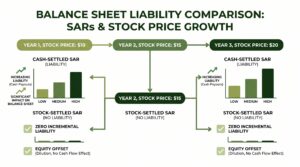
The settlement mechanics distinguish SARs from stock options. A stock option requires the employee to pay the strike price to acquire shares; a SAR delivers the gain with no cash outlay from the employee. This makes SARs particularly attractive for employees in private companies where shares are illiquid and there is no ready market to sell shares to cover the exercise cost. For the company, cash-settled SARs create a balance sheet liability that grows as the stock price increases, while stock-settled SARs dilute existing shareholders when new shares are issued at exercise.
Common SAR settlement types and their key characteristics:
- Cash-settled SARs: The appreciation is paid in cash at exercise; classified as a liability award under ASC 718; remeasured at fair value at every reporting date until settlement; no shareholder dilution.
- Stock-settled SARs: The appreciation is delivered in company shares; classified as an equity award under ASC 718; measured once at grant date using Black-Scholes or a binomial model; dilutes existing shareholders at exercise.
- Tandem SARs: Issued alongside a stock option, giving the employee the right to exercise either the SAR or the option; exercising one cancels the other; used to give employees flexibility in how they realize their compensation.
- Standalone SARs: Issued independently of any option grant; the most common structure in private companies that want equity-upside compensation without the complexity of option mechanics.
What Are the Types of SARs?
The two primary SAR types are defined by how the award is settled at exercise: cash-settled and stock-settled. The distinction matters not only for the employee’s tax experience but for the company’s accounting, balance sheet, and valuation treatment. A third variation, the tandem SAR, is used in specific plan designs where the company wants to give employees a choice between two settlement mechanisms.
Beyond settlement type, SARs also differ by vesting structure. Time-based SARs vest on a fixed schedule tied to employment, typically over four years. Performance-based SARs vest only upon achieving specified business targets such as revenue, EBITDA, or a liquidity event. Event-triggered SARs vest on a change of control or IPO, functioning as a retention mechanism tied to a specific corporate transaction. The vesting structure affects both the compensation expense recognized over time and the treatment of unvested SARs in any acquisition or ESOP feasibility analysis.
| Feature | Cash-Settled SAR | Stock-Settled SAR | Tandem SAR |
|---|---|---|---|
| ASC 718 classification | Liability award | Equity award | Depends on settlement chosen |
| Balance sheet impact | Liability grows with stock price | No ongoing liability | Liability until election made |
| Measurement date | Remeasured every period | Fixed at grant date | Remeasured until election |
| Dilution to shareholders | None | Yes, at exercise | Depends on election |
| 409A compliance required | Generally no | Yes, if deferred comp | Plan-specific |
| Tax to employee at exercise | Ordinary income (cash received) | Ordinary income (spread) | Depends on election |
Are Stock Appreciation Rights Taxable?
Stock appreciation rights are taxed as ordinary income at the time of exercise, regardless of settlement type. For cash-settled SARs, the cash received is included in the employee’s W-2 income for the year of exercise, subject to federal income tax, FICA payroll taxes, and applicable state income taxes. The employer is required to withhold taxes at exercise. There is no favorable capital gains treatment available for SARs because the payout represents compensation income, not a return on invested capital.
For stock-settled SARs, the ordinary income recognized at exercise equals the spread between the grant price and the fair market value of the shares received, just as with a non-qualified stock option. Any subsequent appreciation in the shares received is taxed as capital gain when the shares are sold, long-term if the holding period exceeds twelve months from the exercise date. According to IRS Publication 15-B (2024), employer-provided stock appreciation rights are treated as supplemental wages subject to withholding at the supplemental wage rate or the employee’s regular withholding rate – a classification that also triggers FICA payroll taxes on the full SAR payout at exercise.
Schedule your free consultation with Sofer Advisors to understand how outstanding SARs in your compensation plan affect your company’s valuation and what that means for a sale, ESOP, or 409A engagement , and discover The Sofer Difference.
How Are SARs Valued in a Business Appraisal?
SARs affect a business valuation through two distinct channels: the compensation expense recognized under FASB ASC 718 and the balance sheet liability or dilutive equity created by outstanding awards. For cash-settled SARs, the liability on the balance sheet at any given valuation date represents the fair value of the SAR obligation owed to employees and must be treated as a debt-like item that reduces equity value. For stock-settled SARs, the fully diluted share count used in a per-share value calculation must include the shares that would be issued upon exercise of outstanding SARs.
According to FASB ASC 718 (2023), companies must remeasure cash-settled SAR liabilities at each reporting date using the current fair value of the award, creating direct income statement volatility in companies with growing stock values. Business appraisers valuing companies with SAR programs use option pricing models, typically Black-Scholes or a binomial lattice model, to estimate the fair value of each SAR unit. Key inputs include the current stock price, the SAR grant price, the remaining term to expiration, the expected volatility of the stock, and the risk-free rate. For private companies, expected volatility must be estimated from comparable public companies since there is no observable market price history for the subject company’s shares. This valuation complexity is one reason why businesses with significant SAR programs benefit from working with credentialed appraisers experienced in equity compensation analysis.
Factors that affect the fair value of a SAR in a business appraisal:
- Current stock price vs. grant price: The deeper in-the-money the SAR, the higher its fair value and the larger the liability or dilution recognized.
- Time remaining to expiration: Longer remaining term increases fair value because more time allows additional stock price appreciation before exercise.
- Expected volatility: Higher volatility increases SAR fair value under option pricing models, reflecting the greater potential for upside movement.
- Risk-free rate: The rate on US Treasury securities matching the SAR’s remaining term; influences the time value component of the fair value calculation.
- Expected dividends: For companies that pay dividends, expected dividend yield reduces SAR fair value because dividends reduce the stock price on ex-dividend dates.
When Do SARs Make Sense for a Company?
SARs make sense for private companies that want to provide meaningful equity upside to key employees without creating new shareholders, issuing shares, or requiring employees to fund an option exercise. This is particularly relevant for closely held family businesses, S-corporations with ownership restrictions, and companies approaching a sale or ESOP transaction where adding new equity holders would complicate the transaction structure. Cash-settled SARs are especially attractive because they keep the cap table clean while still aligning employee interests with company performance.
However, SARs carry a cost that stock options do not. Cash-settled SARs create a liability that grows directly with the stock price, meaning a company whose value doubles sees its SAR liability double too, creating a real cash obligation at exercise. Companies expecting rapid valuation growth should model the SAR liability trajectory carefully before committing to a large cash-settled program. Stock-settled SARs avoid the cash outflow but create dilution and require a 409A valuation for IRC Section 409A compliance if they are structured as deferred compensation. Either way, the decision to implement SARs should be made in the context of a formal business valuation that establishes the current per-share value and models the future compensation cost.
Frequently Asked Questions
What are stock appreciation rights?
Stock appreciation rights (SARs) are a form of equity compensation that entitles an employee to receive the increase in the company’s stock value between the grant date and the exercise date, without requiring any share purchase. The payout can be made in cash, in company shares, or in both. SARs are most commonly used in private companies that want to provide equity-like upside to key employees without issuing actual shares or creating new shareholders on the capitalization table.
Are stock appreciation rights taxable?
Yes. SARs are taxed as ordinary income at the time of exercise. For cash-settled SARs, the cash received is included in W-2 income and is subject to federal income tax, FICA payroll taxes, and state income taxes; the employer withholds taxes at exercise. For stock-settled SARs, the spread between grant price and current stock value at exercise is taxed as ordinary income. Any subsequent gain on shares received after exercise is taxed as capital gain when sold, long-term if held more than twelve months.
How are SARs paid out?
SARs are paid out at exercise as the difference between the stock price at grant and the stock price on the exercise date, multiplied by the number of SARs held. A cash-settled SAR pays this amount directly in cash. A stock-settled SAR delivers company shares with a market value equal to the appreciation amount. A tandem SAR allows the employee to choose between cash and shares at exercise. The payout requires no capital outlay from the employee, which is the primary practical advantage of SARs over stock options.
How do SARs differ from stock options?
Stock options require the employee to pay the exercise price to acquire shares; SARs require no payment and deliver only the appreciation. Both are based on stock price growth, but a stock option holder receives full share ownership after exercise, while a SAR holder receives only the gain in value. Cash-settled SARs create no shareholder dilution; stock options and stock-settled SARs both dilute existing shareholders when shares are issued. For employees, SARs eliminate the need to fund an exercise from personal savings or arrange same-day sale financing.
Do SARs require a 409A valuation?
Cash-settled SARs are generally exempt from IRC Section 409A’s deferred compensation rules and do not independently trigger a 409A valuation obligation. Stock-settled SARs may require 409A compliance if structured as a deferred compensation arrangement under the regulation. Even where not legally required for the SAR itself, companies issuing any equity compensation in the same period typically obtain a 409A valuation to establish the current per-share fair market value, which serves as the SAR grant price and provides a defensible basis for the compensation expense calculation under ASC 718.
How does a SAR liability affect a business valuation?
Cash-settled SARs create a balance sheet liability equal to the current fair value of all outstanding SAR awards, remeasured at every reporting date under ASC 718. In a business appraisal, this liability is treated as a debt-equivalent obligation that reduces the equity value of the business. If a company has $500,000 in outstanding cash SAR liabilities at the valuation date, that amount is subtracted from enterprise value when calculating equity value per share. Appraisers use Black-Scholes or binomial models to estimate each SAR’s fair value, incorporating stock price, volatility, remaining term, and risk-free rate.
Can SARs be used instead of an ESOP?
SARs are not a substitute for an ESOP but are sometimes used as a complementary or interim mechanism. An ESOP creates actual employee ownership through a tax-qualified trust that acquires real company shares; SARs deliver economic upside without creating ownership or ESOP-qualified tax benefits for the company. Some owners use a synthetic equity program built around SARs as a first step toward broader employee participation, with the goal of transitioning to a formal ESOP once the company is ready for the more complex transaction. Sofer Advisors advises on both structures as part of exit planning and succession engagements.
What happens to SARs in an acquisition?
In an acquisition, outstanding SARs are typically treated in one of three ways: they are cashed out at the deal price spread over the grant price, assumed by the acquirer and converted to acquirer SARs, or cancelled with a cash payment to the employee. The treatment depends on the plan agreement and the terms negotiated in the purchase agreement. For cash-settled SARs, the acquirer inherits the liability and must account for it in the purchase price allocation. For stock-settled SARs, unvested awards may be accelerated or substituted, with tax consequences depending on whether the transaction qualifies for favorable treatment under IRC Section 424.
How much does a business valuation for a SAR program from Sofer Advisors cost?
A business valuation for a SAR program from Sofer Advisors typically ranges from $7,500 to $25,000 depending on the company’s revenue, industry complexity, and the number of outstanding SAR units requiring analysis. Most engagements are completed in four to eight weeks from document receipt. To receive a fee estimate based on your company’s specific facts, contact Sofer Advisors.
Related Case Studies
- Deferred Compensation Dispute: Precise Valuation Changed the Outcome
- Divorce Business Valuation: Resolving Conflict Through Expert Analysis
- Valuation Timing: Why the Right Date Changes Everything
Executive Summary
Stock appreciation rights are equity compensation awards that pay employees the gain in company stock value between grant and exercise, with no share purchase required. They are taxed as ordinary income at exercise, classified as liability awards (cash-settled) or equity awards (stock-settled) under FASB ASC 718, and valued using option pricing models including Black-Scholes and binomial lattice methods. For business owners, SARs create either a balance sheet liability or dilutive equity that must be addressed in any formal appraisal, ESOP feasibility study, or M&A transaction. Sofer Advisors analyzes SAR programs as a standard component of business valuation engagements, ensuring that outstanding awards, their fair values, and their balance sheet implications are accurately reflected in every appraisal conclusion.
What Should You Do Next?
If your company has issued stock appreciation rights or is considering a SAR program as part of an employee retention or exit planning strategy, the structure and outstanding balance of those awards directly affects your business’s concluded value and your transaction economics. David Hern CPA ABV ASA, founder of Sofer Advisors, and his team of 14 credentialed valuation professionals analyze equity compensation structures including SARs as part of every formal business appraisal and ESOP engagement. Schedule your free consultation to understand how your SAR program affects your company’s value.
People Also Read
- ESOP Transaction Process Steps: Complete Guide for Business Owners
- 409A Valuation for Startups: What Founders Must Know
About the Author
This guide was prepared by David Hern CPA ABV ASA, founder of Sofer Advisors – a business valuation firm headquartered in Atlanta, GA serving clients across the United States. David holds dual accreditations as an Accredited Senior Appraiser (ASA) and is Accredited in Business Valuation (ABV), credentials recognized by the IRS, SEC, and FINRA. He also holds the Certified Exit Planning Advisor (CEPA) designation. With 15+ years of valuation experience, David has served as an expert witness in 11+ cases across multiple jurisdictions and built Sofer Advisors into an Inc. 5000-recognized firm with 180+ five-star Google reviews. The firm’s full W2 employee team maintains subscriptions to all major valuation databases and operates under a next business day response policy.
For professional business valuation services, visit soferadvisors.com or schedule a consultation.
This content is for informational purposes only and does not constitute professional valuation advice. Business valuation conclusions depend on specific facts and circumstances. Contact Sofer Advisors for guidance regarding your specific situation.