

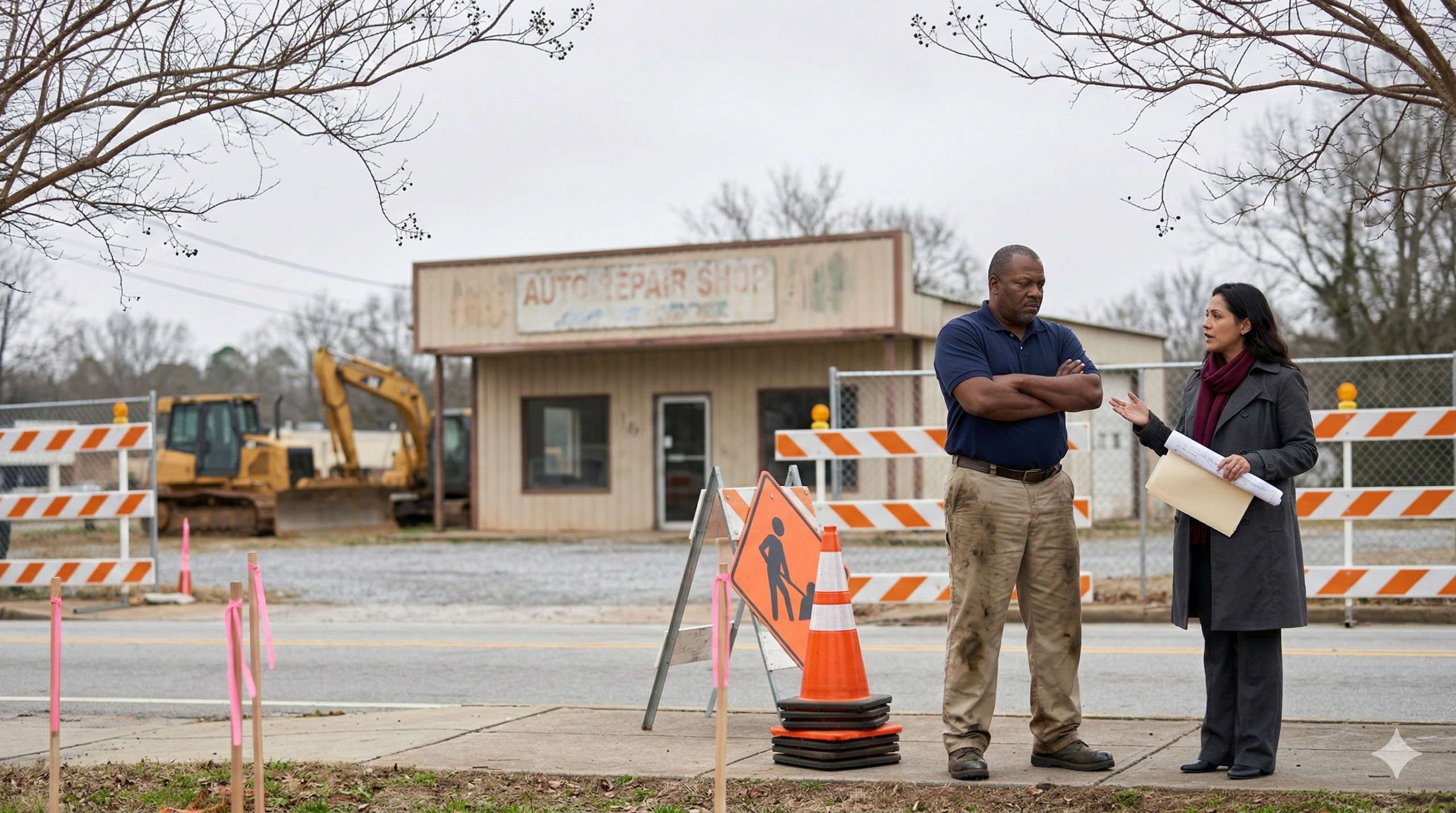
Eminent Domain Business Valuation Georgia: Property and Business Owner Rights
Last Updated: Feb 2026
Eminent domain business valuation quantifies economic damages when government entities exercise condemnation powers to acquire private property for public use, disrupting or destroying business operations through partial takings, total takings, or temporary construction impacts reducing customer access and revenue. Georgia law requires just compensation for property owners, including fair market value for real property taken plus additional damages to remaining property and, in certain circumstances, compensation for business losses, relocation expenses, and goodwill destruction resulting from government action.
Georgia business owners face eminent domain impacts from multiple sources-GDOT highway expansion projects requiring property acquisition along commercial corridors, MARTA transit development displacing businesses in growing urban areas, municipal infrastructure improvements condemning properties for utilities or public facilities, and county road widening projects affecting retail, restaurant, and service businesses dependent on customer access and visibility. Understanding your compensation rights, documentation requirements, and valuation methodologies helps you secure maximum recovery while protecting your business interests during condemnation proceedings.
What Compensation Do Georgia Business Owners Receive in Eminent Domain Cases?
Georgia eminent domain law provides compensation for property taken and consequential damages to remaining property, but business loss compensation follows more restrictive rules than many business owners expect. Property owners receive fair market value for land and improvements actually condemned-if the government takes 0.5 acres from a 2-acre commercial property, compensation covers the fair market value of the 0.5 acres taken plus any reduction in value to the remaining 1.5 acres from the partial taking.
Business damages receive different treatment based on whether businesses own or lease property. Property-owning businesses may recover business damages when business value is inextricably intertwined with real property-for instance, a gas station’s business value tied to corner location visibility, or a restaurant’s reputation built around specific property characteristics. However, Georgia courts generally deny compensation for “portable” business goodwill that could theoretically relocate with the business owner. Tenant businesses face significant compensation limitations under Georgia law-tenants cannot claim compensation for business losses unless lease agreements provide specific condemnation clauses allocating portions of government payments to business damages. Sofer Advisors helps business owners understand their specific compensation rights based on property ownership status and business characteristics.
How Do Experts Calculate Business Value in Georgia Condemnation Cases?
Business valuation in eminent domain cases requires separating compensable property-related business value from non-compensable portable goodwill. The critical distinction focuses on whether business value derives from physical property characteristics (location, visibility, access, physical facilities) or from transferable business elements (customer lists, management expertise, trade names, reputation).
The before-and-after method dominates Georgia eminent domain business valuations. Experts value the business as a going concern immediately before the taking, then value it immediately after considering property loss and consequential damages. Income capitalization approaches quantify lost profits by calculating historical net income, projecting future income losses from condemnation impacts, and capitalizing using appropriate rates. Market approaches compare business sales before and after similar takings, though limited transaction data makes this approach challenging. David Hern CPA ABV ASA, founder of Sofer Advisors, emphasizes that credible business damage claims require rigorous financial analysis, market research, and clear documentation linking value loss to condemnation impacts rather than general business conditions. Understanding how to calculate fair market value provides the foundation for these approaches.
What’s the Difference Between Property Value and Business Damage in Eminent Domain?
Property value compensation addresses real estate taken-land, buildings, improvements, and fixtures that become government property through condemnation. Fair market value represents the price a willing buyer would pay a willing seller, neither under compulsion, with both having reasonable knowledge of relevant facts.
Business damage compensation addresses economic injury to ongoing business operations from property taking or project impacts. Business damages include lost profits from reduced customer access, goodwill destruction from relocation requirements, increased operating costs from inferior replacement locations, and temporary business interruption during transitions. Severance damages compensate property owners when partial takings reduce the value of remaining property. The distinction matters tremendously for compensation calculations-property owners might receive $500,000 for condemned land and buildings but sustain $1.5 million in business damages from relocation requirements, lost customer base, and goodwill destruction. However, Georgia’s portability doctrine often limits business damage recovery, requiring expert analysis distinguishing property-related business value from portable goodwill elements.
Georgia Business Owner Rights and Compensation Categories
| Compensation Type | Availability | Calculation Method | Common Amounts |
|---|---|---|---|
| Property Fair Market Value | All property owners | Comparable sales, income approach, cost approach | Varies by property |
| Severance Damages | Partial taking situations | Before/after valuation of remaining property | 10-50% of taking value |
| Business Damages (Owners) | Limited – property-related value only | Lost profits, goodwill loss, relocation costs | $50K – $500K+ if allowed |
| Business Damages (Tenants) | Very limited – lease provisions required | Per lease condemnation clause terms | Usually $0 |
| Relocation Expenses | Federally-funded projects | Actual moving costs or fixed payment | $10K – $40K typically |
| Temporary Construction Damages | Access/business interruption proven | Lost profits during construction period | Varies by duration |
What Documentation Supports Eminent Domain Business Claims in Georgia?
Financial records proving historical business performance provide the foundation for business damage claims. Three to five years of tax returns, profit and loss statements, balance sheets, sales records, and bank statements establish baseline revenue and profitability. Monthly financial statements showing seasonal patterns, growth trends, and expense structures support before-and-after calculations.
Property-related business characteristics require documentation demonstrating how location, visibility, access, and physical facilities drive business value. Customer surveys showing geographic origin, traffic count studies demonstrating customer traffic patterns, lease rates reflecting location premiums, and market studies analyzing competitive advantages from property characteristics all support arguments that business value derives from real property rather than portable elements. Expert reports from qualified business valuation professionals provide credible analysis supporting damage claims. Our guide on overcoming appraisal hurdles addresses documentation challenges.
Common Mistakes Georgia Business Owners Make in Eminent Domain Cases
Accepting initial government offers without independent valuation represents the most costly mistake. Government agencies typically present “market value” appraisals supporting condemnation prices, but these valuations often use conservative assumptions, exclude valid damage categories, or fail to properly value business impacts. Independent expert review frequently identifies additional compensable damages increasing recovery by 30-100% or more over initial offers.
Failing to document pre-taking business conditions allows governments to dispute baseline performance. Business owners who lack organized financial records, customer data, or operational metrics struggle proving business value and damage calculations. Waiting too long to hire experts limits damage mitigation and claim development. Misunderstanding portable goodwill limitations causes business owners to expect compensation for non-compensable business elements. Neglecting relocation planning and expense documentation reduces recoverable amounts.
When Do Georgia Business Owners Need Expert Witnesses for Eminent Domain?
Large property takings or substantial business impacts justify expert witness engagement. When condemnation affects properties worth $500,000+, businesses generating $250,000+ annual revenue, or situations where business damages potentially exceed $100,000, expert costs (typically $15,000-$35,000) represent reasonable investments given potential recovery increases.
Complex valuation issues require specialized expertise. Partial takings with severance damages, business damage claims requiring portability analysis, temporary construction impact quantification, or specialized property types benefit from expert testimony. Government disputes over compensation amounts necessitate expert support. Litigation proceedings require expert testimony establishing damages-Georgia eminent domain trials rely heavily on expert witnesses presenting valuation conclusions, explaining methodologies, and defending against cross-examination. Credible, well-qualified experts significantly influence outcomes.
Frequently Asked Questions
What is an eminent domain business valuation?
Eminent domain business valuation quantifies economic damages when government condemnation disrupts business operations through property takings. Valuations calculate business value before and after condemnation, measuring lost profits, goodwill destruction, and relocation costs. Georgia law distinguishes between property-related business value (potentially compensable) and portable goodwill (not compensable). Experts analyze financial performance, customer patterns, and location dependencies to determine compensable business damages separate from real property fair market value.
Am I entitled to business loss compensation in Georgia eminent domain?
Business loss compensation depends on property ownership and business value characteristics. Property-owning businesses may recover losses when business value is tied to real property-location, visibility, or access. Georgia courts deny compensation for portable goodwill. Tenant businesses generally cannot claim business losses unless lease agreements contain specific condemnation clauses. All businesses qualify for relocation expense reimbursement on federally-funded projects. Legal counsel should review specific circumstances determining compensation rights.
How is business value calculated in condemnation cases?
Business value calculation uses before-and-after methodology comparing going concern value pre-taking versus post-taking. Experts analyze historical financial performance, project future income impacts, and capitalize losses using appropriate rates. Income approaches quantify lost profits, market approaches compare similar business impacts when data is available, and cost approaches calculate specialized facility reproduction costs. The critical analysis distinguishes property-related business value from portable goodwill requiring expert testimony connecting value loss to specific condemnation impacts.
What’s the difference between property value and business damage in eminent domain?
Property value compensation addresses real estate taken-land, buildings, and improvements. Business damage compensation addresses economic injury to operations-lost profits, goodwill destruction, relocation costs, and temporary interruption. Severance damages compensate when partial takings reduce remaining property value. The distinction matters because property compensation is straightforward while business damages face portability limitations. Business owners might receive property value but limited or no business damage compensation depending on circumstances.
Can I challenge a government valuation in Georgia?
Yes, Georgia property owners can challenge government valuations through negotiation, appraisal proceedings, or litigation. Owners should obtain independent valuations from qualified experts before accepting government offers. If negotiations fail, Georgia law provides appraisal rights allowing neutral appraisers to determine compensation. When disputes persist, owners can litigate in superior court with juries determining just compensation. Challenges require independent expert testimony establishing higher values through credible methodology and evidence.
What documentation supports an eminent domain business claim?
Essential documentation includes 3-5 years of financial records (tax returns, P&L statements, bank statements), property-related business characteristic evidence (customer surveys, traffic studies), post-taking performance records, expert valuation reports, and comparable evidence from similar takings. Monthly financial statements showing seasonal patterns support baseline calculations. Customer data demonstrating geographic dependence proves location value. Independent expert reports applying recognized methodologies withstand government scrutiny. Poor documentation reduces compensation significantly.
How long do eminent domain valuation cases take in Georgia?
Straightforward property takings resolve within 6-12 months through negotiation. Complex cases involving substantial business damages or valuation disagreements extend to 18-36 months or longer through litigation. Factors affecting timing include property complexity, damage magnitude, documentation quality, and court schedules. Early expert engagement and organized documentation accelerate resolution. Georgia’s quick-take procedures allow government immediate possession with compensation determined later, creating urgency for business owners to document damages quickly.
Do I need an expert witness for eminent domain proceedings?
Expert witnesses are strongly recommended for properties worth $500,000+, businesses generating $250,000+ annual revenue, or situations where business damages potentially exceed $100,000. Complex valuation issues benefit from expert testimony. Litigation proceedings require expert witnesses-judges and juries determine compensation based primarily on expert testimony rather than owner statements. Experts with credentials (CPA, ABV, ASA) and litigation experience provide testimony courts take seriously. Expert costs typically range $15,000-$35,000 but often increase recoveries by multiples of fees.
What rights do Georgia business tenants have in eminent domain?
Georgia tenant businesses have very limited compensation rights. Tenants cannot claim business loss compensation unless lease agreements contain specific condemnation clauses allocating portions of government payments. Most standard leases lack such provisions. However, tenants qualify for relocation expense reimbursement on federally-funded projects covering reasonable moving costs, equipment reinstallation, and transition expenses. Tenants should review lease agreements immediately upon learning of potential condemnation and consult legal counsel.
How does relocation loss factor into eminent domain valuation?
Relocation losses include moving costs, equipment reinstallation, business interruption, customer loss, and goodwill destruction. Federal and Georgia law mandate relocation assistance reimbursement for reasonable moving expenses-actual costs or fixed payments up to $40,000 for businesses unable to relocate. Additional business damages from relocation face portability limitations. However, business damage claims properly structured around property-related value loss may recover relocation impacts when supported by expert testimony distinguishing property-dependent business characteristics.
What mistakes do business owners make in eminent domain cases?
Common mistakes include accepting initial government offers without independent valuation, failing to document pre-taking conditions, waiting too long to hire experts, misunderstanding portable goodwill limitations, and neglecting relocation expense documentation. Owners lacking organized records struggle proving damages. Owners who engage experts after accepting offers forfeit leverage. Expecting compensation for portable business elements causes disappointment. Early expert engagement, systematic documentation, realistic expectations, and proper legal counsel prevent costly mistakes.
How much does an eminent domain business valuation cost?
Eminent domain business valuations typically cost $15,000-$35,000 depending on business complexity, property characteristics, and litigation requirements. Simple property-only valuations might cost $10,000-$15,000, while complex business damage claims involving trial testimony range $25,000-$50,000 or more. Costs represent reasonable investments when potential compensation increases exceed fees by multiples. Many experts work on modified contingency arrangements for larger cases. Expert analysis frequently increases compensation by 30-100%+ over government initial offers, providing returns far exceeding professional fees.
Protecting Your Rights Through Expert Valuation Support
Eminent domain business valuations require specialized expertise understanding Georgia condemnation law, property valuation standards, business damage calculation methodologies, and litigation procedures that general business appraisers often lack. The difference between adequate compensation and under compensation often exceeds hundreds of thousands of dollars for businesses suffering significant condemnation impacts-inadequate baseline calculations, missed damage categories, or poor documentation reduce recoveries substantially.
Sofer Advisors provides comprehensive eminent domain business valuation services for Georgia property and business owners backed by 15+ years of experience, dual ABV and ASA certifications recognized by courts, and deep understanding of Georgia condemnation law, business damage quantification, and expert witness testimony requirements. Our systematic approach analyzes pre-taking business performance, documents property-related business characteristics, quantifies all compensable damages, and provides expert testimony withstanding cross-examination during negotiations or litigation.
Georgia business owners benefit from our 180+ five-star Google reviews, Inc. 5000 recognition in 2024 and 2025, and expert witness experience across 11+ cases providing litigation support when eminent domain disputes proceed to trial. Condemnation creates substantial business disruption and financial stress-professional valuation support ensures maximum compensation, accelerates resolution, and protects your legal rights throughout Georgia’s eminent domain process.
SCHEDULE A CONSULTATION to discuss your eminent domain situation and discover how our specialized expertise provides credible valuation analysis maximizing compensation while protecting your business interests during Georgia condemnation proceedings.
People Also Read
- How to Calculate Fair Market Value of a Company: Expert Guide
- How Do You Determine What a Business Is Worth? Complete Guide
- What Is ABV Certification? Complete Guide to Business Valuation
About the Author
This guide was prepared by David Hern CPA ABV ASA, founder of Sofer Advisors — a business valuation firm headquartered in Atlanta, GA serving clients across the United States. David holds dual accreditations as an Accredited Senior Appraiser (ASA) and is Accredited in Business Valuation (ABV), credentials recognized by the IRS, SEC, and FINRA. He also holds the Certified Exit Planning Advisor (CEPA) designation. With 15+ years of valuation experience, David has served as an expert witness in 11+ cases across multiple jurisdictions and built Sofer Advisors into an Inc. 5000-recognized firm with 180+ five-star Google reviews. The firm’s full W2 employee team maintains subscriptions to all major valuation databases and operates under a next business day response policy.
For professional business valuation services, visit soferadvisors.com or schedule a consultation.
This article provides general information for educational purposes only and does not constitute legal, tax, financial, or professional advice-consult qualified professionals regarding your specific circumstances.